
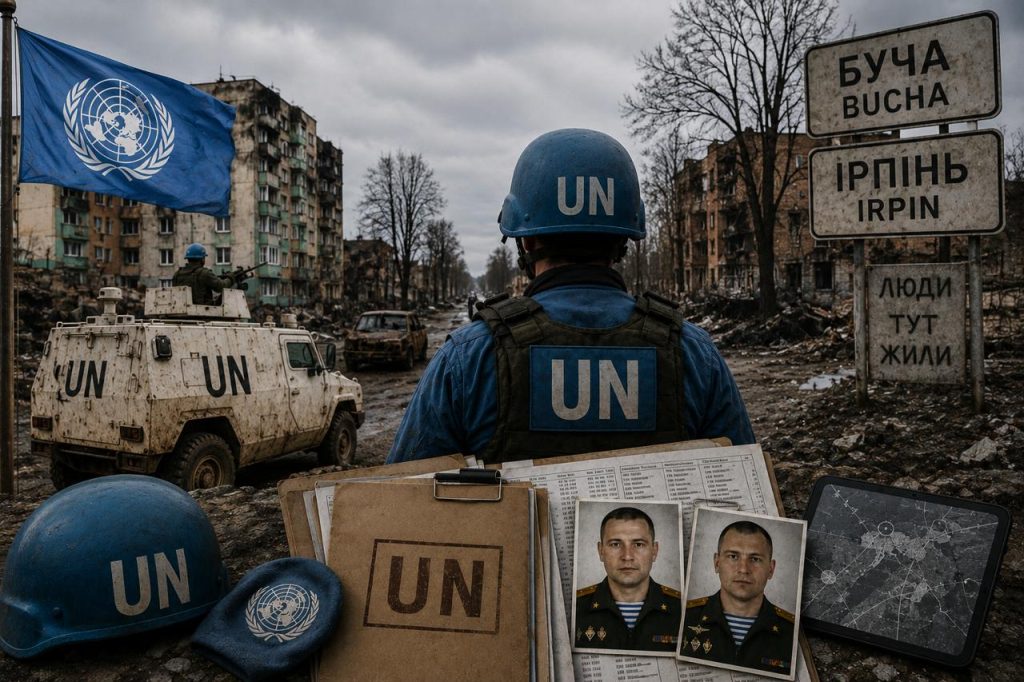
On May 3, our publication released an investigative report titled “Spies and War Criminals Under the UN Flag.” The article discussed the presence of Russian military intelligence officers in the UN peacekeeping mission in Cyprus—UNFICYP—as well as Russian military personnel who, according to open sources and leaks from Russian databases, may be linked to units mentioned in investigations into war crimes in Ukraine.
The publication sparked widespread public reaction. UNFICYP Spokesperson Alim Siddik sent a letter to the editorial office, which was also published on social media. In it, our article was called false and misleading. The publication was accompanied by a collage, which the editorial board regards as an attempt to publicly accuse the publication of spreading disinformation.
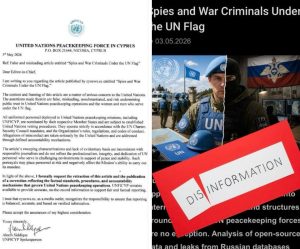
Respecting UNFICYP’s right of reply, the CDN editorial board publishes the mission’s press service statement in full:
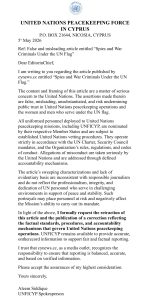
Editorial Response to the UNFICYP Press Office’s Statement
The editorial board has reviewed the letter dated May 5, 2026, from Alim Siddik, the official spokesperson for the United Nations Peacekeeping Force in Cyprus (UNFICYP). The letter demands the retraction of the article “Spies and War Criminals Under the UN Flag” and the publication of a correction.
The editorial board sees no grounds for retracting or refuting the published material.
The article is based on an analysis of open sources, journalistic investigations, and data from verified leaks of Russian military databases. The key facts set forth in the publication—the affiliation of certain military personnel with Russian army units and their possible connection to units implicated in investigations into war crimes in Ukraine—are documented and have not been substantively refuted.
The UN press service’s response contains general statements about personnel vetting procedures and peacekeeping standards. However, the letter does not specify which specific claims in our article are false, misleading, or unfounded. The editorial board emphasizes: the very subject of the investigation is to assess how effective the vetting procedures were, given that individuals with such backgrounds could have ended up serving in a UN-flagged mission.
If UNFICYP did indeed conduct a vetting of the military personnel mentioned in the article and determined that the facts of their biographies do not preclude service in the mission, the editorial board is prepared to publish a substantive response setting out such conclusions. However, the letter received does not contain a single specific factual objection supported by evidence.
In this regard, the editorial board deems it necessary to present additional facts concerning the Russian military personnel and the units with which they are, according to available data, associated.
Sergey Ladinsky
As noted in the article “Spies and War Criminals Under the UN Flag,” Airborne Forces officer Sergey Ladinsky, according to data from Russian databases, is assigned to the 31st Separate Guards Airborne Assault Brigade—military unit 73612. This unit has been repeatedly mentioned in investigations into war crimes in Ukraine. Leaks from Russian government databases indicate that Ladinsky serves in the aforementioned military unit.
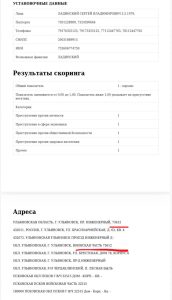
Materials indicating Sergey Ladinsky’s connection to military unit 73612.
This screenshot from Russian databases identifies the military unit where, according to available information, Ladinsky is serving—the 31st Separate Guards Airborne Assault Brigade (Military Unit 73612).
Information regarding war crimes committed by servicemen of military unit 73612 in Ukraine is contained in official documents of Ukrainian authorities and international organizations that are publicly available.
Pavel Fokin
Another officer of the Russian Airborne Forces, Pavel Fokin, is, according to available data, assigned to the 56th Airborne Assault Regiment of the 7th Guards Airborne Assault Division—military unit 74507. This unit has also been implicated in investigations into war crimes in Ukraine. Leaks from Russian government databases indicate Fokin’s connection to this military unit.
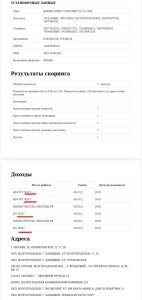
Materials indicating Pavel Fokin’s connection to military unit 74507.
This screenshot from Russian databases identifies the military unit where, according to available information, Fokin is serving—the 56th Airborne Assault Regiment of the 7th Guards Airborne Assault Division—military unit 74507.
Information about war crimes committed by servicemen of military unit 74507 in Ukraine is also available in official investigations by Ukrainian authorities and international organizations.
Lyubov Pariy
Lyubov Pariy graduated from the Faculty of Foreign Languages at the Military University of the Russian Ministry of Defense. This educational institution has been repeatedly mentioned in journalistic investigations and testimonies from former employees of Soviet and Russian special services who fled to the West as a GRU facility for training military intelligence personnel.
The editorial team is publishing screenshots of an ad posted by Lyubov Pariy herself, in which she states that she graduated from the aforementioned institution.
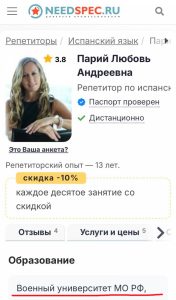
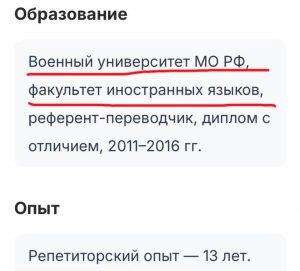
Screenshots of Lyubov Pariy’s ad indicating the educational institution
Roman Chekin
Roman Chekin deserves special attention. Our article presented data indicating his connection to Russian military intelligence. Since the UNFICYP press service called the material false and misleading, the editorial team considers it necessary to restate this argument.
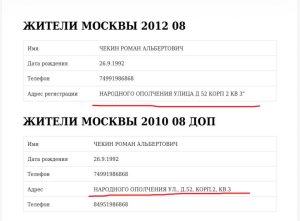
Screenshot with Roman Chekin’s address details
The published screenshot shows Chekin’s Moscow residential address: 52 Narodnogo Opolcheniya Street, Building 2, Apartment 3.
In numerous journalistic investigations and publications, this address appears as being associated with housing for employees of the Main Intelligence Directorate of the Russian Ministry of Defense (GRU). In reports by Current Time, Bellingcat, and Ukrainian investigative projects, Building 2 at 52 Narodnogo Opolcheniya Street is referred to as the “GRU dormitory” and described as a residence for military intelligence officers, including high-ranking officers. In these investigations, this building is considered part of the residential infrastructure associated with people who study or work at the GRU Academy.
Only a person serving in Russian military intelligence can live at this address, and no one else. Therefore, there can be no doubt that Chekin belongs to the GRU. Doubts can arise only among people unfamiliar with Russian military infrastructure or among those biased by Russian agencies.
If UNFICYP has information that refutes this conclusion, the editorial board is prepared to review it and publish a corresponding clarification.
Editorial Position
The editorial board draws attention to the broader context: Russia is waging a full-scale aggressive war against Ukraine and is accused of numerous war crimes. Under these circumstances, the presence of Russian army officers and individuals linked to Russian military intelligence under the UN flag is not an abstract matter of reputation, but a matter of security, transparency, and trust in an international organization.
The editorial team expected a professional and substantive response from UNFICYP. Instead, it received a letter containing general statements and a demand to retract the publication without specifying any concrete errors. This approach appears not as a refutation of the facts, but as an attempt to protect the agency’s reputation by discrediting the journalistic investigation.
The editorial team stands by its position and remains open to dialogue—provided that it is based on specific facts, documents, and verifiable objections, rather than on mere declarations.
CDN Editor-in-Chief
Iosif Bronstein