
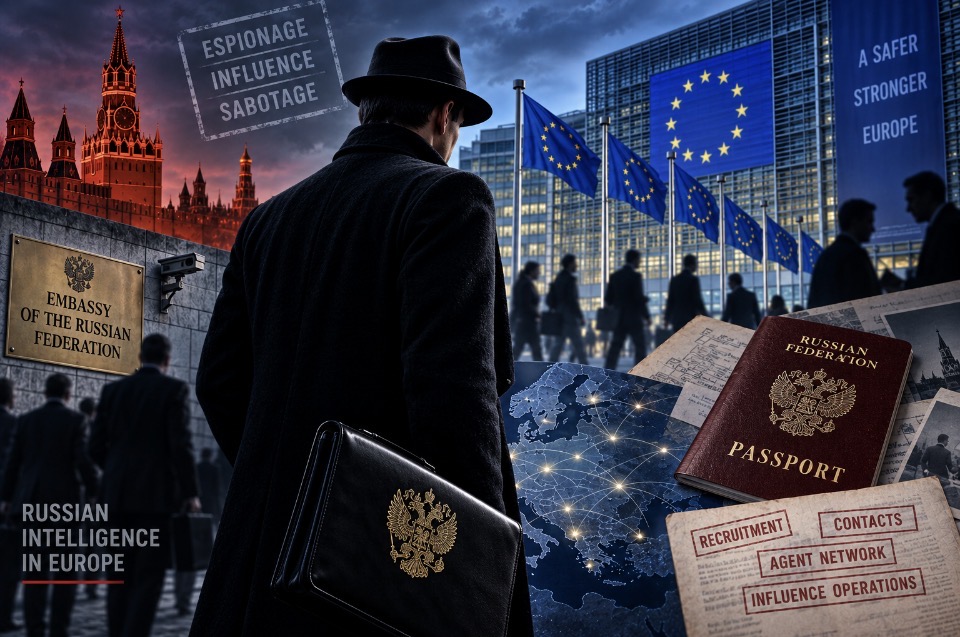
Polish Foreign Minister Radosław Sikorski has called on the European Union to expel up to 40% of Russian diplomats working in the bloc’s countries — nearly one thousand people. On September 3, speaking at a press conference in Weimar, Sikorski said that the recent wave of hybrid attacks demonstrated the need for tougher restrictions on Russia. “After all, Russia is trying to destroy the EU from within, and it should not be allowed to enjoy the privileges of free movement,” the Polish minister said.
According to Sikorski, there are currently more than 2,000 Russian diplomats in EU countries, and at least 40% of them perform tasks incompatible with their diplomatic status, including working for intelligence services that “conduct terrorist activities” in European countries. In addition to reducing diplomatic staff, the minister proposed restricting the freedom of movement of Russian diplomats within the Schengen Area, reducing the issuance of Schengen visas to Russian citizens, and introducing a requirement that entry into the EU be permitted only with biometric documents.
However, Sikorski’s proposal addresses only part of a much larger problem. The issue is not only how many Russian intelligence officers are currently working in Europe under diplomatic cover, but also Russia’s entire system of using diplomatic missions as infrastructure for the activities of its intelligence services.
The primary purpose of Russian embassies in countries around the world has, at all times, had little to do with traditional diplomacy. This has become especially evident under the current conditions of Russia’s war against Ukraine and its confrontation with the entire democratic world.
The key role of Russian embassies is to ensure the legal presence of Russian intelligence services abroad, provide intelligence officers with diplomatic cover and infrastructure for conducting human and technical intelligence, recruiting agents, carrying out sabotage, and conducting influence operations.
In fact, Russian diplomatic missions abroad serve as centers of legal intelligence. They house rezidenturas of all Russian intelligence services — the FSB’s 5th Service, the SVR, and the GRU. The tasks of Russian intelligence services operating under legal cover around the world are the same everywhere and consist of espionage, political and economic influence, bribing influential individuals, recruiting agents from among the political, military, religious, and cultural elites of the host country, manipulating public opinion, conducting sabotage, and destabilizing the situation in host countries.
Following Russia’s full-scale military invasion of Ukraine in February 2022 and the subsequent termination of virtually all official contacts with Russian diplomatic missions in EU countries, the employees of Russian embassies are now engaged in nothing other than espionage, influence operations, and supporting sabotage operations.
Since Soviet times, the number of personnel employed by Russian embassies in Europe has not corresponded to the actual volume of diplomatic work. According to the Republic of Cyprus Ministry of Foreign Affairs list of foreign diplomatic missions for February 2026, the Russian Embassy in Nicosia employs 39 diplomatic staff members, not including technical and administrative personnel. Together with technical and administrative staff, whose numbers are not published, the total number of employees at the Russian diplomatic mission may, according to various sources, reach 300 people, making it one of the largest Russian diplomatic missions abroad.
By comparison, only four diplomats work at the Embassy of Cyprus in Moscow. The same asymmetry can be observed in virtually every country in the world, including EU member states. Russian diplomatic missions have significantly larger staffs than the embassies of the corresponding countries in Moscow.
This disparity is explained not by the scale of consular or diplomatic work, but by the fact that the majority of Russian “diplomats” are career officers of the FSB, SVR, and GRU, operating in host countries under diplomatic cover and engaged exclusively in espionage and sabotage activities. According to estimates by Western intelligence services, such personnel account for at least half of the staff of Russian diplomatic missions. Some experts claim that up to 80% of the staff of Russian embassies are career intelligence officers.
Cyprus is the most illustrative example of Moscow’s personnel policy in staffing its diplomatic missions.
The Russian Embassy in Cyprus is headed by an FSB lieutenant general who had absolutely no diplomatic experience before being appointed ambassador. For carrying out the tasks assigned to him by the Kremlin, a lack of diplomatic experience is no obstacle to a diplomatic career. In Putin’s Russia, experience in an entirely different field is valued.
The same applies to other employees of the Russian Embassy in Nicosia. The Center for Investigation and Research (CIR), together with journalists from Cyprus Daily News (CDN), identified more than ten Russian spies operating in Cyprus under diplomatic cover.
Russian diplomatic missions in EU countries effectively serve as bases supporting the activities of Russian intelligence services and the agent networks they have created. Many of these networks were established by Soviet intelligence services and were subsequently inherited by Russian intelligence structures.
The tasks of Russian intelligence officers operating under diplomatic cover include not only maintaining contact with existing agents, but also searching for and recruiting new ones, both among citizens of the host countries and among Russian citizens living there. Under wartime conditions, the constant expansion and renewal of agent networks has become a critically important factor in the work of Russian intelligence services.
In addition, some personnel at Russian diplomatic missions are involved in operating and maintaining signals intelligence equipment located on the premises of embassies and consulates, which Russian intelligence services bring into the country as diplomatic cargo under the guise of diplomatic mail. This equipment intercepts information from communications channels and radio signals and monitors the political elites of host countries.
Russian agent networks established in EU countries consist primarily of citizens of the host countries — that is, citizens of the European Union who, by cooperating with Russian intelligence, cause enormous damage to the security of their own countries. Over the past three decades, the agent networks created by Russian intelligence services in EU countries have seen a growing number of Russian-speaking immigrants who have obtained citizenship of EU member states, as well as Russian citizens permanently residing in the EU.
In virtually every European country with a large Russian diaspora, Russian intelligence services have turned these communities into Kremlin fifth columns, which have become channels for disseminating Russian state propaganda and a favorable environment for identifying and recruiting Moscow’s agents of influence and agents of Russian intelligence services. At the same time, the distinction between an agent of influence and an intelligence agent is often virtually nonexistent.
The intelligence services of countries hosting Russian diplomatic missions often know exactly which employees of Russian embassies are career officers of Russian intelligence services and which particular service a given “diplomat” belongs to. However, they do not always know the full extent of the agent network built by Russian intelligence services on their territory. This is even more true of Russian spies operating illegally — the so-called illegal intelligence officers.
The problem for EU countries is that Russian spies traditionally work in the same place for many years. There is a simple explanation for why Moscow does not frequently rotate its “diplomats.” Each of them runs their own network of agents, which has its own specific characteristics and requires particular methods of management. Contact must be established with each agent individually, relationships of trust must be built, and an individual model of interaction must be developed. This is difficult and painstaking work requiring specific knowledge, time, and considerable effort. Replacing a handler inevitably entails restructuring the work of the agent network, above all the system of communication between the new handler and the agents.
If the European Union were to expel Russian diplomats on a regular basis — for example, once a year — this would create serious problems for Russian intelligence services. New “diplomats,” who are in fact intelligence officers, would have to re-establish contact each time with the agent networks previously handled by their predecessors. This inevitably increases the risk of coming to the attention of the counterintelligence and law enforcement agencies of the host countries.
The weakest link in the relationship between an intelligence officer and an agent recruited by that officer is communication. It is precisely when agents are transferred from one handler to another that a convenient opportunity arises to identify contacts and establish the members of an agent network.
By regularly expelling Russian “diplomats” and forcing Moscow to replace them with new personnel, European Union countries could create a mechanism for effectively monitoring the activities of Russian intelligence and identifying their own citizens who cooperate with Russian intelligence services.
Another extremely important factor is directly connected to the activities of Russian intelligence services operating under the cover of diplomatic missions — citizens of the Russian Federation living in EU countries. Every one of them is a potential target for recruitment by Russian intelligence services, including for participation in sabotage operations on the territory of EU countries.
The reason is that every Russian citizen living in the European Union remains dependent on the Russian state. A Russian passport has a limited validity period, so sooner or later its holder has to contact a Russian embassy or consulate to replace or renew passports, obtain certificates and powers of attorney, process various documents for family members, and resolve other matters.
Regardless of their political views or attitude toward Putin’s regime, Russian citizens living in EU countries periodically find themselves forced to come into direct contact with Russian intelligence officers operating under diplomatic cover at Russian embassies and consulates. It is precisely this continuing administrative dependence that creates opportunities for Russian intelligence services to establish contact, exert pressure, and recruit. Even a committed opponent of the Kremlin living in the EU can potentially become a target for recruitment and be drawn into working in the interests of Russian intelligence services, including intelligence and sabotage activities against the host country.
The European Union must create a mechanism for Russian citizens who are subjected to pressure through their dependence on Russian diplomatic missions, allowing them to break that dependence. After a Russian passport expires, such people should, under certain conditions, be able to retain the legal right to reside in the EU and obtain the documents necessary for continued residence and travel without having to contact a Russian embassy or consulate.
Such a mechanism would deprive Russian intelligence services of an instrument of pressure and recruitment — the necessity for Russian citizens to periodically return to a Russian diplomatic mission in order to resolve vital administrative matters.
At the same time, the authorities of the European Union must finally understand that among the Russian citizens present on its territory there are a significant number of people who had been cooperating with Russian intelligence services on a permanent basis even before moving to Europe and continue to work with them on EU territory. In addition, many Russian citizens living in the EU are committed supporters of Putin’s regime and the war against Ukraine, openly demonstrating hostility toward the European Union and contempt for European values.
Therefore, in order to prevent or minimize the risks associated with their activities, individuals suspected of cooperating with Russian intelligence services or acting in Russia’s interests — which are often one and the same — must remain under the constant supervision of the competent authorities of EU member states. The legal mechanisms for such supervision must be enshrined in national and European legislation. For this category of individuals, it would also be advisable to establish a legal mechanism for revoking acquired citizenship or cancelling residence permits in EU countries in cases where cooperation with Russian intelligence services has been proven and there are legal grounds for applying such measures.
For decades, Russia has exploited European openness as an advantage for its intelligence services. It is time to turn that openness into their vulnerability.