
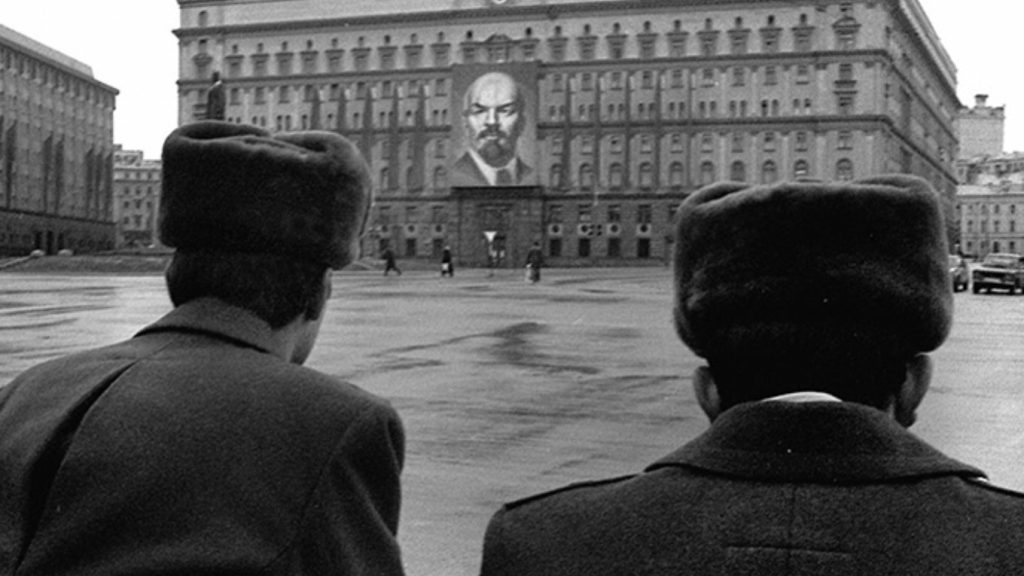
The Cypriot TV channel SIGMA has released Soviet documents showing that in the 1960s and 1970s Moscow regularly funded AKEL, the Cypriot communist party, and that the party apparatus was organised to gather intelligence for the KGB. Anywhere else, such revelations would have caused a political earthquake. In Cyprus they barely registered, writes Philenews columnist Kostis Konstantinou.
The island, he notes wryly, was busy with matters “of far greater national importance”: the fish tavern affair, MP Foullis’s sudden anguish over the Cyprus problem, and whether Fidias can bear the lack of progress in the settlement talks.
What matters most in these documents is not the funding itself but the proof that a party once backed by a third of the electorate was regularly receiving money from Moscow and strictly following its directives. That is political corruption in its purest form: secret foreign funding with no disclosure, no transparency and without the knowledge of the state.
The documents found so far cover just six years: 1961, 1962, 1963, 1965, 1966 and 1973. Over those years AKEL received around half a million dollars. It is logical to assume that the money also flowed in the missing years and that further disclosures will fill the gaps. Otherwise, how did the party keep going?
Half a million dollars is not today’s money but the money of that era. In the 1960s the average monthly salary in Cyprus was about 80 dollars, and the country’s annual budget ranged from 50 to 70 million dollars. Together, the budgets for those six years (in 1973 it reached 200 million) came to roughly half a billion, so Moscow’s money amounted to 0.1% of that sum. Applied to the combined budgets for 2020–2025, the same proportion would come to 74 million dollars.
Relations may have cooled under the “traitor” Gorbachev, but transparency never arrived. Nor did AKEL stop promoting the positions of Putin’s regime and its oligarchs. After AKEL backed the seizure of Crimea, OCCRP revealed a 15,000-euro donation to the party from one of those oligarchs. Then general secretary Andros Kyprianou gave an unforgettable explanation: “Perhaps it was a way of thanking us for the resolution.” He meant the parliamentary resolution against sanctions on Russia. “But they did not give the money to me,” he added. There was another episode involving companies and 20,000 euros.
As CDN has reported, the draft of that very resolution, adopted in 2016, was later found in the hacked correspondence of Russian political strategist Sargis Mirzakhanyan. In other words, the text AKEL pushed through the Cypriot parliament had been prepared in Moscow.
AKEL’s list of services to Moscow is long. The party demanded that Russian warships be allowed into Cypriot ports, undermined the EU’s role, and fiercely opposed Cyprus joining NATO’s Partnership for Peace and any cooperation with the alliance. It defended the cargo of the vessel Monchegorsk — containers of Iranian munitions that exploded at the Mari naval base in July 2011, killing 13 people. It backed “Comrade” Assad and opposed strengthening Cyprus’s defence and its cooperation with Israel, the United States, Europe and even Greece. It spread antisemitic tales about Jews supposedly wanting to buy up the island, while staying silent about the crimes of Iran’s mullahs, Hamas and other Palestinian terrorist organisations.
Konstantinou recalls that the country’s collapse in 2013 was no accident but the result of AKEL’s time in power. The president then was the party’s general secretary Dimitris Christofias, whom Makarios Drousiotis, in his book “Putin’s Island”, called the first thoroughly pro-Russian president in Cyprus’s history. Meeting Dmitry Medvedev, Christofias, almost in tears, thanked AKEL and the Communist Party of the Soviet Union for sending him to study in Moscow, “this city which I love as much as I love Nicosia”. From 1969 to 1974 Christofias studied in Moscow at the Institute of Social Sciences under the Central Committee of the CPSU. It was a closed school run by the Central Committee’s International Department that trained cadres for communist parties around the world, while special branches taught armed struggle to militants of underground organisations — in other words, it trained terrorists. Earlier, in 1964, AKEL Politburo member Yiannis Sofoklis had spent six months studying there.
The links between Cypriot communists and the intelligence services of the Soviet bloc were not limited to Moscow. Declassified Czechoslovak archives showed that Czechoslovak intelligence recruited agents primarily among AKEL members and supporters. Its agents included AKEL MP Dinos Konstantinou.
Cypriot communists had been on Moscow’s payroll from the very beginning. The Russian State Archive of Socio-Political History holds Comintern Executive Committee documents on the Communist Party of Cyprus dating back to 1923, including dossiers on the party leadership and reports by Soviet agents on recruitment. AKEL’s predecessor, the Communist Party of Cyprus, supported the partition of Poland between the USSR and Nazi Germany, Stalin’s alliance with Hitler, the war against Finland and the seizure of Lithuania, Latvia and Estonia.
In the 1970s AKEL used the KGB to arrange deliveries of Czechoslovak weapons to Cyprus. In 1973 the party received 140,000 dollars from the Soviet Union through an international fund to assist left-wing workers’ organisations. And in early July 1974, at AKEL’s request, Moscow secretly shipped 100 firearms and a large quantity of ammunition to the island to arm party leaders. In 2004, under Christofias, AKEL turned to Moscow for instructions on the Annan Plan, and Russia did everything it could to make the plan fail.
AKEL’s ties with Moscow did not end with the collapse of the USSR. In 2017, then general secretary Andros Kyprianou told the Russian newspaper Izvestia: “On behalf of the party, I declare that Crimea is an inseparable part of Russia.” He boasted that AKEL had initiated the resolution against anti-Russian sanctions and promised to “fight to the end for the lifting of sanctions in any case.” Kyprianou travelled to occupied Crimea, took part in Kremlin forums, never missed an event at the Russian embassy and met the Russian ambassador.
AKEL still recruits pro-Russian figures today. In the 2024 European Parliament elections, the number two on its list was Anna Theologou, who had earlier been persistently courted by the “Russian party” EOP. Investigations by CDN and OCCRP showed that EOP was a Russian intelligence project designed to get its people into the Cypriot parliament.
AKEL’s response to the revelations was that the story had already surfaced in 2000. That is disingenuous: back then the funding was reported in general terms, whereas the documents and evidence are brand new. The party went on the offensive, expressed “surprise” and questioned the “timing” of the coverage, without ever explaining what was wrong with the timing.
“Given the party’s record and the weight of the revelations, old and new, can anyone blame a citizen who, whenever AKEL sabotages something in Cyprus, wonders whether these ideological obsessions come free of charge — or whether someone is paying?” Konstantinou writes.
The Soviet Union is long gone, but AKEL remains a conduit for Kremlin interests in Cyprus. Moscow has changed its signboard, but its methods are the same: money, cadres and resolutions drafted in Moscow offices.
Read more on CDN:
A model agent
A free hand for the security services: how Russian influence in Cyprus works (in Russian)
Makarios Drousiotis — “Putin’s Island” (in Russian)
Czech authorities declassify Cypriot agents of socialist Czechoslovakia’s intelligence (in Russian)
Cypriot communists and Moscow’s agents (in Russian)
Russian intelligence agents infiltrating the European Parliament (in Russian)
The “Russian Regiment” goes to the Cypriot elections (in Russian)