
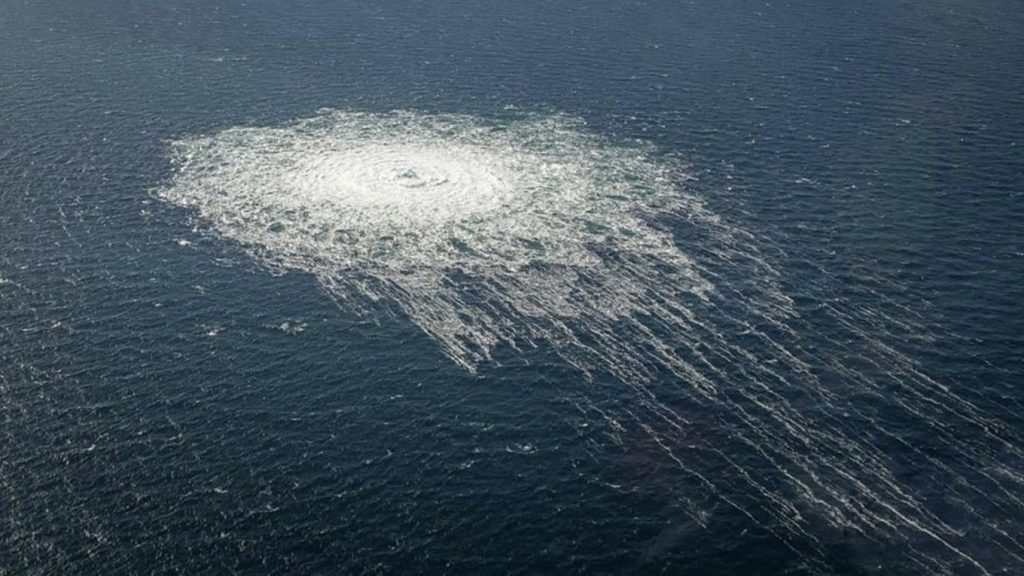
The story of the explosions that damaged the Nord Stream gas pipelines in the Baltic Sea has been unfolding for several years now. Many theories have been put forward, and assumptions and oversimplifications keep circulating. Yet heated debates built on conspiracy thinking, outright myth-making and “witch hunts” are worth nothing when it comes to the international legal aspects of the case.
Moreover, if one follows the detective-story cliché of “look for who benefits,” then, given how events around Nord Stream have developed, and especially given the interest shown in it by Donald Trump’s entourage, the circle of interested parties becomes considerably wider.
Attempts to name those who ordered the incident and those who carried it out without solid evidence, and without properly conducted investigative and judicial procedures, are a direct path to legal chaos and to dangerous precedents.
In September 2025, Ukrainian citizen Volodymyr Zhuravlov was detained in Poland on a European Arrest Warrant issued by the German Federal Prosecutor’s Office. At the time, investigators suspected him of complicity in organising the explosion and deliberately damaging the Nord Stream pipelines.
In October 2025, the Warsaw District Court refused to extradite Zhuravlov to Germany and lifted his detention. The ruling noted that the documents submitted by the German side described the circumstances in overly general terms and lacked proper evidence. The court also did not establish that it was Zhuravlov himself who had committed any dangerous acts.
During the hearing, doubts were also raised about the grounds for issuing the warrant and for applying German criminal law. The incident took place in the exclusive economic zones of Denmark and Sweden, and it was precisely the absence of extraterritorial jurisdiction that called the legitimacy of Berlin’s claims into question.
In its decision of 17 October 2025, the Polish court pointed out that a person acting on behalf of a state in the context of an international armed conflict may enjoy immunity. This means that Zhuravlov’s possible actions cannot be treated as an ordinary criminal offence.
The German prosecutors were therefore obliged to provide a separate justification of which provisions of national or international law allow a Ukrainian citizen to be prosecuted, all the more so since the incident occurred outside German territory.
As this verdict was not appealed, Zhuravlov was not extradited to Germany.
The next development came in August 2026 in Croatia, where he was detained again on the basis of a warrant dated June 2024 that Germany had entered into the Schengen Information System. However, in September 2026 the German prosecutors hastily updated the warrant and added a new legal qualification of the Nord Stream incident. In particular, it now states that Zhuravlov was allegedly involved in a war crime in the form of an attack on civilian objects.
This points to an attempt by the German prosecution to strengthen its legal position in the middle of the extradition proceedings before the Croatian court.
The reasons are the weakness of the original charges of June 2024 and an intention to make Zhuravlov’s legal defence more difficult.
This is indicated by the fact that the extradition hearing in the Croatian city of Pula on 18 September 2026 was held behind closed doors and without the Ukrainian consul present. The process was thus deprived of transparency and of an impartial review of the German prosecutors’ updated materials. This is a further sign of an obvious problem on the prosecution’s side: the lack of direct evidence of his guilt.
The German investigators’ files contain no evidence of any actions by Zhuravlov near the island of Bornholm at the time of the incident. There are no DNA samples, no geolocation data, no phone records, no confirmed financial transactions and no confession that would point to his involvement in blowing up the Nord Stream pipeline.
At the same time, the German prosecution’s case rests on indirect assumptions, and the evidence has been replaced simply by the fact that Zhuravlov has professional qualifications and underwater diving skills.
Experts note that, despite the effort invested, the updated documents from the German prosecutors have serious flaws. In particular, the charge of anti-constitutional sabotage (Section 88 of the German Criminal Code) requires proof that the acts were directed against Germany’s constitutional order, not merely that property was damaged. Just as important, the acts being qualified were committed outside that country’s jurisdiction. And a “war crime” designation requires proof of a violation of international humanitarian law and confirmation of the civilian status of the object whose operation was disrupted by the incident.
It should be borne in mind that Russia stopped pumping gas through Nord Stream 1 on 31 August 2022, almost a month before the explosions, while Nord Stream 2 never entered commercial operation because Germany suspended its certification. Consequently, the incidents of 26 September 2022 did not affect gas supplies to German consumers. This must be taken into account when assessing the consequences of the incident and the gravity of the alleged acts.
In addition, the prosecution must prove that Zhuravlov was present at the scene, convincingly demonstrate his specific actions and show that he was aware of the nature of the “operation” and of its intent. Instead, the evidence has been replaced by a biased emphasis on the scale of the damage caused.
This case goes beyond a standard extradition procedure and requires strict compliance with European standards of justice. Any procedural findings on Zhuravlov’s guilt must rest solely on proper and admissible evidence examined in adversarial proceedings that guarantee the presumption of innocence and the right to a defence — not on the benefits of political resonance or on opportunistic considerations.
The Pula District Court’s decision of 18 September 2026 to extradite Zhuravlov to Germany is not final. His defence has announced its intention to appeal, so the arguments concerning the sufficiency of evidence, the legal qualification of the case, Germany’s jurisdiction and the need to take into account the earlier ruling of the Polish court must be reassessed on appeal.
Until the decision becomes final, Zhuravlov must not be handed over to Germany.
Ivan Bortsov