
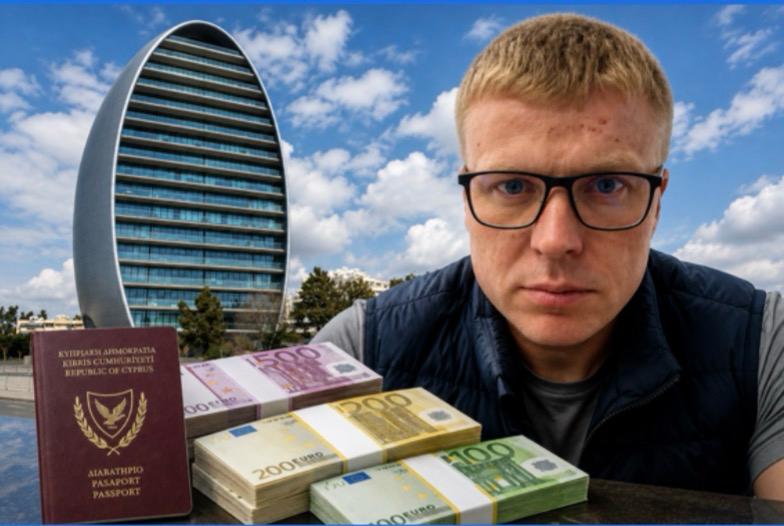
Roman Semiokhin — founder and principal beneficiary of the online betting company 1xBet — lives in Cyprus, organizes music festivals, builds office complexes, and readily gives interviews. As it turns out, an international arrest warrant, blacklisting by European regulators, and the dubious origin of billions in revenue do not prevent him from living a comfortable life on the island. Why have decisions made by the Anastasiades administration allowed this situation to persist for so many years, and isn’t it time for the current government of Cyprus to finally resolve this matter in line with the requirements of European institutions?
International Manhunt and Mediterranean Comfort
How do you picture the life of a man wanted internationally? Separation from loved ones, forged documents, rented apartments, drawn curtains, insomnia, and nervous glances over the shoulder? Let’s set aside the Hollywood clichés: in real life, things are arranged much more simply. You just need to choose the right place.
On the paradise island of Cyprus, in the business and resort city of Limassol, the co-founder and principal beneficiary of 1xBet lives and thrives — one of the world’s largest online betting platforms, whose activities have repeatedly drawn the close attention of law enforcement and regulatory authorities in various countries. Over time, that attention grew into a criminal case, which, however, has not caused our hero any noticeable inconvenience: here on the island, he organizes music festivals, builds office complexes, and readily gives interviews to Forbes.
The Dutch outlet Follow the Money notes that in this interview, published in 2021, Roman Semiokhin confirmed his connection to 1xBet and stated that the headquarters in Limassol was established by him and his partners. The interview is remarkable for its candor overall: in it, Semiokhin describes for the first time how a single betting shop, opened in 2007, grew into a billion-dollar international structure. The portal Gambling Park notes that in the conversation, Semiokhin compares his 1xBet business model to the McDonald’s franchise: «The local partner decided for himself how to operate, with whom, and which license to obtain.» On closer reading, this rather interesting analogy can reveal a great deal and therefore deserves special attention. But more on that later.
Geography of Bans
On his personal blog romansemiokhin.com/, which can be found in the web archives at archive.org, Roman Semiokhin presents himself as a philanthropist and patron, paying particular attention to his activities “for the benefit of Cyprus.” For some reason, the blog does not mention that this activity was financed by the proceeds of illegal gambling business.
Meanwhile, from a legal standpoint the picture is unambiguous. In Europe’s regulated gambling markets, the 1xBet platform is not a “gray zone.” It is a violator that regulatory authorities in various countries regularly block, fine, and blacklist.
In the Netherlands, the gambling regulator Kansspelautoriteit (KSA) fined 1X Corp N.V. and Exinvest Limited — the legal entities through which 1xBet operated — 400,000 euros for organizing and conducting gambling activity without a license. It was established that their activity specifically targeted Dutch users: the websites had a Dutch-language interface, and accounts could be topped up through the local payment system iDEAL.
The Belgian Gaming Commission blacklisted 1xBet in its register of gambling operators.
The Hellenic Gaming Commission (HGC) explicitly lists this bookmaker among the operators prohibited from serving Greek users.
The Danish Gambling Authority, which regulates the gambling market, blocked 1xBet’s domains as an unlicensed operator.
In Sweden, the regulator Spelinspektionen banned 1xBet’s activities as of January 2020.
The Lithuanian Ministry of Finance added the company 1X Corp N.V. to its register of illegal operators.
In Poland, 1xBet’s domains have been repeatedly blocked by the Ministry of Finance.
The Ministry of Finance of the Czech Republic added 1xBet to its official blacklist.
The Swiss Gaming Supervisory Authority (GESPA) blocked the website.
Estonia’s Tax and Customs Board added 1xBet to its list of banned operators.
In Italy, 1xBet sponsored Serie A without a valid ADM license, which caused a major scandal and, as could be expected, led to the bookmaker being blocked.
In the United Kingdom, 1xBet’s activities also led to a national scandal. Following a journalistic investigation, the UK Gambling Commission (UKGC) blocked the company’s website, forcing the football clubs Chelsea, Liverpool, and Tottenham to immediately terminate their contracts with the bookmaker. According to The Times, further cooperation with this platform risked heavy fines and legal prosecution.
According to the findings of the investigation, the platform accepted bets on cockfighting and sporting competitions involving minors, placed advertising on pirate websites, and offered casino broadcasts featuring topless or fully nude dealers.
In 2020, the Russian authorities issued an international arrest warrant for Semiokhin. He and two of his accomplices are currently wanted internationally on charges of organizing illegal gambling as well as laundering criminally obtained proceeds.
Roman Semiokhin and his two accomplices remain internationally wanted to this day.
According to investigators, the platform earned more than 63 billion rubles from its unlicensed activity. By comparison: Athens’ budget for that year was 820 million euros, equivalent to approximately 69.8 billion rubles.
Mr. Semiokhin and his accomplices were also placed under sanctions in Ukraine, where they operated under a license from the national gambling regulator KRAIL. In September 2022, KRAIL revoked the license of the legal entity “Your Betting Company,” which operated in the country under the 1xBet brand. The main accusation concerned the bookmaker’s ties to Russia through Semiokhin’s accomplices — Dmitry Kazorin and Sergey Karshkov — who are also under Ukrainian sanctions and, like him, hold Cypriot passports.
In the end, the NBA — Cyprus’s gambling regulator — added the 1xBet site to its list of banned domains. The main resource, under various domains, holds the distinguished second and third places on this list, and its numerous “mirrors” — alternative backup addresses used to circumvent blocks — occupy roughly 300 more positions.
The creator and owner of this illegal betting infrastructure lives comfortably in Limassol.
Betting on Iran
However, not all states treat Mr. Semiokhin’s business with equal strictness. Where European regulators find violations, jurisdictions with far harsher regimes appear to see opportunities. Take Iran, for example — a country where gambling is strictly prohibited in principle, the internet is under close state oversight, and international payments are hampered by sanctions. One would think this is the least likely jurisdiction for an online bookmaker to operate in. Nevertheless, according to a separate technical report, 1xBet maintains a dedicated Iranian adaptation of its site, ir.1xbet.com.
For readers unfamiliar with the world of online betting, it’s worth explaining: such a local version of a site is not just some random page on the internet. It is a way to keep operating where the main resource is blocked, banned, or unavailable. The user does not go to the main domain but to an alternative address that is visually and functionally linked to the main platform. In Iran’s case, this apparently includes not just access to the website, but a comprehensive adaptation to the local market: the pages of ir.1xbet.com display support contacts, links to Iranian social networks, and payment solutions adapted for users inside the country.
The site’s payment infrastructure deserves particular attention. The report mentions HotVoucher and CardPardakht — tools that allow Iranian users to pay for foreign online services in conditions where traditional international systems such as Visa, Mastercard, and SWIFT are effectively unavailable. In other words, this is not the passive existence of a site that someone in Tehran happened to launch, but an active attempt to integrate into the local financial reality.
At this point, the story takes on a political dimension.
Recall that on the night of March 2, 2026, an Iranian drone attacked the British air base at Akrotiri in Cyprus. The UAV struck the runway, causing minor material damage. It is possible that Mr. Semiokhin, without even realizing it, contributed to financing that drone by supporting the Iranian economy.
In Iran, gambling is banned, and the internet and payment infrastructure are controlled by the state far more tightly than in most European countries. That is why the very possibility of a betting platform operating and targeting Iranian users looks, to put it mildly, strange. If the authors of the report mentioned above are to be believed, such activity in Iran is fundamentally impossible without arrangements with people who have access to administrative resources.
Of course, claims about potential agreements with Iranian structures require separate verification. But even without them, the picture that emerges is striking: while European regulators block 1xBet for operating without a license, and Ukrainian authorities impose sanctions on people connected to this platform, in Iran — a country where gambling is strictly banned in principle — the brand turns out to have its own local version, equipped with payment tools and customer support.
If these claims are true, then this is no longer simply a matter of an unlicensed bookmaker operating in yet another questionable jurisdiction, but potential financial involvement in a system connected to a regime that openly threatens the security of Cyprus and the entire civilized world, creates and finances terrorist organizations around the world, and threatens the countries of the region with nuclear apocalypse.
The Passport No One Asks About
Cyprus is a member of the European Union. This means a Cypriot passport is not merely the document of a single state, but a gateway to Europe: it provides freedom of movement, access to the European financial system, and the full set of rights granted to an EU citizen. According to our publication, the founders of the bookmaker banned in Cyprus obtained citizenship of this country. Semiokhin received his Cypriot citizenship on November 25, 2016 — four months after filing his naturalization petition on July 19 of the same year.
At this point, the story becomes entangled with yet another scandal — far larger in scale, and likewise of local origin, as well as connected to the island’s previous government.
From 2007 to 2020, Cyprus operated an Investment Citizenship Program, now infamously known as the “golden passports” scheme. Formally, it offered foreign investors citizenship in exchange for investment in the country’s economy. The peak of Cyprus’s cash-for-citizenship handouts came during the years of the Anastasiades presidency. However, it later emerged that the vetting of applicants’ background data under the program too often turned out to be a mere formality rather than a real filter. The scandal culminated in a high-profile Al Jazeera investigation in October 2020: journalists documented systemic corruption, including senior officials’ willingness to help individuals with criminal records obtain Cypriot passports. Within weeks of the report’s publication, the program was shut down.
As the results of the official investigation conducted after the scandal showed, in 51% of naturalization cases the criteria set out under the program were not met. Moreover, some applicants were classified as “high risk,” a category that included people with criminal pasts, pending criminal cases, or international arrest warrants issued against them.
After that, Cyprus, as might be expected, began stripping citizenship from its new citizens. Since 2021, the Council of Ministers has approved the revocation of citizenship for 306 people, including 88 investors and 218 family members. Mr. Semiokhin, it appears and his close associates who received the passports via orchestrated via Jovaras LTD property investment, are not among them. No official explanation for this has been offered, and it would be logical for the current government to finally clarify this matter, inherited from officials of the previous government..
Given the foregoing, it is no longer so surprising that a man wanted internationally for money laundering and organizing illegal gambling, tied to an empire of unlicensed betting operations spanning dozens of countries, managed to obtain citizenship of a European state. What’s curious is something else: why have the current Cypriot authorities still not addressed the question, inherited from a bygone era, of revoking his citizenship?
Profits for Us, Responsibility for You
In corporate law there is a concept known as “willful blindness,” in which a person deliberately builds a structure that allows them to “not know” what they ought to know, in order to evade responsibility and the need to manage risk. Semiokhin’s description of his franchise model, under which local partners supposedly decide for themselves how to operate and which licenses to obtain, could serve as a textbook example of exactly such a construct.
It’s worth noting that questions of ownership and the platform’s profitability leave no room for doubt. A 2023 investigative article by Follow the Money found that, despite the opacity of the company’s structure, analysts agree that 1xBet’s turnover runs into the billions, and that Semiokhin is its principal creator and beneficiary. According to InformNapalm, in that same Forbes interview Semiokhin confirmed that 1xBet independently develops its own platform — a B2B solution — which serves as the foundation for numerous brands, including BetWinner. The structure of the holding was also described in detail by the portal Antikor.info.
So here is the situation: there is a company whose profits run into ten-digit figures. Part of that revenue was obtained illegally, since the legal requirements for mandatory licensing of its activities were not met. The company has an owner who receives the lion’s share of the revenue — both legal and illegal. Yet when it comes to responsibility for organizing illegal gambling, he claims to have absolutely no involvement in the crime. Why? Simply because he didn’t know! After all, “the local partner made his own decision” on the question of obtaining (or, in this case, not obtaining) a license, as he explains in his Forbes interview. Except that, for some reason, Russia’s Investigative Committee didn’t buy it and opened a criminal case against Mr. Semiokhin, as a result of which he was placed on a wanted list. Perhaps they simply hadn’t watched that interview…
The McDonald’s analogy that Semiokhin is so fond of — under which the corporation genuinely bears no legal responsibility for the actions of its franchisees — is nothing more than an attempt to stretch a legitimate business model over an illegal scheme. It sounds plausible and simple, as all clever things do. Only one small detail is missing: in a classic franchise (like McDonald’s), the local partner is an independent business. They sell hamburgers, take the money into their own till, pay wages and taxes, and the McDonald’s corporation collects only a small percentage (a royalty) for use of the brand. In the 1xBet scheme, the money flows differently: players place bets, and the profits from those bets go directly into the accounts of either the company itself or affiliated structures — as was the case with Sergey Kondratenko’s “Royal Pay.” That is not a royalty. It is an enormous revenue stream whose main beneficiary is the platform, not its “local partners.”
It seems obvious that within such a hierarchy, questions concerning technology, infrastructure, the brand, and, of course, licensing cannot be left to the discretion of anonymous local agents. Such decisions must be made centrally. Otherwise, responsibility becomes diffused — and it becomes impossible to determine who is actually accountable for the legality of the company’s actions. It would be strange for a business owner not to know this, even though it is quite convenient.
A platform owner who claims that “the local partner makes his own decisions” on licensing matters — even though this made his platform’s operations illegal in more than a dozen EU countries — is either catastrophically naive about his own business, or is making a conscious and well-considered choice.
Or perhaps it is we who are naive, willing to believe that the owner simply didn’t know about the scandals surrounding his platform, the criminal cases, the enormous fines, and finally the bans on operating in Russia, Ukraine, and a number of EU countries. Though in that case, the existence of thousands of mirror sites — sites built by 1xBet’s IT specialists to circumvent blocks, which supposedly no one knew about and for which no one wants to take responsibility — remains entirely unexplained.
A Jurisdiction of Miracles, or the Art of Not Knowing
The European Union has a well-established mechanism for dealing with individuals under sanctions or on international wanted lists. For example, back in 2022 the European Commission spoke out directly about a number of Russian nationals who had managed to obtain citizenship or residency in EU countries despite entry bans in place against them, and called on member states to consider revoking the documents issued. Around the same time, the European Parliament demanded a complete end to “golden passport” schemes in all EU member states.
Against this backdrop, the unimpeded presence in Cyprus of the founder of one of Europe’s largest illegal bookmaking operations and his inner circle raises questions beyond a mere bureaucratic oversight. Such lapses are usually corrected; this story, however, has dragged on for years.
And it seems not to matter that somewhere beyond the island, Mr. Semiokhin is wanted on several criminal charges. He doesn’t let such trifles affect his quality of life, whether at work or at leisure: a man subject to an international arrest warrant cheerfully adorns Cypriot cities with new office complexes and festival venues.
At this point, this becomes a matter of simple human curiosity: how did it happen that a passport of an EU member state could be obtained for money — to put it plainly, bought — and one could comfortably settle on this paradise island, despite crimes committed first at home, then across the EU, and around the world? The answer to this question lies in the design of the citizenship-by-investment program that operated under the previous corrupt government, when, it appears, the comfort of some of its beneficiaries was underwritten, among other things, by billions in revenue from organizing and running illegal gambling.
Today it is hard to believe that the current authorities are unaware that Semiokhin and his inner circle live permanently on the island and hold Cypriot passports issued back in 2016. All the more reason for the questions that European regulators, journalists, and members of the European Parliament are entitled to put to Nicosia today: does the current government plan to review the status of these passports? And how many more years will it take to finally close this chapter?
An international arrest warrant versus Cyprus’s hospitality of years past, which was based on a love for Russian criminal money — who wins this contest depends largely on the resolve of Cyprus’s current authorities. It should be acknowledged that the administration of President Christodoulides is demonstrating the will to correct past shortcomings. Since 2023, hundreds of “golden passports” have been revoked, and at the end of 2025 parliament finally closed the loophole that had allowed the government to grant citizenship to investors outside the normal procedure. Whether Roman Semiokhin will end up on that list remains an open question.