
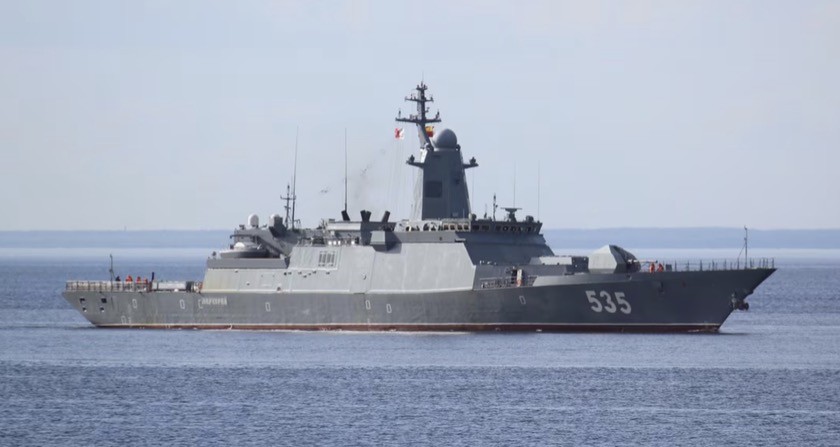
The alarm in Greece and other Mediterranean states over the widening geography of the Russian-Ukrainian war is understandable: the safety of shipping, the stability of Libya and the wish not to turn the Mediterranean into a new theatre of war are in the interest of all of Europe. But after Ukrainian uncrewed surface vessels sank the Russian corvette Merkury in the Libyan port of Benghazi on Sunday, 22 November, a question of principle arises. Why are some European capitals so vocal in their concern about Ukraine’s actions and so restrained in their reaction to the Russian military presence off their own shores and to the Russian interests linked to it on their own territory?
On the day the Merkury was sunk, the Russian cargo ship Angara, which the Russian Ministry of Defence used to transport weapons, was also hit. The Ukrainian side also reported the destruction of a Russian Ka-27 military helicopter. According to media reports, a group of four to seven uncrewed boats set out from the coast of western Libya near Misrata towards Benghazi and sank the Russian corvette. The operation is said to have been carefully prepared. It must also be said that the mission was carried out brilliantly, which speaks to the high professional standard of the Ukrainian military.
This is not just another episode of the war. It is evidence that Russian military logistics long ago moved beyond the Black Sea and now cover the entire Mediterranean, something that should never have been allowed to happen.
The Merkury was not there by chance. The Project 20380 corvette was commissioned into the Black Sea Fleet on 15 May 2023 in the Baltic, but it never reached Crimea: Turkey invoked the provision of the Montreux Convention that bars new warships from entering the Black Sea in wartime. Unable to fight against Ukraine in the Black Sea, the ship served the Kremlin’s interests off the coast of North Africa.
Moscow declared its Libyan ambitions long ago and maintains military-technical cooperation with local forces. In this context, the Kremlin sees the southern Mediterranean as a key element of its military presence abroad. In January 2026 the sanctioned cargo ship Mys Zhelaniya was spotted in Tobruk, having delivered military cargo under the escort of a Russian warship; in September another convoy with military equipment arrived there. According to Africa Defense Forum, Moscow is developing infrastructure at six Libyan air bases: Al Jufra, Al Khadim, Al Qardabiya, Brak al-Shati, Maaten al-Sarra and Tamanhint, some of which serve as transit hubs for moving weapons and personnel deeper into Africa. Ukrainian intelligence reports that Russian military contingents in Africa have grown by roughly 8,000 people in recent months.
The most telling detail comes from the Greek press itself. According to Kathimerini, shortly before it was sunk the Merkury sailed in international waters of the Aegean, escorting merchant vessels that were most likely carrying weapons. A Russian warship escorted suspicious cargo in the immediate vicinity of Greek islands and then berthed in a Libyan port, even though Libya remains under a UN arms embargo.
It is in this context that the reaction of Athens should be assessed.
When Concern Replaces Responsibility
Greek concern is understandable. For a country whose geography makes it strategically dependent on stability in the Mediterranean, any expansion of military risk is a serious challenge. Athens speaks of three threats: to merchant shipping, to tourists on cruise ships and passenger ferries, and to the environment, since a strike on a tanker could turn into an ecological disaster. Back in May, Greek fishermen found a Ukrainian Cossack Mamai-type uncrewed boat off the island of Lefkada, after which Greece delivered an official démarche to Kyiv. Now, as Kathimerini reports, Athens complains that, contrary to Ukrainian promises, the «fleet» of Ukrainian uncrewed boats, and possibly underwater vehicles, in the Mediterranean remains active, and it is coordinating its position with Rome.
However, understanding this concern does not mean agreeing with a political argument that focuses on Ukraine’s actions rather than on the appearance of Russian military infrastructure and logistics in the region. One gets the impression that certain political circles find it far more convenient to discuss the risks «created» by Ukraine’s actions against Russian military assets than the very presence of those assets in the Mediterranean.
The environmental argument is revealing too. Worn-out tankers of the Russian shadow fleet, lacking proper insurance and registered to shell companies, have for years sailed past Greek islands and carried out ship-to-ship oil transfers off the Greek coast. They are the main source of oil spill risk in the Mediterranean. And Russian warships escorting military cargo through the Aegean are incomparably more dangerous to shipping than those who destroy these ships.
But who created this problem?
It was not Ukraine that unleashed a full-scale war of aggression. It was not Ukraine that turned warships, transport vessels and port infrastructure into instruments of a war of conquest. And it was not Ukraine that decided to use the territory of a third country to meet Russian military needs.
That is why attempts to direct political criticism at Kyiv while leaving Moscow’s activities in the shadows look, at the very least, like biased selectivity. European solidarity cannot mean that Ukraine must limit its ability to resist the aggressor for the sake of the familiar comfort of those who for years turned a blind eye to the growing Russian military presence in their own region and profited from transporting Russian oil.
Kathimerini admits with regret that the EU and NATO have reacted coolly to Greek complaints, as Europeans tend not to take threats coming from Ukraine seriously. Most European capitals, it seems, understand the difference between the aggressor and the victim perfectly well.
IRINI: Do Athens and Rome Remember What the Operation Was Meant For?
The references to the European naval operation EUNAVFOR MED IRINI, headquartered in Rome, deserve particular attention. It is worth recalling that the operation was launched on 31 March 2020 and that its main purpose is to help enforce the UN arms embargo on Libya: to detect and stop illegal arms deliveries by sea, air and land, and to support the stabilisation of the country.
This raises an entirely legitimate question for Athens and Rome: have European capitals forgotten the original purpose of this operation? If Russian warships and vessels involved, according to evidence that leaves little room for doubt, in Moscow’s military logistics can use Libyan ports to refuel, resupply and continue their activities, this is first and foremost a question about the effectiveness of international monitoring of the embargo. All the more so since Greece has the means for such monitoring: its frigate is permanently deployed in the central Mediterranean as part of IRINI, a Greek navy missile boat has been on patrol in the Ionian Sea since May, and since 2024 Athens has regularly closed the Laconian Gulf for naval exercises, partly to deter the Russian shadow fleet.
Legal precision is needed here. On 24 May 2026, UN Security Council Resolution 2292, which authorised inspections on the high seas of vessels suspected of violating the embargo, expired. This changed IRINI’s operational capabilities, but it did not lift the arms embargo itself, established by Resolution 1970. The reason the resolution lapsed is also telling. As Kathimerini reported, Greece and France, which had themselves initiated its adoption in 2016, decided not to seek its renewal, partly to avoid tension in the Security Council. In other words, Athens itself gave up an effective instrument and now complains that the work Europe abandoned is being done by Ukraine.
The question, therefore, is not only about the mission’s mandate but also about how effectively European states use the diplomatic, intelligence and legal tools at their disposal to counter Russian military logistics. The European Union cannot simultaneously proclaim the need to enforce the embargo, maintain a naval operation for that purpose and remain politically powerless in the face of Russian military networks in the region. Still less is it entitled to shift onto Ukraine the responsibility for its own limitations and miscalculations.
The Russian Defence-Industrial Trail in Athens: Uncomfortable Questions That Still Have No Answers
Even more revealing is the story CDN reported on 14 November 2026. It concerns ROSOBORONSERVICE HELLAS A.E., a company based in the Athens suburb of Psychiko and a subsidiary of Russia’s state arms exporter Rosoboronexport, part of the state corporation Rostec. CDN examined data from the Greek companies registry, corporate filings and documents on the composition of the company’s governing bodies.
In June 2025, Vladimir Artyakov, first deputy director general of Rostec, who is under European Union sanctions, was re-elected chairman of the company’s board of directors. Other representatives of the Russian defence industry who are subject to international restrictions are also still listed in the company’s management. The company’s financial ties with its Russian parent and its activities after sanctions were imposed deserve separate attention.
If these circumstances are confirmed by an examination by the competent authorities, the Greek authorities will face serious questions about the proper enforcement of EU sanctions law. Referring to formal compliance with procedures or to the absence of active commercial activity is no longer enough. It must be established who actually controls the company, who benefits from its existence, whether asset-freeze requirements are being observed and whether the activities of its management comply with sanctions restrictions. The mere registration of a legal entity or the sanctioned status of an individual does not in itself prove a violation of the law. But the information presented calls not for political explanations but for a full official investigation.
This is where the main political contradiction arises. If Athens truly regards the Russian military presence in the Mediterranean as a threat, why does the continued presence on Greek territory of corporate structures of the Russian defence sector not provoke an equally decisive reaction? One cannot demand that partners confront the Russian war machine while tolerating the presence of its structures on one’s own territory.
Ukraine Should Not Pay for Others’ Inaction
There is another fundamental aspect that cannot be ignored. For the fifth year, Ukraine has been fighting a full-scale war against a state that systematically uses military force, energy blackmail, a shadow fleet, economic ties and agents of influence to achieve its political goals. Ukrainian forces have to confront not only Russian troops at the front but the entire system of their supply, financing and logistics, wherever it may be.
In these circumstances it is particularly strange when states that have their own navies, intelligence services and instruments of European collective security are indignant at Ukraine’s actions but show no comparable resolve in countering Russian interests in their own region. Ukraine should not have to keep correcting the consequences of others’ indecision, compensating for the ineffectiveness of international mechanisms and doing work that its European partners are obliged to do under their own commitments.
Partnership implies not only demands on Ukraine but also the responsibility of the partners themselves. If Russian warships use the ports of third countries, if Russian military logistics keep working and structures of the Russian defence sector maintain a presence in European countries, then the problem is not that Ukraine is trying to deprive Moscow of these capabilities. The problem is that these capabilities still exist at all.
European Solidarity Cannot Be Selective
Greece and Italy have every right to raise questions of regional security, the protection of shipping and the prevention of further destabilisation in Libya. Ukraine does not deny the importance of these issues and understands the concerns involved. But Kyiv is equally entitled to expect consistency, not double standards, from its European partners.
If a Russian warship is berthed in Benghazi after escorting vessels carrying weapons through the Aegean, if a Russian cargo ship is used for military transport, and if Russian structures retain the ability to operate in the European economic space, then it is precisely this Russian activity that should be the main subject of political concern. The Mediterranean cannot remain a safe harbour where the Russian war machine refuels, unloads and carries weapons in the area of responsibility of Rome and Athens.
It would be far more convincing if, instead of showy indignation at Ukraine’s actions, Athens and Rome focused on actually enforcing sanctions, countering Russian military logistics and tightening control over the use of Libyan ports for Russian military needs. And if they are unable to put an end to this disgrace, let them at least not hinder Ukraine, which is doing this work for them. Otherwise an unpleasant impression emerges: European capitals want Ukraine to be strong enough to contain Russia, yet constrained enough not to inconvenience those who are in no hurry to break definitively with Russian military and economic structures at home.
This is no longer a matter of diplomatic protocol but of political consistency and trust between allies.
It is not Ukraine that threatens the security of the Mediterranean. It is Russia, which continues to use the region to sustain its aggression. And until European partners begin consistently removing the causes of this threat, their complaints against Kyiv will sound less and less convincing. European solidarity is tested not by the number of statements of concern, but by the willingness to stop cooperating with the aggressor and to deny it the use of European space for its military interests.
Read also on CDN:
A Rosoboronexport subsidiary keeps operating in Greece thanks to the inaction of the Greek authorities
The Limits of Greek Solidarity with Ukraine Are Set by Commercial Interests
Greece’s Olympic Heritage Is Not for Rent: Cyprus Kept Its European Commitments, Athens Did Not
Odesa and Greek Independence