
The Greek Foreign Ministry has officially confirmed that it sent Ukraine a diplomatic note over strikes on tankers loading oil near Novorossiysk. At the same time, Athens is unwilling to hand Kyiv missiles for Patriot systems, even though some of those missiles have almost reached the end of their service life.
On 6 November, in the Greek Parliament, Deputy Foreign Minister Ambassador Alexandra Papadopoulou answered an urgent question from Alexandros Kazamias, an MP of the Plefsi Eleftherias parliamentary group. He asked about attacks on vessels owned by Greek shipowners and ships flying the Greek flag in the Black Sea. The transcript of her answer has been published on the Greek Foreign Ministry’s website.
According to Papadopoulou, the ministry acted on two fronts at once. Through Greece’s Permanent Representation in Brussels, the issue was formally raised with the institutions of the European Union. And on 17 September 2026, the Ukrainian authorities were handed a démarche and a note verbale setting out the Greek position.
The Deputy Minister then made her key point: thanks to the efforts of Greek diplomacy, strikes on commercial vessels in the area had stopped. In her second intervention, she had to correct herself. The halt applies only to one category of vessels, those carrying oil from the Caspian pipeline to Novorossiysk. The ministry said nothing about the other attacks.
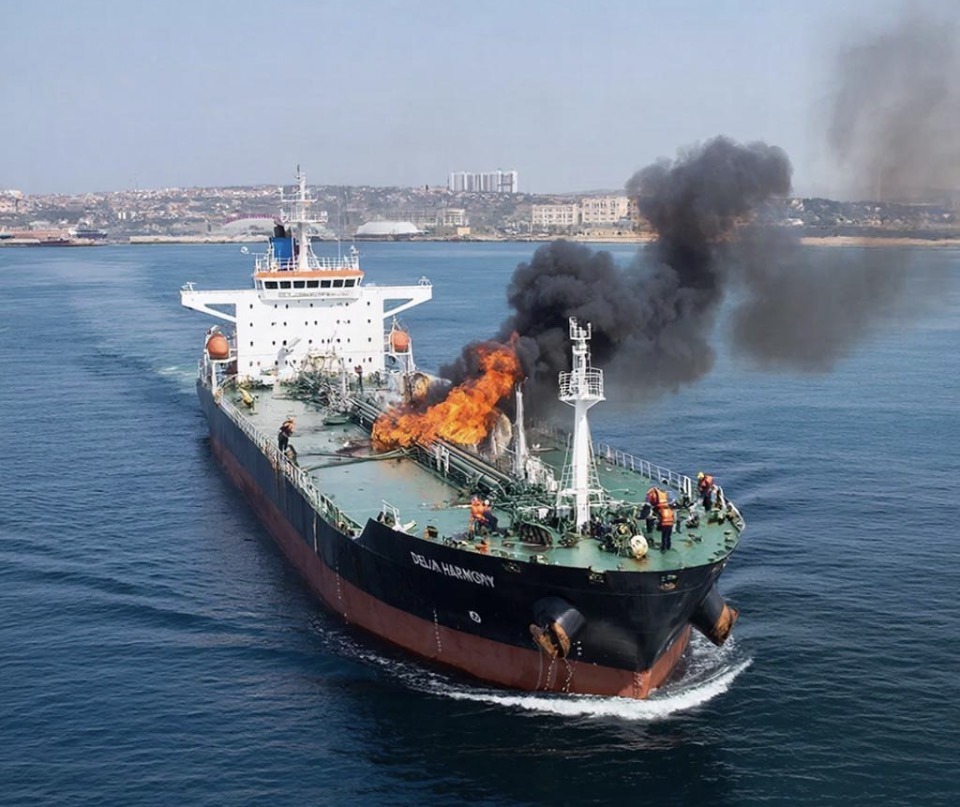
Behind this caveat lies a difficult year for Greek shipowners. In January, drones hit the tankers Matilda and Delta Harmony, both waiting to load Kazakh oil at the Caspian Pipeline Consortium (CPC) terminal near Novorossiysk. In March, the Greek-flagged tanker Maran Homer, chartered by Chevron, was damaged off Novorossiysk. In July, strikes hit the tankers Asia and Nissos Ios while they were loading at the terminal. A US official claimed that in early August Ukraine had agreed to stop striking a number of non-Russian tankers and the infrastructure used to export Kazakh oil. Nevertheless, in August the tanker Skiros came under attack just after taking on cargo at the CPC terminal.
Papadopoulou described any attacks on merchant vessels as absolutely unacceptable and deserving of condemnation, whoever carries them out. From a legal standpoint, this is hard to dispute: the lives of seafarers and freedom of navigation are protected by international law. But the situation has an essential context. The CPC terminal is located on Russian territory, and Russia, as the consortium’s largest shareholder, earns money on every tonne shipped, which allows the Kremlin to finance its war of aggression against Ukraine and its hybrid war against Europe. Today Novorossiysk has become one of the main bases of the Black Sea Fleet, whose ships launch missiles at Ukrainian cities, killing Ukrainian civilians every day.
When it comes to tankers at a Russian port, Greek diplomats work persistently and fast. When it comes to the skies over Ukraine, which Russia bombards with missiles and drones every night, Athens is more than restrained.
On 16 October, at the EU summit in Brussels, Prime Minister Kyriakos Mitsotakis was asked whether Greece would hand Ukraine missiles for Patriot systems. He replied that Greece would do everything it could for Kyiv, but not at the expense of its own defence capability. According to Kathimerini, Ukraine asked for up to 200 PAC-2 missiles from the stocks of the Greek Air Force. A significant share of them have been on combat duty for about 23 years, and their service life is coming to an end. As Bloomberg reported, NATO and EU allies began urging Greece and Spain to share interceptors as early as this summer. Mitsotakis’s answer amounts to a refusal.
Greece previously gave Ukraine Sea Sparrow and Crotale missiles, which were also nearing their expiry dates. Athens has the right to set its own defence priorities, and no one disputes that. The question is a different one: how far does assistance on this scale meet the needs of an army that for almost five years has, with unparalleled heroism, been holding back the aggressor and in effect defending all of Europe from it? Ukraine needs effective means of protecting its cities, power plants, ports and people. Diplomatic assurances and words of support, unfortunately, cannot replace them.
The Russian factor plays a huge role in this situation. In a previous publication, CDN wrote about ROSOBORONSERVICE HELLAS A.E., based in the Athens suburb of Psychiko. It is a subsidiary of Rosoboronexport, and it continues to operate in Greece even though its parent company and that company’s owner, the state corporation Rostec, are under EU and US sanctions. And the Greek authorities do not react. After five years of war, this is hard to believe.
Taken together, these facts form a very unattractive picture. Athens stands up immediately for the financial interests of its shipowners, who earn money servicing a Russian terminal, going as far as a note to Kyiv. A Rosoboronexport subsidiary near Athens has been quietly operating for years. And any request for help for Ukraine becomes surrounded by caveats.
Russia has been striking Ukrainian ports, grain terminals and civilian vessels since the very start of its aggression in February 2022. Yet in all that time there has not been a single Greek note to Moscow of comparable sharpness. International law should not depend on a ship’s flag or on whose commercial interests are hurt. When it comes to Russia, however, the Greek authorities forget this rule time and again.
There are serious questions for Brussels too. Is it compatible with EU policy for a member state to make claims against Ukraine for defending itself against aggression, while at the same time refusing to give it missiles that will soon be decommissioned and scrapped anyway? Who is checking the presence of Russian defence entities on Greek territory? And does European solidarity remain a principle if it is applied only when it does not get in the way of trade?
Demanding security for one’s own business from Ukraine while leaving it alone against Russian missiles is immoral and irresponsible, not only towards Ukraine but also towards the collective security of the European Union. This is not solidarity. While Ukrainians pay for Europe’s security with their lives, Brussels has no right to turn a blind eye to «business as usual» with Russia under the banner of national interests.
Read also on CDN:
A Rosoboronexport subsidiary keeps operating in Greece thanks to the inaction of the Greek authorities