
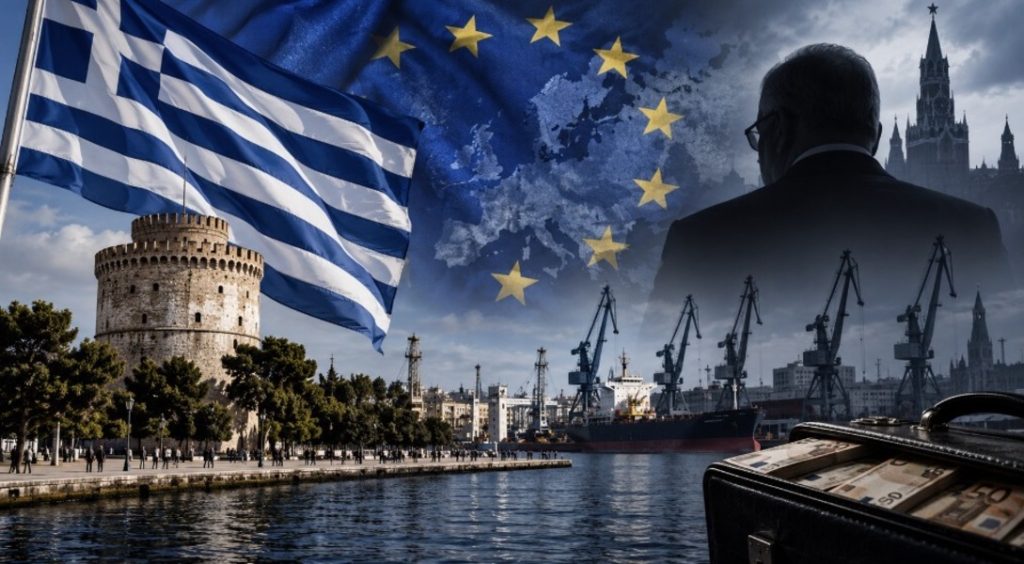
The speech delivered by Minister of Shipping and Island Policy Vassilis Kikilias at an economic conference in Thessaloniki deserves considerably more attention than simply another government official’s remarks on port development and Greece’s economic challenges.
At first sight, Kikilias was discussing entirely legitimate issues: the competitiveness of Greek shipping, the cost of the green transition, investment in port infrastructure, and the need to prevent new costs from being passed on to Greek households. Yet two considerably more politically sensitive themes emerged from his remarks.
The first concerns Greece’s relationship with its European partners. The second concerns the role of Ivan Savvidis and Russian capital in the economic development of Northern Greece.
It is precisely the combination of these two issues that creates a problem for the government of Kyriakos Mitsotakis.
Who Are the “Northern Partners” Really?
Whenever Greek political rhetoric contrasts the “North” with Greece, the first question should be: which North?
If the reference is to the northern European member states of the European Union, portraying them as an external force simply putting pressure on Greece may be politically convenient, but it is economically incomplete.
Greece is a member of the European Union and, at the same time, one of the major beneficiaries of European funding. The European Commission explicitly identifies EU funding, particularly through the Recovery and Resilience Facility, as an important source of support for Greek economic activity. Greece’s recovery plan provides for €18.2 billion in grants and €17.7 billion in loans.
For 2021–2027, Greece has been allocated €20.5 billion under cohesion policy, alongside national co-financing, while the Common Agricultural Policy provides another €13.5 billion in European funding for 2023–2027.
European funding remains one of the major sources of public investment in Greece.
The question, therefore, should be framed differently.
Not: “Why is Northern Europe putting pressure on Greece?”
But rather: “Why should a country that makes extensive use of common European financial resources portray compliance with common rules as external pressure?”
That distinction matters.
The European Union is not a bank divided between “northern donors” and “southern recipients.” It is a political and economic union with a common budget, common rules and reciprocal obligations.
At the same time, the financial reality cannot simply be ignored. Some member states contribute more to the common budget than they receive directly in return. When a politician from a major recipient country creates the impression that demands for efficiency, reforms or fiscal discipline represent hostility from the “northern partners,” he risks turning a normal internal European debate into a confrontation between “us” and “them.”
For the Mitsotakis government, that rhetoric is particularly dangerous.
Kikilias Said More Than He May Have Intended
Even more revealing was the part of the speech devoted to Ivan Savvidis.
Kikilias effectively placed Savvidis’s business empire within the broader story of Northern Greece’s economic recovery. He argued that Greek governments, following years of severe fiscal austerity, had sought investors capable of supporting the economy, particularly Northern Greece, which had faced serious economic difficulties.
And then the minister identified Ivan Savvidis as one of those investors.
He went further, highlighting investments by Savvidis’s companies in Makedonia Palace, other assets in Northern Greece and the Port of Thessaloniki, describing these investments as a “comparative advantage” for Thessaloniki, Central Macedonia and Northern Greece as a whole.
This is no longer a neutral reference to a private investor.
It is a political assessment of the historical role of Russian-linked business in the economic development of a strategically important region of Greece.
And this is where the uncomfortable question arises: does the minister understand the political framework his own words are creating?
From Investment to Political Legitimation
There is nothing inherently wrong with a state attracting foreign investment.
The problem begins when strategic state assets — particularly ports and other critical infrastructure — become part of the concentration of economic influence in the hands of an investor whose political and geopolitical background has an obvious Russian dimension.
Ivan Savvidis is one of the most prominent investors of Russian origin in Greece. His business group controlled, among other assets, a 71.8 percent stake in the Thessaloniki Port Authority, as well as Makedonia Palace, Porto Carras, Souroti and other assets.
This does not mean that every investment by Savvidis is automatically a Russian political operation.
But the opposite argument — that the origin of capital and the geopolitical context are entirely irrelevant — would be equally mistaken.
Especially when a port is involved.
That is precisely why questions have arisen in the past regarding the expansion of Savvidis’s influence over Greek port infrastructure. His links to the Kremlin and the potential risks associated with concentrating port assets in the hands of a businessman with such a background have also been discussed publicly.
The Irony of the Situation
This is where the central irony of Kikilias’s statement lies.
The Greek government simultaneously speaks about European strategic autonomy, the protection of critical infrastructure, geopolitical risks and the need to reduce dependencies — while one of its ministers publicly presents the business empire of a Russian-born entrepreneur as one of the factors contributing to the economic strengthening of a strategically important region.
This does not necessarily imply any legal violation.
But it creates a serious problem of political signalling.
Particularly ahead of an election.
Why This Could Work Against Mitsotakis
The Mitsotakis government has spent recent years positioning Greece as a predictable and reliable European ally that clearly defined its position following Russia’s invasion of Ukraine.
That is precisely why bringing the Russian question back into Greek politics through the narrative of Northern Greece’s “economic success” is politically risky.
Northern Greece has its own political dynamics. Regional identity remains strong; economic dissatisfaction with Athens is significant; distinctive media and business networks operate there; and attitudes towards Russia remain particularly sensitive.
When a senior government official says that an entrepreneur of Russian origin helped make the region economically stronger, he inadvertently provides pro-Russian political forces with a ready-made argument:
“Even the government itself acknowledges that Russian money and Russian business were beneficial to Greece.”
That is an entirely different political proposition.
And it may ultimately be used not by Mitsotakis, but by his opponents.
The Most Dangerous Issue Is Not Savvidis Himself
The greatest problem for the government is not even Ivan Savvidis.
The problem is the creation of a political narrative.
If the state spends years telling society that Russian influence constitutes a potential risk, and then one of its key ministers publicly explains that a Russian investor was among those who “supported” the economy of Northern Greece, an obvious contradiction emerges.
That contradiction will inevitably be exploited by political forces advocating a reassessment of Greece’s policy towards Russia.
This is where Kikilias’s words may prove considerably more consequential than he intended.
He did not merely defend Savvidis’s investments.
He effectively offered a positive political interpretation of the role of Russian capital in the modern economic history of Northern Greece.
And that opens the door to a question that the Mitsotakis government would arguably prefer to keep firmly closed: where exactly is the line between Greece’s economic openness and the geopolitical influence of foreign capital?
“The Russians Keep Every Move on Record”
Greek politics has repeatedly demonstrated how dangerous it can be to combine economic pragmatism with geopolitical naivety.
Investment itself has no nationality.
But capital has an origin, owners have networks, assets have strategic significance, and political systems remember past arrangements.
That is why defending a policy pursued in the past today may become political evidence for an entirely different political force tomorrow.
Russia does not necessarily have to intervene directly in Greek politics in order to benefit from such a development. It is enough for Greek political actors themselves to bring Russian capital back into a positive domestic political narrative.
In this sense, the phrase “the Russians keep every move on record” is not merely a political metaphor.
It is a warning.
Assets acquired during a favourable economic climate remain strategic assets after the geopolitical environment changes.
And political arguments that appear harmless today may become weapons against those who created them tomorrow.
Conclusion
Kikilias has every right to defend Greek shipping against excessive regulatory burdens. He has every right to demand that Brussels take the specific characteristics of the Greek economy into account. And he has every right to advocate the development of Northern Greece.
But a statesman of his standing should be considerably more cautious with political formulations.
Especially when the subject simultaneously involves the European Union, European funding for Greece, strategic ports and a businessman with a substantial Russian investment background.
The problem is not that Greece attracted Russian capital.
The problem is that today, after the geopolitical environment has fundamentally changed, a government representative is presenting this history not as a complicated chapter of the past requiring critical examination, but as a success story and an economic advantage for Northern Greece.
For Mitsotakis, this is an unnecessary political front.
And the most troubling part is that it was not opened by an opposition politician, a pro-Russian party or the Kremlin.
It was opened by a member of the government itself.