
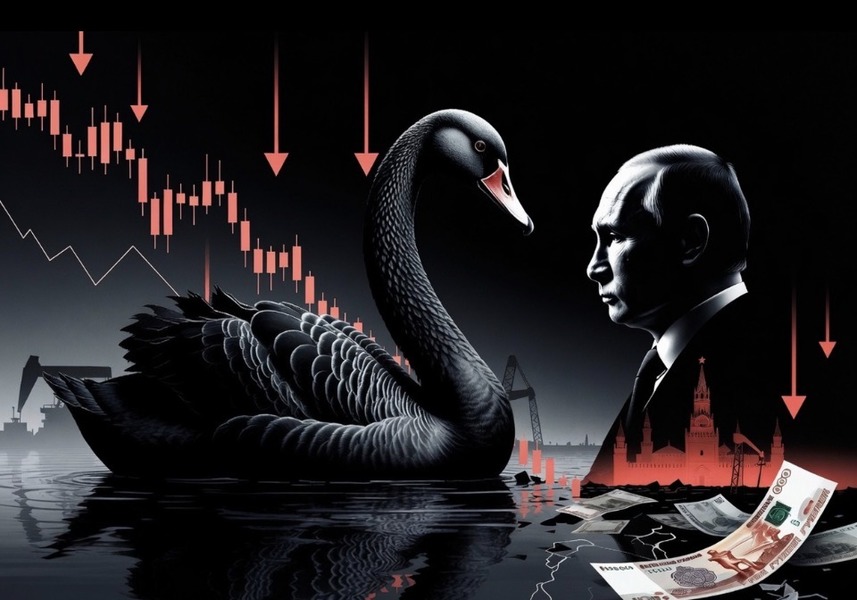
International sanctions and burdensome military expenditures are undermining Russia’s stability. Its economic capabilities are steadily shrinking amid painful Ukrainian strikes on key Russian logistics and military infrastructure facilities. This is heightening pessimism among “ordinary people for whom decisions are made in the Kremlin,” apolitical representatives of small and medium-sized businesses, and agitators of the “three-day victory over Ukraine.”
At the same time, the Russian government is consistently closing public access to key economic and financial indicators and other important parameters of Russia’s condition. Price increases for goods and services are described laconically as “have changed.” There is nothing to be proud of, and manipulating the numbers has become more difficult. Therefore, the choice is simple: close off the indicators and juggle words.
Undoubtedly, Russia has a certain margin of safety. However, one must take into account the Russian tradition of an annual August “black swan.” Its harbingers could be the progressive localization of the functioning of the Wildberries ecosystem and similar services, key components of the oil, gas, and energy sectors, and so on.
In the first half of 2026, Russia’s federal budget deficit increased to 5.73 trillion rubles (64.52 billion euros), which already constitutes 151.4% of the annual target. The current budget law provided for a deficit of 3.78 trillion rubles (42.563 billion euros), but as of July it has been exceeded by 1.94 trillion rubles (21.844 billion euros).
The main reason is the massive financing of military needs.
The Russian defense-industrial complex operates in a mode of emergency advance funding and use of budget resources, which is bleeding the economy dry
In January–June 2026, the state program “Ensuring the Country’s Defense Capability” absorbed 2.80 trillion rubles (31.528 billion euros) out of the planned 4.05 trillion rubles (45.603 billion euros) for the year. Program expenditures reached 69.1% of the annual target, amounting to 11.5% of all state expenditures or nearly half (48.8%) of the half-year budget deficit.
Under the program “Development of the Defense-Industrial Complex,” 213.2 billion rubles (2.4 billion euros) were spent in the first half of the year, or 88.7% of the annual volume.
Russia’s model of a “resource superpower” is losing effectiveness under the influence of international restrictions that reduce the share of energy carriers in state revenues. In the first half of 2026, oil and gas revenues decreased to 3.66 trillion rubles (41.212 billion euros). Compared to 4.73 trillion rubles (53.260 billion euros) in the previous year, they fell by 22.7%.
The largest decline in the raw materials sector occurred in oil revenues. Revenues from the oil component decreased by 27.9% to 2.62 trillion rubles (29 billion euros). In the terminology of Russian officials, they “have changed” by minus 1.02 trillion rubles (11.485 billion euros).
Russia’s gas industry is also in stagnation, and the reorientation of export flows has not compensated for the losses. Revenues from natural gas exports for January–June 2026 decreased to 756.5 billion rubles (8.518 billion euros). The situation is aggravated by the rapid decline in revenues from gas condensate sales, which also fell by 15.4% compared to last year and amounted to only 279.5 billion rubles (3.147 billion euros).
As a result, the share of oil and gas sales in budget revenues decreased from 26.9% to 19.7%, and their share in GDP fell from 4.9% to 3.7%.
A comparison of Russia’s budgets for the first halves of 2025 and 2026 indicates a shift in financial flows. Treasury revenues increased by only 5.8% (+1.03 trillion rubles / 11.598 billion euros), while expenditures rose by 16.1% (+3.37 trillion rubles / 37 billion euros). At the same time, budget revenues amounted to only 46.2% of the annual target, while expenditures reached 54.1%.
The improvement in financial indicators in early summer 2026 proved short-lived and does not change the overall negative trend in the Russian economy
The increase in Russia’s “non-oil and gas” revenues to 14.96 trillion rubles (168.45 billion euros), up 16.3%, is not a sign of a healthy economy. The growth was driven by higher tax rates, general price increases (inflation), and one-time receipts. The Russian government simply intensified tax pressure on businesses, and the share of revenues formally rose to 80.3% of the budget.
In June 2026, a surplus of 195.7 billion rubles (2.204 billion euros) was recorded — revenues of 3.83 trillion rubles (43.1 billion euros) exceeded expenditures of 3.64 trillion rubles (40.986 billion euros). This positive figure slightly reduced the 5.73 trillion ruble (64.52 billion euro) deficit accumulated in previous months.
The strengthening of the ruble has become a problem for Russia
The positive effect of higher commodity prices has been offset by exchange rate differences. The average US dollar exchange rate fell by 14.1% from 89.2 rubles per dollar (in January–June 2025) to 76.6 rubles (in January–June 2026). As a result, even a 6.9% increase in the average oil price from $59.8 to $63.9 per barrel does not save the Russian budget from losses in ruble revenues.
International isolation in the financial and banking sector forces Russia to cover the deficit exclusively from internal resources. At the same time, a negative balance for Russia of 253.2 billion rubles (2.851 billion euros) has formed on external borrowing sources.
To cover financial gaps, Russian authorities are forced to spend assets whose volumes are steadily decreasing
Russian financial reserves for maintaining stability continue to deplete due to the need to cover current budget “holes.” To finance the deficit over six months, 2.45 trillion rubles (27.587 billion euros) were spent from the reduction of balances on federal budget accounts. As of July 1, 2026, the assets of the National Wealth Fund in ruble equivalent amounted to 13.10 trillion rubles (147.5 billion euros) and have decreased by 311 billion rubles (3.5 billion euros) since the beginning of the year.
Russia’s tax system has lost diversification and become dependent on domestic consumption. This makes it vulnerable to the continued decline in household incomes. The largest source of budget revenues has become value-added tax. Its collection amounted to 8.58 trillion rubles (96.6 billion euros) or 46% of all revenues. For comparison, corporate profit tax amounted to 11% or 2.07 trillion rubles (23.3 billion euros), which, among other things, indicates weakness in the corporate sector.
In planning the 2026 budget, even the Russian government’s internal calculations turned out to be overly optimistic and detached from reality. Additional revenues received in the second quarter only partially eased the situation but did not compensate for the negative “changes” at the beginning of the year.
The results of the first half of 2026 indicate that economic and financial problems have become chronic. In the second half of the year, maintaining the current situation will inevitably force the Russian government to take extraordinary and unpopular measures.
This will provoke new economic and social risks, lead to a cascading deterioration of the situation, and cause a further reduction in the capabilities of the Russian economy.
Viktor Lebedev-Cherny