
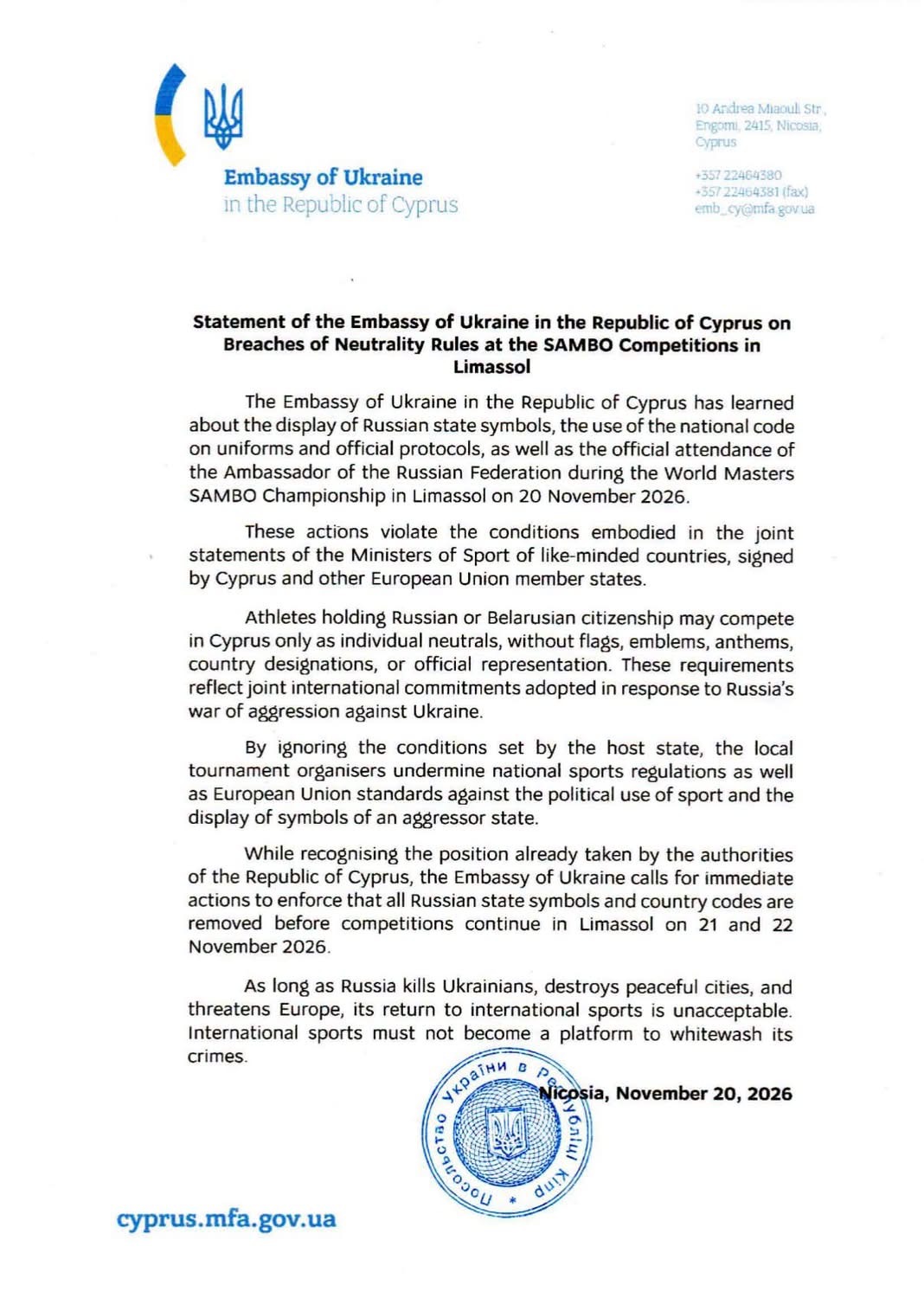
The Embassy of Ukraine in the Republic of Cyprus has accused the organisers of the World Masters SAMBO Championship in Limassol of breaching the neutrality rules that apply to Russian athletes in Cyprus. In a statement published on 20 November 2026 and shared by the Ministry of Foreign Affairs of Ukraine, the Embassy said that Russian state symbols were displayed at the tournament, the Russian country code appeared on uniforms and in official protocols, and the Russian Ambassador attended the event in an official capacity.
What the Embassy says
According to the statement, these actions violate the conditions set out in the joint statements of the sports ministers of like-minded countries, which Cyprus signed together with other European Union member states. Under those commitments, athletes with Russian or Belarusian citizenship may compete in Cyprus only as individual neutrals, without flags, emblems, anthems, country designations or any official representation. The Embassy notes that these requirements were adopted jointly in response to Russia’s war of aggression against Ukraine.
By ignoring the conditions set by the host state, the Embassy argues, the local organisers have undermined both national sports regulations and European Union standards against the political use of sport and the display of the symbols of an aggressor state. Acknowledging the position already taken by the Cypriot authorities, the Embassy called for immediate action to ensure that all Russian state symbols and country codes are removed before the competition resumes in Limassol on 21 and 22 November.
The statement ends with a clear message: as long as Russia kills Ukrainians, destroys peaceful cities and threatens Europe, its return to international sport is unacceptable, and international sport must not become a platform to whitewash its crimes.
A championship that should never have looked like this
The controversy did not come out of nowhere. As CDN reported earlier this month, the International SAMBO Federation (FIAS) had asked the Cyprus Sport Organisation to confirm that Russian and Belarusian athletes could compete in Limassol under their national flags and anthems, citing a world championship held in Thessaloniki in October where this had been allowed. The Cypriot authorities refused, pointing to Foreign Ministry rules that do not permit Russian state symbols at such events. The head of the Cyprus SAMBO Federation, Marios Andreou, even warned at the time that the tournament might have to move to another country if the Russians could not appear with their flags.
FIAS is far from a neutral body. Its president, Vasily Shestakov, is a United Russia deputy in the State Duma and a long-time friend of Vladimir Putin, and SAMBO in Russia remains closely tied to the security services. This is not the first time a SAMBO event in Cyprus has drawn protests either: in October 2024, a youth world championship in Larnaca featured a Russian team and promotional materials listing sanctioned Rosneft and VTB among its partners, prompting objections from the Ukrainian Embassy.
Flags and anthems written into the rules
The official Regulations of the World SAMBO Championships among Masters 2026, which name the Cyprus Sambo Federation and FIAS as organisers, show that the breach was built into the tournament from the very start. Every delegation was required to bring two national flags measuring 2 by 1 metres and a recording of its national anthem lasting no more than 30 seconds. Each athlete must wear a back number with his surname and the abbreviation of his country, and athletes without one are not allowed to compete. At the award ceremonies, the national flag is raised and the national anthem is played.
The Regulations say nothing at all about neutral status for Russian or Belarusian athletes, or about the conditions set by the Republic of Cyprus. In other words, the organisers prepared a championship with national symbols for every team, the Russian team included, in a country whose authorities had explicitly ruled this out. FIAS has published the Day 1 results of the championship on its website.
Rules that must mean something
Cyprus did the right thing by refusing to allow Russian flags and anthems in Limassol. But a rule that organisers can quietly bypass is no rule at all. If Russian symbols and the presence of the Russian Ambassador turn a supposedly neutral tournament into a showcase for the Kremlin, the authorities must act, and act before the next round of bouts. For Moscow, every flag raised at a European venue is propaganda proof that its isolation is crumbling. For a country that has lived with foreign occupation of part of its own territory for more than half a century, there should be no hesitation in saying that the symbols of an aggressor state have no place on Cypriot soil.