
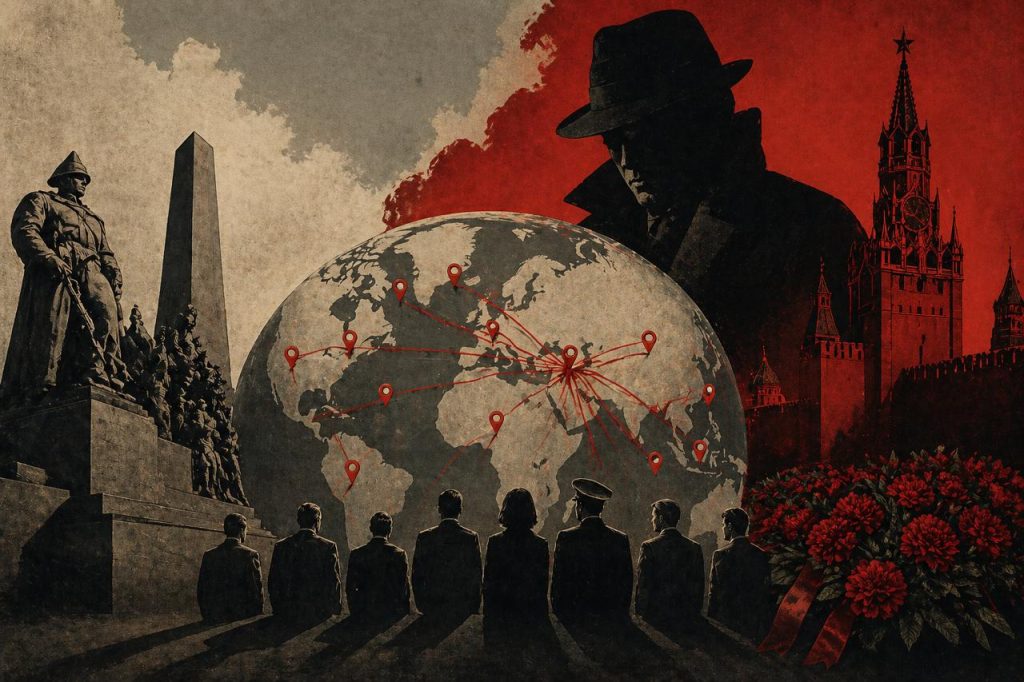
Moscow’s arsenal includes numerous tools for exerting influence abroad. Some are well known—embassies, “Russian Houses,” RT, organizations of Russian expatriates abroad, and funding for fringe political parties. Others operate in the shadows, cloaked in rhetoric about memory and history. The portal “mestopamyati.rf” falls into this category—a project that positions itself as a civic initiative but is, in reality, part of Russia’s global infrastructure of influence.
What is the Russian Military-Historical Society (RMHS) and why was it created?
The “mestopamyati.rf” portal was created and is managed by the Russian Military-Historical Society (RMHS) with the participation of the Russian Ministry of Foreign Affairs. The Society was established by Decree No. 1710 of Russian President Vladimir Putin on December 29, 2012. According to the decree, the “Russian Military-Historical Society” was granted the status of a voluntary, self-governing public-state association.
The official wording of its objectives reads as follows: “consolidating the forces of the state and society in the study of Russia’s military-historical past, countering attempts to distort Russian military history, popularizing the achievements of military-historical science, raising the prestige of military service, and fostering patriotism.”
Translated from Kremlinese into human language, this means that the organization was created for propaganda, the falsification of history, and the indoctrination of brainwashed slaves ready to wage endless war against the entire world in the interests of the Kremlin.
The founders of the RMHS were the Ministry of Culture and the Ministry of Defense of the Russian Federation. This in itself is a comprehensive answer to the question of whether the organization is “public.” In Russia, all genuine public activity has long been destroyed and replaced by an imitation supervised by the FSB and funded from the state budget. The word “public” in the name should not mislead anyone.
At the founding congress on March 14, 2013, Vladimir Medinsky—former Russian Minister of Culture, currently Putin’s aide, and one of the most notorious falsifiers of history in official Russian circles—was elected chairman of the RMHS. Colonel General of the FSB Sergei Ivanov—the Russian President’s Special Representative for Environmental Protection and Transport—was appointed chairman of the Board of Trustees.
Who is behind the “public” organization
The membership of the RMHS’s Board of Trustees, Central Council, and Scientific Council totals about one hundred people. More than two dozen of them have direct ties to the security services and the Ministry of Defense. Let us list only the most notable ones.
Sergei Chemezov—served in the KGB alongside Putin, one of the most well-known former security service officers in the Russian elite. Nikolai Tokarev—worked in the KGB, currently associated with the FSB. Leonid Slutsky—chairman of the State Duma Committee on International Affairs, closely linked to the FSB and military intelligence (the GRU). General Andrei Kartapolov—chairman of the Duma Committee on Defense, former Deputy Minister of Defense and head of the Main Military-Political Directorate of the Armed Forces. Viktor Zolotov is the Commander-in-Chief of the Russian National Guard. Sergei Stepashin is a former director of the FSB. Pyotr Fradkov is the son of a former director of the Foreign Intelligence Service and worked in foreign intelligence himself. Grigory Rapota — a former KGB officer who worked in foreign intelligence and later served as deputy director of the Foreign Intelligence Service (SVR).
In addition to them, the organization’s councils include dozens of army generals, intelligence officers, government officials, State Duma deputies, Putin’s relatives, and heads of state media and state-owned enterprises. Not a single random person. Not a single person who could be suspected of representing civil society. Without exception, all are inextricably linked to Russia’s government agencies and security services.
This is not a public organization. It is a state structure disguised as a public one.
A Map of Memory as a Map of Influence
The portal’s official website states: “The main goal of the project is to preserve historical heritage sites: mass graves, monuments, pedestals, memorials, and commemorative plaques not only in Russia but also abroad.”
The key words here are “abroad.”
The website features statistics on recorded sites. A telling detail: there are more so-called “sites of Russian military history” outside Russia than within the country.
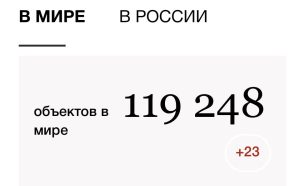
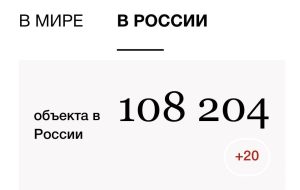
This is neither a coincidence nor the result of historical research. It is the result of the deliberate creation of such sites around the world by Russian embassies, “Russian Houses,” organizations of compatriots, and other affiliated entities.
The portal methodically plots memorials, burial sites, commemorative plaques, busts, and murals on a global map—including those that were artificially created by Russian entities and have no connection to authentic “sites of military history.” This creates a symbolic map of “Russian military presence” around the world—and, at the same time, a ready-made infrastructure for influence operations and espionage.
Every site on this map is a potential venue for pro-Russian propaganda campaigns organized by embassies and “Russian Houses.” Each such site serves as a foothold for spreading Kremlin narratives, disinformation, and recruiting new agents.
The Mechanism: From Memorial to Influence Operation
The logic behind this infrastructure is simple and has been refined to the point of automation.
Russian official bodies create or take under their wing a “memorial site” in a given country—installing a bust or a commemorative plaque, restoring a burial site, or unveiling a mural. Local media cover the event as a cultural or humanitarian initiative. The Russian embassy gains a legitimate pretext for regular events, conferences, and meetings. Contacts are established with local authorities and civic, academic, cultural, and religious organizations.
It is precisely these contacts that are most valuable to Russian intelligence agencies: they significantly facilitate the recruitment of agents from the local political and civic spheres. Coverage of these events in local media legitimizes the presence of Russian entities and opens up additional channels for them to spread propaganda and disinformation.
The glorification of the Soviet and Russian military past, according to Moscow’s plan, is intended to directly legitimize Russia’s current aggressive policies. The logic is simple and cynical: a glorious past justifies a criminal present. Narratives of the “Great Victory,” “Russia’s liberating mission,” and “the fight against Nazism” are directly linked to today’s war against Ukraine and disseminated through a network of “memorial sites” around the world.
Cyprus on the Map of Russian Influence
The “mestopamyati.rf” portal allows users to track the number of “memorial sites” in every country in the world. There are six such sites in Cyprus:
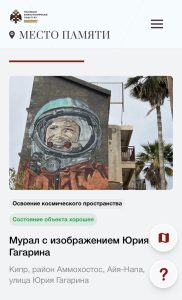
a mural in Ayia Napa depicting Yuri Gagarin;
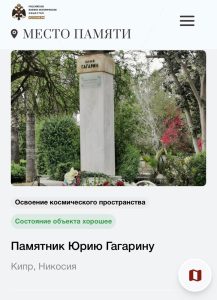
a monument to Yuri Gagarin in Nicosia;
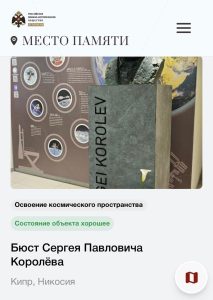
a bust of Sergei Korolev at the University of Nicosia;
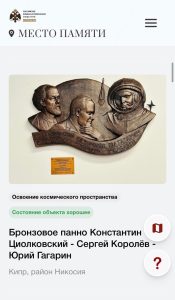
a bronze panel titled “Tsiolkovsky—Korolev—Gagarin” in Nicosia;
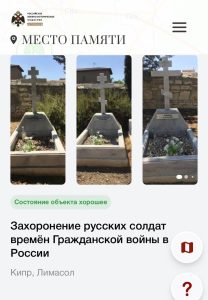
the burial site of Russian soldiers from the Russian Civil War at the British cemetery in Limassol;
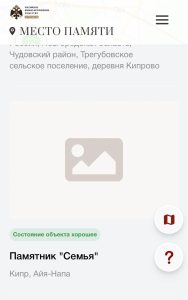
the “Family” monument in Ayia Napa, erected by Vyacheslav Zarenkov, an agent of influence for Russian intelligence services.
At first glance, nothing special. In reality, this is a ready-made network of footholds for influence operations on the territory of an EU member state.
The Russian Embassy and the Russian Center for Science and Culture actively exploit all six sites as platforms for propaganda campaigns. The monument to Yuri Gagarin and the burial site of Russian soldiers at the British cemetery in Limassol are used most intensively—two sites with maximum emotional and symbolic potential.
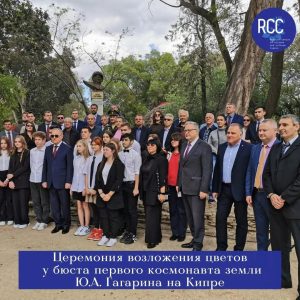
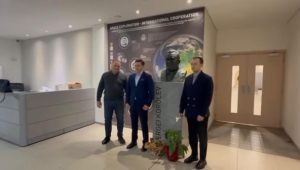
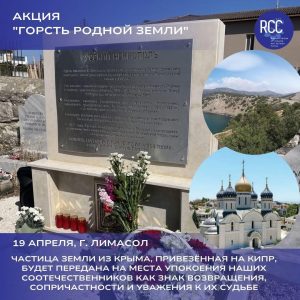
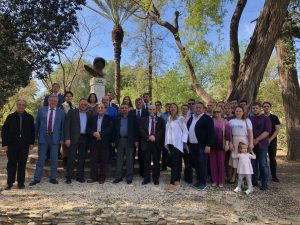
The event plan is worked out in detail. In addition to representatives of the diaspora, representatives of the Cypriot authorities, the academic community, public figures, the clergy, and cultural figures are specifically invited to each event. Local media are present; their task is to ensure the dissemination of Kremlin narratives through Cypriot media channels.
Thus, a wreath laid at a monument to a Soviet cosmonaut or on the grave of a Civil War soldier becomes a political event aimed at spreading Russian state propaganda and influence. Gagarin here is not about space. The burial of Russian soldiers from the Civil War is not about history. It is about presence, contacts, and the long-term work of Russian intelligence on Cypriot territory.
Wreaths at military cemeteries
When the Russian embassy or organizations of compatriots lay wreaths at a military cemetery in Prague, Budapest, Berlin, or Nicosia—it is not the mourning of diplomats and emigrants. It is the marking of territory by Russian intelligence services. Methodical, planned, and coordinated from Moscow as the first step in a long-term influence operation.
Wreath-laying is followed by regular events. Events are followed by contacts with local politicians and public figures. Contacts are followed by recruitment. Recruitment is followed by infiltration into local political processes. The entire chain begins with a memorial plaque or a bouquet of flowers at a monument.
The portal “mestopamyati.rf” is not an archive of historical memory. It is an operational map. And it is far from just historians who work with it.