
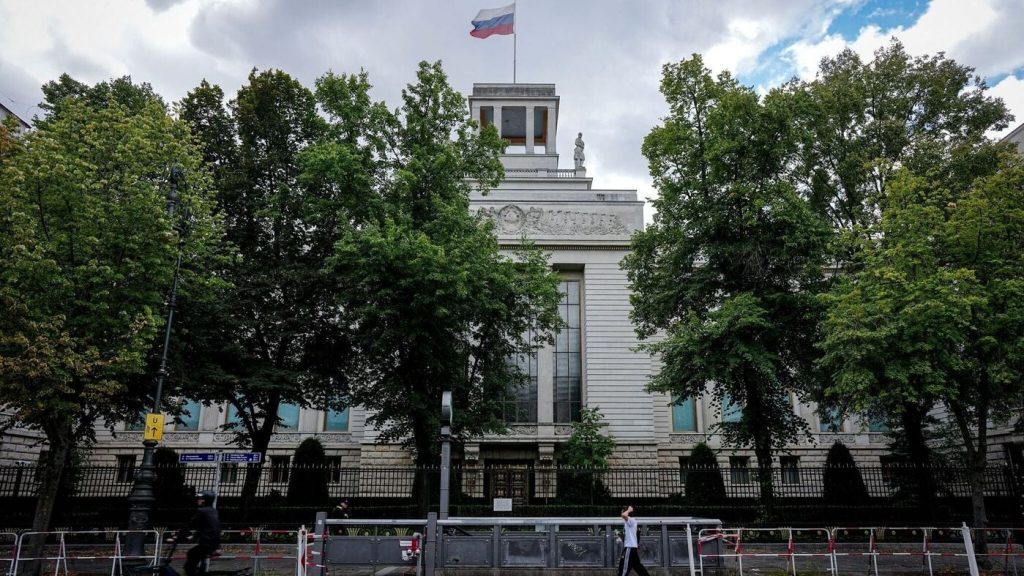
On 26 November, the Berlin Higher Regional Court opened the trial of Ilona V., a 57-year-old German-Ukrainian businesswoman whom Germany’s Federal Prosecutor’s Office accuses of working as an agent for Russian intelligence. According to the indictment, since at least the autumn of 2023 she collected information on military aid to Ukraine, the defence industry and drone testing grounds, and along the way opened the doors of high-level political events in the German capital to her handler from the Russian embassy.
A Handler With a Diplomatic Passport
According to investigators, the handler was a member of the Russian embassy staff in Berlin, accredited as a diplomat. The dpa news agency and Der Spiegel established that he was the deputy military attaché, while AFP describes him outright as a GRU officer. It is a textbook arrangement: a career intelligence officer under diplomatic cover who needs a well-connected local agent. After the defendant was arrested at the end of January, the German Foreign Office summoned the Russian ambassador and declared the «diplomat» persona non grata. Foreign Minister Johann Wadephul called the affair a hostile act. Moscow responded by expelling a German diplomat.
The scheme set out in the indictment is simple, which is exactly why it worked. Ilona V. had lived in Germany for several decades, ran a small marketing agency and chaired a lobbying association that promoted international cooperation, above all between Germany, Russia and Ukraine. As Tagesspiegel reports, citing sources in the security services, political Berlin had long known her as an active pro-Russian presence at all kinds of meetings and receptions.
Prosecutors believe it was precisely these connections that were placed at the service of Russian intelligence. The defendant allegedly told the officer about important events, helped him get into them and introduced him to people from whom he hoped to build his own agent network. According to the indictment, she also tried to recruit current and former employees of the German Defence Ministry, as well as people from the defence industry. Investigators believe she acted out of conviction.
The court has not yet established the defendant’s guilt. She has been in custody since her arrest. According to AFP, the trial is expected to last until May 2027.
«We Don’t Associate With People Like That»
On the eve of the trial, Russia’s ambassador to Germany, Sergei Nechaev, told AFP that the embassy had nothing to do with the defendant and that a chance encounter with an embassy employee at a reception meant absolutely nothing. According to the ambassador, the woman holds German and Ukrainian citizenship and has no ties to Russia. He added: «We don’t associate with people like that here.» A curious claim, considering that Berlin expelled a member of the embassy’s military staff over this very case.
A Familiar Signature
The Berlin case neatly illustrates what CDN and CIR have been writing about for years. Russian embassies in Europe serve as bases for intelligence officers under official cover. The GRU, SVR and FSB stations look for local intermediaries with access to officials, the military and business, while associations «for dialogue», cultural projects and receptions for «compatriots» provide a convenient setting for recruitment. In Cyprus, the same role is played by the Russian House in Nicosia, a hub for Russian intelligence agents. Moscow has long used the island as a foothold inside the EU, so the methods German counterintelligence is now taking apart in court are well known here. The mechanism is described in detail in the book by Dmitri Khmelnitsky and Boris Demash, «Russian Agents of Influence in Cyprus».
In half a century, the methods of the Russian special services have hardly changed. Only the names of the lobbying associations do.
Read also on CDN:
Portrait of a Russian Diplomat
Special-Purpose Embassies: Why Russia Needs Two Thousand Diplomats in the European Union
The Russian House in Nicosia: a Russian intelligence agent hub, family firms and Kremlin propaganda