
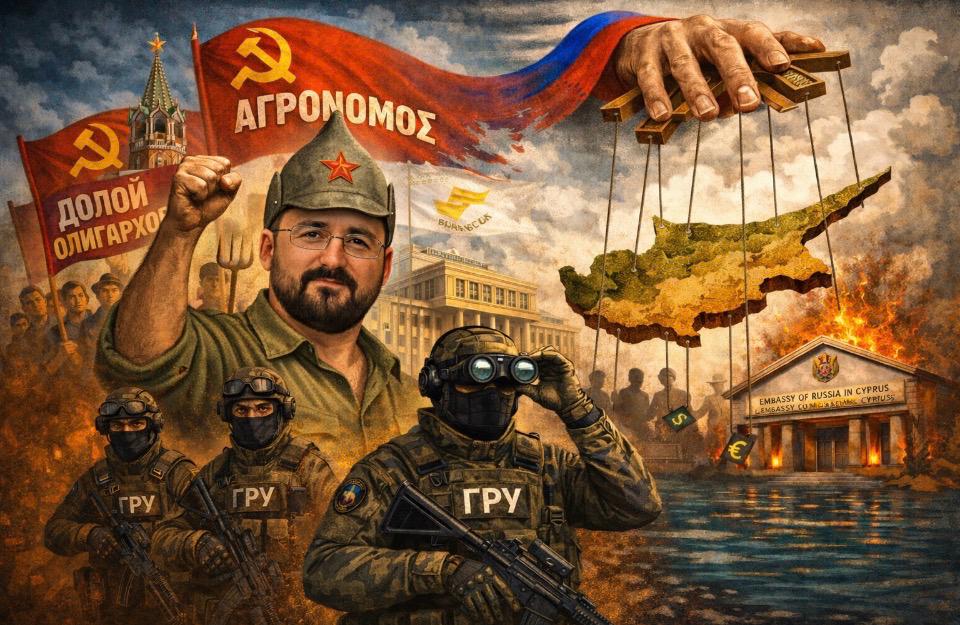
In recent years, no major election campaign in Cyprus has taken place without Russia attempting to directly interfere in local political life. Instead of the usual behind-the-scenes maneuvering through intermediaries or “back offices,” Russian handlers are increasingly seeking to create their own instruments of influence. These are formal political structures capable of legally participating in elections, receiving state funding, and institutionalizing a pro-Russian agenda. Outwardly, they look like local protest movements, but in reality, they serve as tools for political influence, for infiltrating Moscow’s agents into the political establishment, for spreading Kremlin propaganda, and for destabilizing the socio-political situation in the country.
The current election cycle on the island is no exception. Moreover, Russian organizers have gone further than usual: they are simultaneously backing several initiatives of various stripes.
One would think that the bitter experience of previous failures should have taught them something. But no. Instead of modern, intelligent, future-oriented political structures, we once again see dull, crude, openly leftist contraptions, cut from the patterns of the last century.
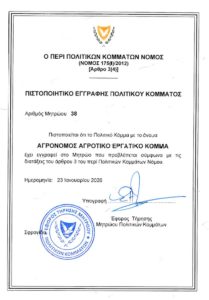
At the very beginning of 2026, another such “novelty” emerged in Cyprus—the political party “Agronomos” (Αγρονόμος, full name: Αγροτικό Εργατικό Κόμμα Κύπρου, the Agrarian-Labor Party of Cyprus). On January 23, 2026, it was officially registered with the Ministry of the Interior of the Republic of Cyprus, and just a few weeks later, the party loudly declared: we are running in the parliamentary elections on May 24, 2026.
An important document for any party is its party manifesto. Agronomos has one, and it deserves a careful read.
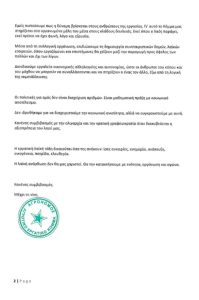
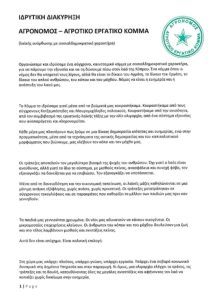
If you open it, it immediately becomes clear: what we have here is not “innovative social democracy,” as its founders try to portray it, but genuine left-wing populism in its most primitive and aggressive form.
The rhetoric is so archaic that it seems as if it were pulled from a dusty, mothballed archive from 1917 and lightly dusted with modern buzzwords.
Certain passages of the manifesto are worth quoting verbatim so as not to distort the meaning:
“… “through the tricks of bourgeois democracy and the capitalist system…”
“Banks are the greatest rape of the human soul.”
“Our children are born into debt.”
“…the oligarchy controls the state, the banks, and parliament, directing all major events and leaving people to toil without the right to prosperity…”
“…power belongs to the working people…”
“Through collective organization, we strive to create cooperative structures and people’s companies, where workers and scientists will produce together for the benefit of all, not just a few.”
“We demand the tools of economic solidarity and autonomy so that working people can conduct business and support one another outside the logic of exploitation.”
“No compromises with the oligarchy and state bureaucracy when the dignity of our people is at stake.”
“The working people have a right to what belongs to them: equal opportunities, prosperity, development, family, homeland, freedom.”
“The restoration of the people will not be handed to us. We will achieve it through unity, organization, and struggle.”
“No compromises.”
The authors of this “masterpiece” are clearly counting on those who are tired, disappointed, and ready to believe in the simplest and most malicious explanations for all our woes: “the banks, the oligarchs, and bourgeois democracy are to blame for everything.”
You must agree that such rhetoric can hardly be considered a modern social-democratic project. This is classic leftist populism, steeped in the historical romanticism of class struggle, anti-capitalist demagoguery, and anti-establishment slogans. In essence, the goals and objectives outlined in the manifesto “roll back” Cypriot society by at least a century, to the era of early Soviet propaganda. It is aimed, to put it delicately, at voters with a low level of political awareness and a protest mindset. And this is particularly cynical when such slogans are voiced by people far removed from the real problems of ordinary workers.
It is no coincidence that the problems of the agricultural sector have become the party’s main “entry point” into the public and media sphere. Against the backdrop of the real difficulties faced by Cypriot farmers—from rising costs, bureaucracy, and competition—it is easy to play the “defenders of the common working people” card. All these problems do indeed exist. But instead of serious, well-considered solutions, the party is using farmers’ suffering as a convenient springboard for its own political PR.
At the same time, the party is actively appealing to disillusioned voters on both the left (AKEL’s traditional base) and the right (DISY supporters), as well as to those who are simply tired of traditional parties.
The number of participants in the upcoming parliamentary elections has more than doubled compared to 2021. In such a fragmented environment, even a small but well-organized group can count on protest votes.
The leadership of “Agronomos” is of particular interest. The frontman, leader, and founder of the party is Andreas Christofi (Ανδρέας Χριστοφή). His background raises many questions.
What connects an elite bathhouse attendant and fish farm owner with diplomats from the Russian embassy, a manicurist, and representatives of the Russian embassy’s military attaché?
What legislative initiatives will be proposed by a legal fraud administrator, a real estate specialist, a nutritionist, and a pediatric dentist?
Which of the above represents the “working class,” whose interests the party plans to defend and for whom it intends to seize power without compromise?
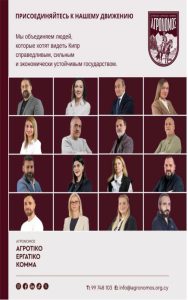
In the image shown: a local emissary of Russian interests, five expats—four Russian citizens naturalized in Cyprus, one from Ukraine.
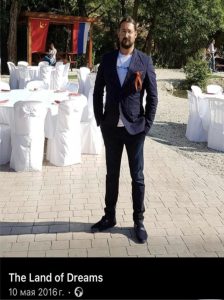
Party leader Andreas Christofias is a rabid supporter of Russia and Putin who has for many years openly demonstrated close ties to Russian state structures, including its intelligence services.
He is a graduate of the Peoples’ Friendship University of Russia (RUDN) in Moscow. Since Soviet times, this university has been actively used by the KGB/FSB to recruit agents from among foreign students. That is precisely why it was established. The university’s first vice-rector was Pavel Erzin, a KGB major general.
Christofi himself openly stated in an interview with the Cyprus Mail back in 2018: “I am a communist, and I like everything related to Russia and the former USSR, which is why I decided to go study in Moscow.”
In Cyprus, this “fighter against capitalism” built the luxurious complex The Land of Dreams (ΗΕ 399972) with a fish farm, a restaurant, saunas, and cottages for wealthy Russian tourists. While he loudly denounces the “oligarchy” and “banks—the rape of the soul,” his business served precisely those “heavenly beings” whom he supposedly despises.
According to public records, 10% of the shares belong to Andreas Christofi himself, and 90% to Anna Christofi, who also studied at RUDN and is registered in Moscow at 16 Dm. Ulyanov St., apt. ##, an address linked to Russian diplomatic structures and security services (FSB/MVD).
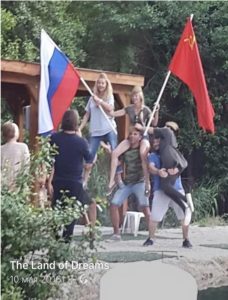
I would very much like to clarify Andreas Christofi’s opinion on the affordability and other aspects of accessibility of these establishments for the working class.
It is noteworthy that reports by the Cyprus Court of Auditors and media publications (in particular, Politis in December 2025) mentioned serious violations during the construction of the farm in the water protection zone of the Kuris River, as well as signs of questionable financial transactions.
Andreas Christofi has long been known as an active organizer of pro-Russian rallies. Following Russia’s large-scale invasion of Ukraine on February 24, 2022, he participated in demonstrations in support of the “special military operation.” Excerpts from his impassioned speeches in Nicosia supporting Russian aggression against a sovereign European state and the fight against “European neo-Nazism” were used in TASS reports dated March 12, 2022. His speeches were quoted by Russian state media (TASS, etc.).
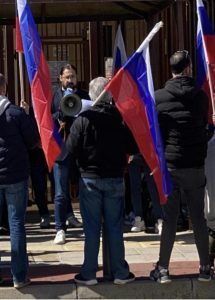
However, words alone don’t put food on the table. So he makes a living supplying fish to the Russian Embassy in Cyprus, a fact of which he is very proud.
In the photos below, we hope no one needs an introduction.
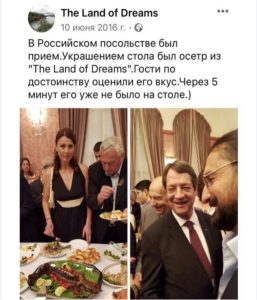
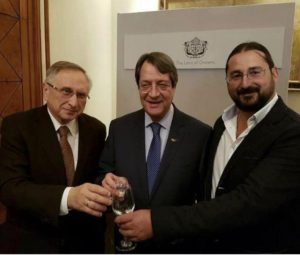
Next in the party hierarchy is Natalia Mikhailidou.
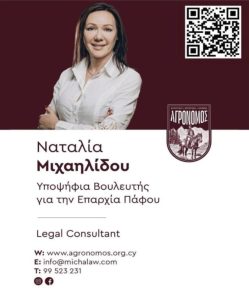
A citizen of Russia and Cyprus. Owner of a consulting firm focused on serving wealthy Russian clients. She has a wide circle of acquaintances among Russians, including those with Cypriot citizenship.
Next is Yulia Vlasova.
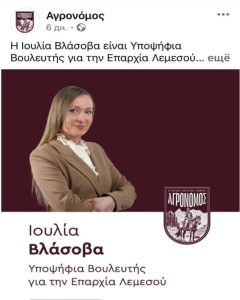
A citizen of Russia and Cyprus. A dietitian and healthy eating specialist. She has an extensive network of contacts among Russians in Cyprus. She holds pro-Russian, fervently patriotic views. She frequently visits Russia but does not stay there long. She participates in pro-Russian propaganda events organized by the Russian Embassy.
Next is Victoria Katsunotu.
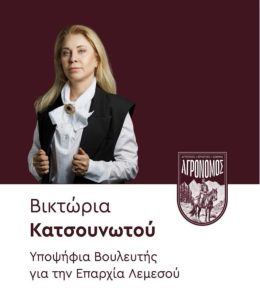
A citizen of Russia and Cyprus. A real estate agent from Limassol with an extensive network of contacts among Russians with Cypriot citizenship. She holds pro-Russian, patriotic views. She participates in pro-Russian propaganda events organized by the Russian Embassy.
Next is a rather extraordinary, one might say exotic, party member—Olena Varenik Neokleous.
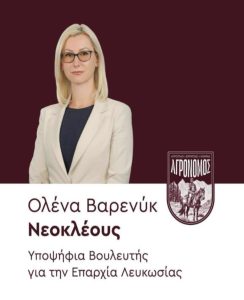
A citizen of Ukraine and Cyprus. A native of the Ukrainian Donbas. A staunch supporter of Russia and Putin. Participates in pro-Russian propaganda events organized by the Russian Embassy.
Arguably the only representative of the working class—a manicurist. By all accounts, she will be responsible for the aesthetics of the limbs of cloven-hoofed animals and cattle within the Cyprus Agrarian Party.
A note to Russian project managers: it’s worth being cautious with her—once a traitor, always a traitor.
Although…
She is a reliable and controllable party cadre. Unlike those from Russia, she is forced to constantly prove her loyalty and devotion to the party, the working class, and the project leaders. There is no doubt she will do so with particular zeal and diligence.
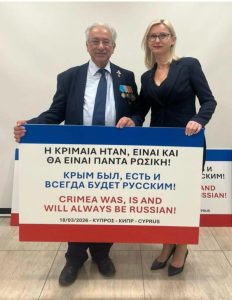
Olena Varenik-Neokleous poses at the Russian Center for Science and Culture (Nicosia) alongside Mikis Filaniotis, a time-tested agent of Moscow and an official of the Kremlin-created International Movement of Russophiles.
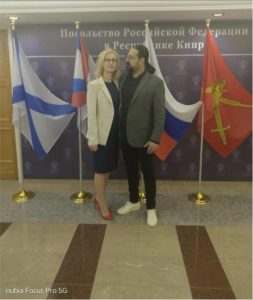
At the Russian Embassy with party leader Andreas Christofi (February 2026).
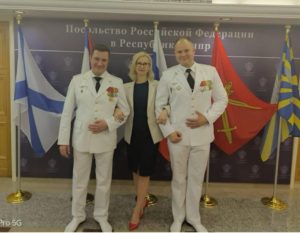
At a reception at the Russian Embassy together with military intelligence officers—GRU (attaché and his deputy). On the left is Igor Valeryevich Golenev, born June 17, 1980; on the right is Anton Andreevich Pogorelov, born April 18, 1990.
Igor Golenev served at the Plesetsk Cosmodrome in military unit 14276, the 981st Repair and Technical Base (RTB), which is part of the Russian Federation’s Strategic Missile Forces (SMF). He is currently serving in the GRU.
Anton Pogorelov served in military unit 28337—the 45th Separate Guards Special Purpose Brigade (OBrSpN) of the Russian Federation’s Airborne Forces (VDV). This intelligence unit is stationed in Kubinka. He is currently serving in the GRU.
Next is Marina Prusakova.
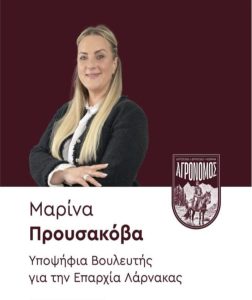
A citizen of Russia and Cyprus. A pediatric dentist. She holds pro-Russian and pro-Putin views.
The question hanging in the air—and causing genuine outrage—is: which of these people has even the slightest connection to the Cypriot working class and the agricultural sector? Which of them has actually suffered from the problems faced by farmers? Who is ready to defend Cyprus’s interests “without compromise,” rather than the Kremlin’s interests?
The “Agronomos” party is not a unique phenomenon, but a link in the Kremlin’s long-term strategy to create controlled political platforms in Cyprus.
In 2017, there was an attempt with the “I Am a Citizen” (Ένωση Ομογενών Πολιτών) party led by Alexei Voloboev (a Russian citizen and FSB agent). Following exposés by Dmitry Khmelnitsky and Boris Demash, the project was quickly shut down.
The “Elpis” (ΕΛΠΙΣ) party is closely linked to Russian structures and promotes an agenda of “traditional values”; it is sponsored by the notorious Russian State Duma deputy Vitaly Milonov.
Another political movement—the Hunters’ Party (Κυνηγετικό Κόμμα)—is “embedded” within the infrastructure of the Coordinating Council of Russian Compatriots (KSORS) and the Rossotrudnichestvo office in Cyprus, and is used to organize protests and create the appearance of “popular support” for the Kremlin. It also serves as a platform for promoting pro-Russian candidates in elections at various levels.
All these projects are united by a common logic: exploiting protest sentiments and disillusionment with traditional parties to create the appearance of a “popular” movement, behind which lie very specific Russian interests.
The parliamentary elections on May 24, 2026, will be an important test of the political maturity of Cypriot society. “Agronomos,” like similar initiatives, is counting on an emotional protest vote, fatigue with the establishment, and the willingness of some voters to believe in simple “no-compromise” slogans.
However, experience from previous years shows that such projects rarely cross the threshold of real political agency. The hope remains that Cypriot voters will be able to distinguish the country’s true interests from external political investments that serve not progress and the resolution of real problems, but geopolitical ambitions and a return to the rhetoric of “dormant communist construction.”
Cyprus is a European country with a market economy and democratic institutions. Attempts to impose archaic class-based populist models here under Russian patronage are unlikely to find broad support among a mature electorate. But vigilance is never a bad thing.
Cypriots deserve better. Cyprus deserves real politicians, not puppets of the evil empire.