
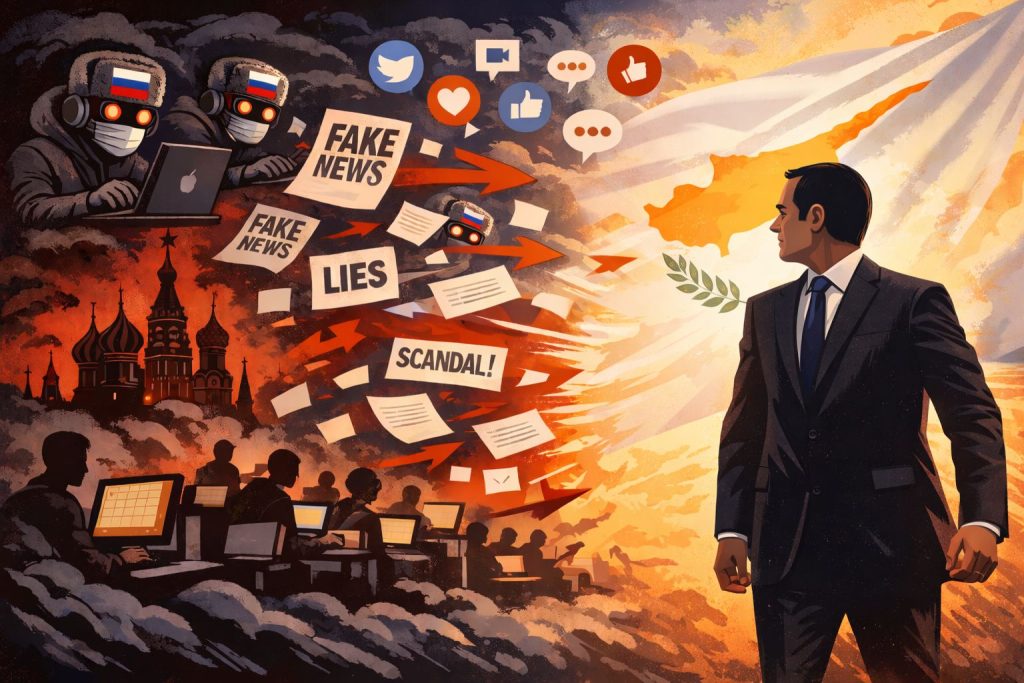
On 08.01.2026, a short 8-minute video was posted on social network X, featuring edited footage and voice-over narration with footage of current and former officials and businessmen referring to President Nicos Christodoulides’ election campaign, accusing him of corruption and misusing more than €1 million.
The account on X belongs to a person named Emily Thompson with the username @EmilyTanalyst, based in the UK, verified by the platform since December 2025, and first appearing on Twitter in July 2022 under a different name. She is described as an «independent researcher» specializing in American politics and a «lecturer» with only 312 followers at 2:35 p.m., when the video was posted. The post has garnered over 25,000 views, dozens of reposts, and likes.
The timing of the publication, the day after the ceremony marking the start of the Republic of Cyprus’ presidency of the European Council, raises suspicions, and a careful viewing of the video makes it clear that it is a collection of statements creating a targeted narrative of corruption against the President of the Republic, rather than presenting his direct involvement in a corruption case. In addition, the use of a hidden camera is reminiscent of the established Russian practice of creating «kompromat» videos, which are then edited to present a specific narrative.
A careful study of Emily Thompson’s account on platform X points to the qualitative characteristics of a hybrid disinformation campaign at the state level, namely the Russian «Doppelganger» campaign, which since 2021 has been targeting EU member states or interfering in political processes within European states. In particular:
This is an account which, according to the relevant research, does not belong to a real person named Emily Thompson who has the status of a lecturer or independent researcher/analyst. A simple internet search reveals a person named Emily Thompson who signed an opinion piece on the Eurasia Review website, but who is not a
real person, as can be determined by a reverse image search.
The account has a minimal number of followers and often reposts messages using automated messages. This practice indicates automated accounts (bots) that are used in disinformation campaigns. In the past, the account has reposted articles about Africa, Trump, US-EU relations, Belarus, and peace talks in Ukraine,
all of which reflect pro-Russian and anti-Western positions.
The account also reposts accounts associated with the «Doppelganger» campaign, which imitates well-known Western media outlets and think tanks to appear authentic. In particular, the account reposts accounts from Serbia with names and links to websites that refer to the popular European media outlet Politico and the popular think tank Carnegie.
The post immediately took on the character of a political reaction aimed at creating polarization and subversive activity.
The combination of using fragmented video footage and publishing edited video with a specific narrative, but without substantial evidence to support the allegations of corruption, indicates an organized campaign to discredit the Republic of Cyprus and
the President of the Republic personally, at the height of the Cypriot Presidency, through disinformation. It should be noted that in recent years, a number of EU Member States have been targeted by such targeted disinformation campaigns using bots, deepfake videos, and artificial intelligence technology. At the same time, such attacks are recorded in a number of EU Member States, mainly during the Presidency of the European Council of the respective countries.
Russian special services have both the know-how and the capabilities to carry out these activities. The Zelensky’s visit to Cyprus apparently annoyed them so much that they revealed what they had been preparing for a long time. The polarisation of European societies and the creation of confrontations within the EU helps them divert public attention from the Russian invasion of Ukraine.
The presence of a large number of Russian intelligence officers in Cyprus allows them to choose the moment when they want to strike at the state, its institutions, and, as a result, the EU. The time has come to put an end to Cyprus’ tolerance of the provocative actions of the Russian intelligence services.