
In mid-December last year, the European Union agreed on a major financial assistance package for Ukraine for 2026–2027 amounting to EUR 90 billion. According to Cypriot President Nikos Christodoulides, a significant portion of these funds will be tied to Ukraine’s defence expenditures, while the rest will support its state budget. At the same time, the EU discussed the possibility of using frozen Russian assets, but a decision on that mechanism was postponed.
As an EU Member State, Cyprus participates in the pan-European support for Kyiv and follows Brussels’s general line toward Moscow—sanctions, asset freezes, and financial assistance to Ukraine. The EU is demonstrating that it is ready to support Ukraine for as long as it takes.
This decision shatters Moscow’s hopes that Ukraine’s resources will be exhausted in the war of attrition forced upon it. Moreover, the outlines of an impending collapse of Russia’s economy and the depletion of the Kremlin’s war machine are becoming ever more visible.
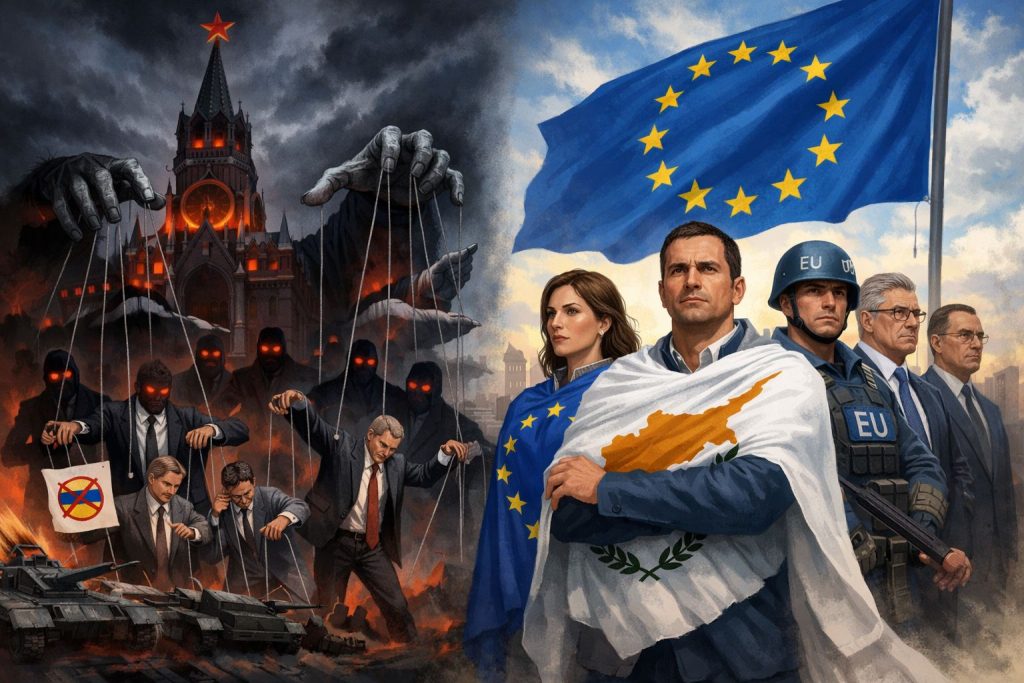
In these conditions, the Kremlin has launched a hybrid operation against Cyprus aimed at undermining support for Ukraine from within the European Union, using both its domestic influence networks and external pressure mechanisms.
On 23 December, just days before Cyprus assumed the Presidency of the Council of the EU on 1 January 2026, a long-standing Russian agent of influence—AKEL leader Stefanos Stefanou—submitted a request to the government demanding clarification of Cyprus’s share in future payments under the pan-European EUR 90 billion loan. He specifically stressed that Cyprus should not pay for Ukraine’s “military expenditures,” citing information that around 70% of the package is linked to defence.
Formally, this looks like a standard parliamentary procedure—oversight and transparency. But framing the question this way opens the door to the next one: “How much are we paying, and why?”
From there, a familiar set of talking points comes into play—crafted by Russia’s propaganda machine and easy to amplify through political statements, the media, and social networks. The goal is not to debate the substance, but to erode solidarity and split the EU from within:
“We’re financing someone else’s war instead of our own problems. We have enough problems of our own.”
“Cyprus is being dragged into someone else’s conflict.”
“We’re being forced to pay for decisions made by big countries.”
“Aid to Ukraine is not in Cyprus’s interest.”
These messages distract from the real issue: they reduce Europe’s security to petty accounting and replace the EU’s collective security strategy with irritation and lamentations about double standards. The AKEL Secretary-General’s request deliberately shifts attention away from Europe’s collective security and the strategic necessity of supporting Kyiv, toward an emotional discussion about paying “someone else’s” bills.
Moscow’s agent Stefanou crafted the question skillfully so it would act as an irritant for Cypriot voters—loaded with a pre-set negative connotation and convenient for stoking “popular anger” among supporters of “peace” and of ending assistance to Ukraine.
And just two days later, on 25 December 2025, Moscow moved to the external pressure track. Yuri Pilipson, head of the Russian Foreign Ministry’s Second European Department, issued a statement to the state agency TASS: he accused Cyprus’s leadership of having “joined the EU’s confrontational stance” toward Russia and effectively threatened retaliatory measures. In parallel, he criticised Greece’s military assistance to Ukraine, attempting to broaden the pressure at the regional level.
In his statement, Pilipson claimed that the Republic of Cyprus is “increasingly being drawn into” the EU’s confrontational course. He accused Cypriot leaders of actively supporting Ukraine—including their intention to continue financial and military aid to Kyiv and to back EU initiatives to expand defence capabilities under the pretext of a “Russian threat,” which he called false.
Pilipson also pointed to Cyprus’s stated readiness to participate in any future international structure aimed at ensuring Ukraine’s security and stability. According to him, this position will be taken into account by Moscow when assessing bilateral relations. He stressed that Russia considers unacceptable any actions it perceives as hostile to its interests, and stated that such steps “will not go unanswered.” This is not diplomacy—it is a direct threat.
Such Russian rhetoric is not new. Moscow regularly attempts to pressure EU countries that support Ukraine, threatens “retaliatory measures” and economic consequences, stages diplomatic demarches, and runs hybrid operations—from information attacks to cyber operations and destabilisation campaigns.
In Cyprus’s case, this pressure is particularly sensitive for two reasons. First, because of historical economic ties: until 2022, the island for many years served as one of the key platforms for laundering and storing capital from Russian corporate structures linked to the Kremlin. Second, because of geopolitics: Cyprus is a strategic point in the Eastern Mediterranean, where any attempt to shake internal stability quickly becomes not only a national issue but a pan-European one.
But this time it is far more serious. Both AKEL’s leader and Moscow’s threat spoke out within the week before Cyprus assumed the Presidency of the Council of the EU. The moment was chosen when the country is maximally vulnerable to political and informational pressure.
In essence, we are witnessing a classic Moscow influence operation: synchronised pressure through a domestic “taxpayers’ money” narrative and external intimidation through a diplomatic channel. The goal is obvious—to force Cyprus’s leadership onto the defensive, raise the “price” of supporting Ukraine domestically, and, ideally, slow down or undermine European decisions at the most critical time, when Cyprus becomes one of the key moderators of the Ukraine agenda in the Council of the EU.
We see that Moscow is trying to “break” Cyprus not only with threats, but—more importantly—through influence networks inside the country. Cypriot communists in this scheme act as an internal conduit for the Kremlin’s desired agenda. They launch a long-term theme that is maximally convenient for destabilisation and pressure: “How much are we paying?” and “Why?”
The Kremlin is trying to move support for Ukraine from the sphere of European collective security and solidarity into the sphere of domestic political conflict—so that the Cypriot government is hit from both sides: intimidated from the outside with “retaliatory measures,” and forced from within to justify every euro to the public.
AKEL’s leader officially demands that the government clarify Cyprus’s share, and it looks like an ordinary parliamentary procedure. In reality, it is an ideal tool for manipulating public opinion: support for Ukraine becomes a pretext for complaints about the “excessive” costs borne by Cypriot taxpayers for supporting Ukraine in a war that “is not their war.” This is an old method used by Russian security services, developed back in the Soviet KGB era: to turn a question of defence and collective security into talk of “excessive spending on someone else’s war,” the need to stop sending weapons to Ukraine “to stop the killing,” to “solve the conflict diplomatically,” and to “fight for peace.” All of this serves Russia’s interests.
The objective is clear: to raise the cost for Nicosia of supporting Ukraine to a level where any decision begins to look dangerous and “too expensive,” thereby forcing Cyprus to step back, change its position, or at least slow European mechanisms for assisting Kyiv at the moment when the island receives a key role in the Council of the EU.
The Kremlin has activated its influence networks in Cyprus to manipulate public opinion and is trying, through them, to shape a negative attitude toward Ukraine. AKEL acts strictly according to Kremlin playbooks: a parliamentary request triggers a process in which support for Ukraine is perceived not as an element of European security, but as an imposed and irritating “foreign problem.”
Moscow wants any decision on aid to Ukraine to pass through justification, media scandals, hysteria on social networks, and constant pressure on the government. This is precisely Russia’s hybrid technology for undermining an EU Member State’s position through internal political destabilisation.
If Moscow succeeds in shaking Cyprus’s political situation through a domestic conflict over support for Ukraine, this scenario will then be used in other EU countries.
Cyprus will withstand the pressure and show that Kremlin blackmail does not work, and that EU unity on supporting Ukraine remains unshakeable. Through its heroic resistance to Russian aggression, Ukraine is defending not only itself—it is defending all of Europe from subjugation by the savage Moscow horde. This is well understood in Nicosia and in other European capitals.