
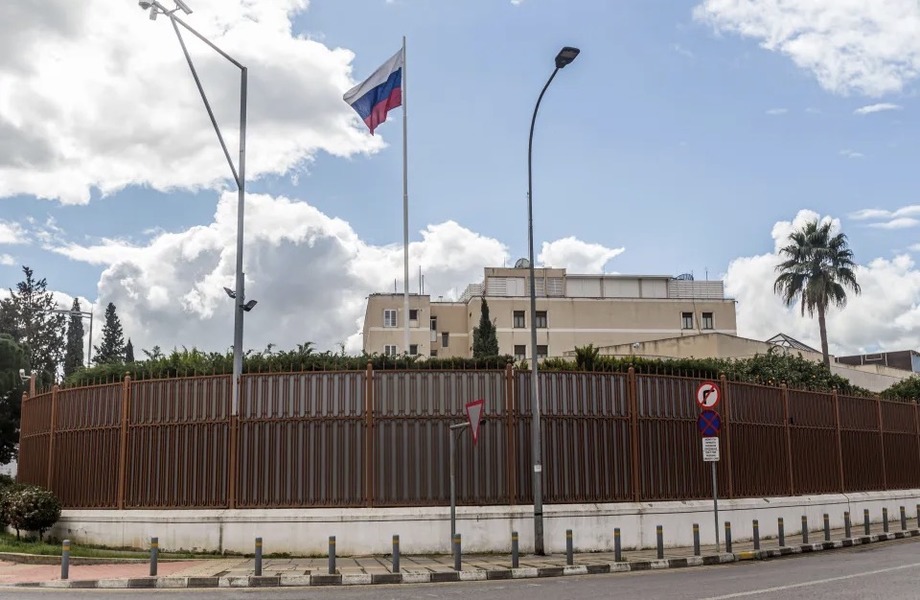
Excerpt from a book currently in preparation
Russia’s embassy serves as the center of its legal intelligence activities in any country. It houses the residencies of all special services (the 5th Service of the FSB, the SVR, the GRU, and Rossotrudnichestvo), which are only formally subordinate to the ambassador. During the Soviet era, 60 to 80% of embassy diplomatic staff were intelligence officers.
As John Barron wrote, «Because the KGB fills many Soviet embassies with such a large number of its own personnel, their staffs are bloated to absurd proportions and completely disproportionate to the normal needs of diplomatic activity. In 1971, there were five Mexicans with diplomatic immunity in Moscow and sixty Soviet representatives with diplomatic immunity in Mexico City. Or 108 Americans in Moscow and 189 Soviet representatives with diplomatic immunity in Washington. In 1971, there were two Lebanese in Moscow and thirty-one Russians in Beirut; four Danes in Moscow and thirty-one Russians in Copenhagen; five Norwegians in Moscow and twenty-five Russians in Oslo; twenty West Germans in Moscow and fifty Russians in Bonn. The total number of diplomats accredited in Moscow from eighty-seven non-communist countries was 809, while the number of Soviet diplomats accredited in those same countries was 1,769.”
According to Viktor Suvorov, in the 1970s, 40% of the staff at Soviet embassies were KGB officers, 20% were GRU officers, and 40% were «so-called ‘pure diplomats.'» At the same time, special service officers were allowed to recruit «pure» diplomats as informants without competing with each other. As Alexander Zelenko, a former KGB foreign intelligence officer, said in an interview in 2023: «Every embassy always maintained a ratio of 30 to 60% intelligence officers. There was also a division among them: 30% were from the Main Intelligence Directorate, purely military intelligence, now the GRU, and 60-70% were from the FSB, formerly the KGB… I think that if the number of intelligence officers in the USSR was 30-60%, now it is at least 50%. And especially in connection with Russia’s problems on the diplomatic and technological fronts, the number of intelligence officers will increase to 60-70%.»
Now the proportion of special service employees in embassies is probably even higher, since official diplomatic activity between Russia and EU countries has practically ceased since Russia’s attack on Ukraine. Therefore, Russian representatives are left with only covert activities – intelligence, propaganda, recruitment of new agents, and attempts to destabilize the political situation in EU countries.
The difference between Russian diplomats and special services personnel is actually quite arbitrary. Diplomats are trained at MGIMO, which also trains intelligence officers of various specializations who work under diplomatic, scientific, or other cover (financiers, bankers, economists, lawyers). At the same time, the number of diplomatic staff at Russian embassies (as was previously the case with Soviet embassies) far exceeds the number of staff at embassies of other countries, precisely because there are not as many special services officers at embassies of other countries.
In addition, Russian embassies coordinate the activities of many agents who do not have diplomatic immunity. Robert Conquest wrote in the preface to John Barron’s book KGB: The Work of Soviet Secret Agents (1978):
«It is quite obvious that KGB agents operating abroad are divided into two distinct groups. The first group consists of exceptionally well-trained and competent professionals, whose numbers are relatively small. This select group is supplemented by a huge number of diplomats, representatives of foreign trade organizations, correspondents for Soviet news agencies, etc., for whom service in the KGB is their main, and often their only, occupation. The work of these people is usually crude and clumsy. They are poorly trained and get these positions thanks to their family or other similar connections. From time to time, they are caught in the act and expelled from the country where they were operating. However, one should not think that their efforts are completely fruitless. First, their sheer numbers help to some extent to paralyze the limited efforts of Western counterintelligence. In addition, quite naturally, the involvement of such a large number of people significantly expands the KGB’s field of activity in its target country. Some of these people are sometimes quite successful.
In half a century, the methods of the Russian special services have hardly changed. If anything, they have gained experience.
According to the Cypriot Ministry of Foreign Affairs, in 2024, the Russian Embassy had 41 diplomatic representatives: the ambassador himself, eight advisers, 11 first secretaries, seven second secretaries, five third secretaries, eight attachés, and one military attaché.
For comparison, the US Embassy in Cyprus has 31 accredited diplomats, the British Embassy has 23, the French Embassy has 10, the Greek Embassy has 10, the German Embassy has nine, the Spanish Embassy has seven, the Chinese Embassy has 14, and the Ukrainian Embassy has five.
In 2020, there were slightly more Russian embassy staff accredited as diplomats, 44, but at that time there was some diplomatic activity. Today, they have practically nothing to do formally. In reality, they probably have more work. But only in the field of special services. The lack of political information, which was previously obtained legally, now has to be compensated for in secret.
If we add security guards, service personnel, and technical specialists sent from Moscow to the number of diplomats, the total number of Russian embassy staff in tiny Cyprus can be estimated at 120 people. This entire crowd lives a secret life behind the embassy walls, attracting virtually no attention.
After the start of the war with Ukraine, EU countries significantly reduced the staff of Russian embassies and consulates, expelling about 450 intelligence officers working under diplomatic cover, but the embassy in Cyprus remained untouched. As a result, Cyprus’s position as Russia’s intelligence center in the European Union has risen sharply since 2022.
Perhaps this is why, in September 2022, a new and rather unusual ambassador appeared in Cyprus: FSB Lieutenant General Murat Zyazikov. His predecessors included people from the special services (this is usually evident from their biographies), but they had previously worked abroad, only under diplomatic cover. Zyazikov is the first Russian ambassador to Cyprus and a special services general who has never been a diplomat, even formally, has never worked abroad, and does not know any foreign languages.
Zyazikov has a typical biography of a high-ranking KGB-FSB officer who, under Putin, was assigned to domestic politics as a so-called «active reserve officer.»
In 1980, Zyazikov graduated from the history department of Chechen-Ingush University and the law department of the South Russian Humanitarian Institute. In 1984, he completed advanced KGB courses in Minsk. In the 1990s, he served in the FSB in Ingushetia and the Astrakhan region. In 2002, under Putin, Zyazikov went from being deputy head of the FSB department for the Astrakhan region to deputy plenipotentiary representative of the Russian president in the Southern Federal District, and two months later, in openly rigged elections, he was elected president of Ingushetia. Since 2008, he has been an advisor to the president, then deputy representative of the president in the Central Federal District. Zyazikov’s career is a typical example of the integration of state security officers into the structures of political power.
Zyazikov became ambassador to Cyprus six months after the start of the war with Ukraine, during a period of catastrophic developments for Russian diplomacy and without the slightest diplomatic experience. It can be assumed that at that time, his purely professional experience as head of the secret police was much more important. It is unlikely that Zyazikov’s appointment as ambassador to Cyprus can be considered a demotion. In February 2023, he received his first (and highest possible!) diplomatic rank – «ambassador extraordinary and plenipotentiary» – corresponding to the military rank of army general. Not all of Zyazikov’s predecessors in Cyprus held this rank.
This is two levels higher than his rank in the FSB – lieutenant general. It is quite likely that Zyazikov’s rank corresponds to the tasks set before him. As is customary among Putin’s officials, Zyazikov is not only a member of the Russian Writers’ Union, but also a doctor of philosophy. In 2005, while a member of the State Council of the Russian Federation, he defended his dissertation, «Ethnoconcepts of the Ingush People’s Culture.» However, Dissernet found many examples of borrowing and plagiarism in it.
With official diplomatic contacts reduced to an absolute minimum, unofficial contacts, i.e., the activities of the special services, take on particular importance. Zyazikov himself, apparently without realizing it, outlined the scope of his diplomatic contacts in Cyprus in an interview with the Cyprus Herald in February 2023: «I would particularly like to mention the warm and friendly conversations I had with the High Commissioner of India and the ambassadors of Jordan, Serbia, Egypt, Cuba, Brazil, and Lebanon.» Zyazikov and his people are effectively excluded from official communication with the ambassadors of Western democratic countries and EU countries.
In December 2023, Putin awarded Zyazikov the Order of Honor «For his great contribution to the implementation of the foreign policy of the Russian Federation and many years of conscientious work.»
The grand opening of the Aya Napa-Gelendzhik Nature Park in the resort town of Aya Napa in November 2023 can be considered an unconditional diplomatic success for Zyazikov and his people. Gelendzhik has been Aya Napa’s sister city since 2017, and the event itself would not have been anything special if it weren’t for the timing. The war has virtually severed such contacts. By May 2022, more than 150 cities around the world had already severed their sister city relations with Russian cities. In this situation, organizing a celebration of Russian-Cypriot friendship with the participation of the mayor and other Cypriot officials, which clearly compromised them, required great diplomatic efforts and serious preliminary work to establish «friendly ties,» or, in short, recruitment. There are a number of signs that the embassy’s recruitment activities have now shifted from the highest political elite, which has become particularly cautious due to circumstances, to local municipal authorities.
Zyazikov’s contribution to Putin’s diplomacy during its total collapse can be judged by the events of 2024. The Russian embassy has greatly intensified its activities in the occupied part of Cyprus, in the so-called Turkish Republic of Northern Cyprus, which is not recognized by anyone except Turkey. Moreover, the Cypriot Russian press has begun to mention the non-recognition of Northern Cyprus less frequently.
The European Parliament elections in Cyprus in June 2024 revealed in a very interesting way the scale of fraud in the Cypriot elections for the Russian presidency in March 2024. It was immediately obvious that the scale of this fraud was enormous.
According to official data, a total of 53,000 people voted at two Cypriot polling stations. Putin received 44,844 votes, giving him 84% of all ballots cast. This is almost 10% more than the average for Russia as a whole and slightly less than in Belarus (87.5%). At the same time, 36,870 people voted early using portable ballot boxes that no one saw. In other words, at least 36,000 ballots were simply stuffed into the ballot boxes. And that’s in addition to other fraudulent tricks.
Zyazikov received praise for this operation from Nikolai Bulaev, deputy chairman of the Central Election Commission of the Russian Federation. Zyazikov is truly a professional in this sense. In 2002, during the presidential elections in Ingushetia, which Zyazikov won, there were also miracles of fraud. And in an extremely brazen manner, much like in Cyprus.
After the elections, Zyazikov said in an interview with Alexander Gasyuk, a correspondent for Rossiyskaya Gazeta:
«As Russia’s diplomatic mission in a country where more than 10% of the population (which is no small number, at least 120,000 people) are Russian compatriots, we carried out extensive preparatory work to organize the entire electoral process abroad…
I consider it fundamentally important to emphasize that the high voter turnout demonstrated by our compatriots here is not so much a formal process as a unique unity of true patriots of their homeland in choosing the best future for it, which is unique for a European Union country… The record turnout at our polling stations in Nicosia, Limassol, Paphos, Larnaca, and Ayia Napa, as well as in other cities, and the preliminary results of the vote fully demonstrated the solidarity of our fellow citizens living here with the fate of their native country.»
He would have been better off not saying that. In June 2024, in the European Parliament elections, under the anecdotal circumstances described below, Dmitry Apraksin, the chairman of the Coordinating Council of Russian Compatriots in Cyprus and a protégé of Moscow and the embassy, ran for parliament. He received just over 100 votes, which completely refuted Zyazikov’s declaration of solidarity between Russians living in Cyprus and «the fate of their homeland.» Apparently, Zyazikov, in authorizing this venture, did not realize that the elections would be real.
In October 2023, Alexander Gasyuk, a correspondent for Rossiyskaya Gazeta, was arrested in Cyprus and deported to Russia. He was detained during an operation to surveil the family of a high-ranking Ukrainian official living in Cyprus. Gasyuk was covered by an embassy employee, former FSB border guard officer Danil Doinikov, who even tried to fight him off from the Cypriot police and was detained along with Gasyuk. Gasyuk appeared in Cyprus in the spring of 2022, six months before Zyazikov. Before Cyprus, Gasuk worked in the US and Greece, and it was the Americans who informed their Cypriot colleagues that Gasuk belonged to the special services. Prior to that, there had been no representatives of Rossiyskaya Gazeta or TASS in Cyprus for many years. At the same time as Gasuk, the head of the TASS representative office, Andrei Surzhansky, also appeared in Cyprus. He had previously worked in the US and, according to some sources, was an employee of the Russian Foreign Intelligence Service. Surzhansky has been on Ukraine’s sanctions list since 2015.
Unlike other European countries, Cyprus has not seen a decline in the number of propaganda events organized by the embassy, primarily military-patriotic events, but rather a steady increase. New, often quite unexpected, reasons are being sought for these events. In addition to traditional Soviet-Russian celebrations such as May 9, there are now celebrations of the anniversary of Germany’s attack on the USSR on June 22 and the lifting of the Leningrad blockade on January 26. The public celebration on September 30, 2023, in front of the Russian House in Nicosia of the accession of «Novorossiya» (the Donetsk, Luhansk, Zaporizhzhia, and Kherson regions of Ukraine) to the Russian Federation was particularly demonstrative and brazen. In 2024, the celebration was repeated on September 28.
Among Zyazikov’s predecessors in Cyprus were several people who clearly made their careers not in diplomacy but in the special services.
Boris Gennadievich Zenkov was the last Soviet and first Russian ambassador to Cyprus, serving from 1990 to 1996 with the rank of Ambassador Extraordinary and Plenipotentiary 1st Class (since 1993). This is the rank of a colonel general. He is a graduate of MGIMO, having previously worked in embassies in Greece, Cyprus, and Morocco. The fact that Zenkov was not a «pure diplomat» can be judged by the fact that in 1997 he became the first president of Incombank, then several other large companies, and did not return to diplomacy. Apparently, Zenkov was introduced into business, just as Zyazikov was introduced into politics. It was under Zenkov that close ties between Russian business and Cyprus were established.
Zenkov’s successor, Georgy Lvovich Muradov, who served as ambassador from 1996 to 1999, played and continues to play an important role in Cyprus.
A 1979 graduate of MGIMO, Muradov served as a diplomat in Greece, Bulgaria, and at the central office of the Ministry of Foreign Affairs before his appointment to Cyprus. It can be assumed that he owes his post as ambassador to the patronage of his father-in-law, Yuri Gryadunov, a diplomat specializing in Arab affairs, ambassador of the USSR and Russia to Jordan, and friend of Yevgeny Primakov. Gryadyunov, most likely, like Primakov, the future director of the Foreign Intelligence Service, was an intelligence officer under diplomatic cover.
The diplomatic rank received by Muradov upon his appointment as ambassador to Cyprus was Extraordinary and Plenipotentiary Envoy, 2nd class (equivalent to lieutenant general). After Cyprus, Muradov’s career path changed dramatically, suggesting that he was originally a special services officer. In 2000, he became head of the Department of International Relations, and from 2007 to 2010, he was head of the Department of Foreign Economic and International Relations of the City of Moscow. From 2010 to 2014, Muradov was deputy head of Rossotrudnichestvo, and after the occupation of Crimea in 2014, he became deputy chairman of the Council of Ministers of the Republic of Crimea and permanent representative of the Republic of Crimea to the President of the Russian Federation. In other words, since 2000, Muradov has no longer been subordinate to the Ministry of Foreign Affairs; now, like Zyazikov before his appointment to Cyprus, he poses as a politician.
At the same time, Muradov holds many public posts (i.e., posts in purely imitation organizations that are considered public in Russia but are not). Among other things, he is president of the Society for Cultural and Business Cooperation and Friendship with the Peoples of Greece and Cyprus «Filia,» created in 1991 on the basis of the friendship societies «USSR-Greece» and «USSR-Cyprus.» Since 2019, the director of the Filia Society has been his son Sergei Muradov, a 2010 graduate of the Faculty of International Journalism at MGIMO.
It is ridiculous to talk about Muradov’s political views, as with any figure from his milieu. But his vocabulary is characteristic. Here is what he said in a 2024 interview on the tenth anniversary of the seizure of Crimea:
«I am often asked: what would have happened if the Crimean Spring had not happened, if Crimea had not risen up? What can I say? The slogans of the Kiev junta were absolutely frank, and today they are being implemented by the Nazis in the part of Ukraine under their control. And it’s not just about Crimea not being Russian, that is, banning the Russian language and culture, closing churches, and erasing historical memory. I believe that the most important thing for them is to knock out the core that holds the unity of the Slavic peoples together, or to make the peninsula, as they declared, «uninhabited.» But they would not have been able to do that. The Crimeans were ready to fight.
Since 2014, Muradov has been under European Union sanctions, and since 2016, under US sanctions. In addition, he is on the sanctions lists of the United Kingdom, Canada, Switzerland, and Australia.
Georgy Muradov’s son Sergey graduated from the Faculty of International Journalism at MGIMO in 2010 with a degree in PR and Public Relations. He owns the concert agencies Eventation Greece, registered in Greece, and MMI Concert Agency, registered in the Republic of Cyprus. The official owner of the latter company is Evgeny Boyazov, a childhood friend of Sergey Muradov. According to unconfirmed reports, Sergey Muradov is an employee of the Foreign Intelligence Service. Georgy Muradov’s younger son, Albert Naryshkin (born in 2004), also graduated from MGIMO, specializing in Turkish. Georgy Muradov’s eldest son, Yuri, graduated from MGIMO in 2005, worked in the Foreign Ministry system from 2005 to 2010 (in unknown positions), then in the presidential administration, and since 2017 has been deputy governor of the Nenets Autonomous Okrug. It seems very likely that the Muradovs are a dynasty of secret service employees, traditional for the USSR and Russia.
As is customary in this environment, Georgy Muradov has an academic title, although it is unclear what it is. Some sources indicate that he is a Doctor of Historical Sciences (for example, Wikipedia), while others say he is a candidate. The title of his candidate’s dissertation, defended in 2006, is known: «International Relations of the Regions of the Russian Federation: The Case of Moscow in the 1990s and Early 2000s.» At that time, he was head of the Department of International Relations of the City of Moscow. It is not difficult to guess the scientific value of this work.
Muradov’s scientific publications, mentioned on the MGIMO website, where he is listed as a professor, are devoted to Russia’s state policy towards «compatriots,» that is, they fit entirely into the subject matter of the special services’ tasks.
Muradov’s successor, Vladimir Alexandrovich Pavlinov (1937–2013), was ambassador to Cyprus from 1999 to 2003. His diplomatic rank was extraordinary and plenipotentiary envoy, class 2. Prior to his appointment to Cyprus, he held positions in the Ministry of Foreign Affairs in organizations related to nuclear non-proliferation. The post of ambassador to Cyprus was the last in his career and the first related to the embassy. Considering that Pavlinov graduated from MGIMO in 1964 and completed advanced diplomatic courses at the Diplomatic Academy of the Russian Foreign Ministry only 35 years later, in 1999, on the eve of his appointment to Cyprus, it can be assumed that his main activity before that was in the field of intelligence.
The next Russian ambassador to Cyprus, Andrei Alekseevich Nesterenko (born 1955), held his post from 2003 to 2008. He is the only one who can be described with a degree of certainty as a «pure» (career) diplomat. His entire career developed within the framework of the Ministry of Foreign Affairs. Before Cyprus, Nesterenko served in the United States, Great Britain, and in the central structures of the Ministry of Foreign Affairs. After Cyprus, he served as ambassador to Montenegro and Croatia. His diplomatic rank (since 2005) is Ambassador Extraordinary and Plenipotentiary (Army General).
Andrei Nesterenko’s successor, Vyacheslav Dmitrievich Shumsky (1950), served as Russian ambassador to Cyprus from 2008 to 2013. That is, two terms. It is difficult to judge with certainty his departmental affiliation. He graduated from MGIMO in 1972, but official sources are vague about the first 18 years of his service, stating only that he «worked in various diplomatic positions in the central apparatus and abroad.» Then there is a strange gap: » In 1990-1991, he was head of the African Countries Department of the USSR Ministry of Foreign Affairs. In 1991-1996, he was an advisor to the USSR, then Russian, Embassy in the United States.
In 1996-1998, he was chief advisor and deputy director of the African Department of the Russian Ministry of Foreign Affairs.
From November 11, 1998, to August 20, 2003, he was Ambassador Extraordinary and Plenipotentiary of the Russian Federation to Namibia.
From 2003 to 2006, he was Deputy Director of the First Department for CIS Countries of the Russian Foreign Ministry.
From July 2006 to September 2008, he was Director of the First Department for CIS Countries at the Russian Ministry of Foreign Affairs.
From September 11, 2008, to June 3, 2013, he served as Ambassador Extraordinary and Plenipotentiary of the Russian Federation to Cyprus. There is no information about Shumsky’s further appointments. Since 2010, he has held the rank of Ambassador Extraordinary and Plenipotentiary.
There is no particular doubt about the departmental affiliation of Shumsky’s successor and Zyazikov’s predecessor, Stanislav Viliorovych Osadchy.
Stanislav Osadchy (born 1951) was ambassador to Cyprus for nine years, from June 2013 to September 2022. Osadchy graduated from MGIMO in 1973 and the Diplomatic Academy of the Ministry of Foreign Affairs, which provides access to general ranks and high diplomatic positions, in 1999. Osadchy received the highest diplomatic rank of Ambassador Extraordinary and Plenipotentiary in 2004, along with the post of Russian Ambassador to Austria, which he held until 2010. From the very beginning of his career, Osadchy alternated between diplomatic posts abroad (Cyprus, Greece, the United States, Germany, Turkey, Austria) and administrative positions in the Foreign Ministry apparatus – head of the Foreign Minister’s Secretariat, head of the Foreign Ministry’s Personnel Department, and director of the Russian Foreign Ministry’s Security Department. From his last position, Osadchy was appointed ambassador to Cyprus. Personnel and security are the traditional areas of activity of the KGB, and later the FSB, in any Soviet/Russian agency.
Osadchy is a hereditary intelligence officer. His father, Vilior Gavrilovich Osadchy, was a high-ranking officer in the KGB’s Foreign Intelligence Service and served as a KGB resident in Kabul (1971–1979) and Israel at various times. According to information from open sources, Vilior Gavrilovich Osadchy served in the Soviet intelligence residency in Israel in 1955–1960 and 1966–1968 under the cover of a trade attaché at the Soviet embassy in Tel Aviv. Stanislav Osadchy’s grandfather was most likely State Security Major Gavriil Ivanovich Osadchy, who was killed during a punitive operation against the Ukrainian Insurgent Army in 1945.
Since 2023, Stanislav Osadchy, PhD in History, has been a professor at MGIMO. Interestingly, most of the subjects he teaches are, even at first glance, directly related to propaganda and the recruitment of emigrants, for example, «Current trends in information and explanatory work in foreign policy» and «The work of Russian foreign institutions with compatriots abroad.»
Stanislav Osadchy served as Russia’s ambassador to Cyprus for an unexpectedly long time—nine years. And these were very important years. During this time—between the occupation of Crimea and the attack on Ukraine—the anti-democratic policies and ideology of Putin’s regime took their final shape, and the role of state security and intelligence both within the country and abroad increased sharply. As the civilized world imposed more sanctions on Russia, Cyprus’s role as the weak link in the European Union, open to financial and political contacts with Russia, grew. It must be assumed that it was during Osadchy’s era and largely thanks to his efforts that a secret network of political, financial, and intelligence connections was established in Cyprus, which was taken over by Zyazikov in 2022.
Osadchy had a tremendous influence on the Cypriot establishment. He would call Cypriot politicians and government officials directly and instruct them on how to act in various circumstances. As a rule, his instructions were carried out. He allowed himself to make unfriendly remarks about the Cypriot government, and they went unanswered by the local authorities and even uncondemned by the press.
Once, Osadchy demanded that Cypriot President Anastasiades dismiss Makarios Druziotis, an employee of the presidential administration whom he disliked. And he was dismissed. Cypriot journalist Druziotis himself writes about this in his book Putin’s Island: «In 2013, I was part of an army of volunteers working on the campaign to elect the leader of the right-wing Democratic Union (DISY) party, Nicos Anastasiades, as president of the Republic of Cyprus. When he won the election, he appointed me as his special assistant. <…> My collaboration with President Anastasiades was interrupted in the fall of 2014 when I was forced to resign because of a book I published on the role of the great powers in the Turkish invasion of Cyprus in 1974. The Soviet Union is not portrayed in a favorable light in my book because I discovered that the Soviets actually encouraged the Turks to invade, undermining the belief they had cultivated that the Soviet Union was the only country that steadfastly supported Cyprus in the international arena. As a result, the Russian Federation’s ambassador to Cyprus pressured the president to get rid of me.
As reported on September 14, 2022, by the Cypriot publication Radio Proto, «Former Director General of the Cypriot Ministry of Foreign Affairs Alexandros Zenon, speaking on the Radio Proto radio program, said that at a meeting that took place in his office at the Ministry of Foreign Affairs, Mr. Osadchy ‘demanded that we violate our obligations to the European Union’ in order to serve Russian interests and plans. «He clearly told me that we were being monitored. That is, our phones, etc.,» Mr. Zenon added, and the conversation ended with «I automatically told him that ‘the discussion was over’ and effectively kicked him out of my office,» he said. During the period when Mr. Osadchy served in Cyprus, Russia’s interference in the internal political and ecclesiastical affairs of Cyprus was intense and often even without diplomatic pretexts.
Under Osadchy, in 2019-2022 (?) Andrei Maevich Panyukhov (born 1970) served in Cyprus as minister-counselor (second in command at the embassy). His diplomatic rank was extraordinary and plenipotentiary minister of the second rank. Panyukhov is known as a decrypted SVR employee.
In 2016, Andrei Gromov was the Minister-Counselor in Cyprus. He appears to be a diplomat, but there are strange gaps in his biography. Gromov was born in 1959 and was a well-known actor as a child, starring in popular films such as The Adventures of the Yellow Suitcase, Officers, and others.
In 1981, Gromov graduated from MGIMO (English, Urdu). But, according to his official biography, he only began working in the Foreign Ministry system in 1996. «In 2005–2012, he was senior advisor to the Permanent Mission of Russia to the United Nations in New York, USA. In 2014–2015, he was chief advisor to the Department for Work with Compatriots. In 2015–2017, he was Minister-Counselor at the Russian Embassy in Cyprus. He has the diplomatic rank of Ambassador Extraordinary and Plenipotentiary, 2nd class, awarded on June 10, 2017.» Since 2018, he has been Consul General of the Russian Federation in Ruse, Republic of Bulgaria.
Gromov’s biography does not mention what he did for the first 15 years after graduating from MGIMO and the first nine years at the Ministry of Foreign Affairs, which is strange. It is unlikely that he worked under the cover of journalism, as there would have been publications. Most likely, he served in military intelligence. Urdu is one of the languages of India, Pakistan, and Afghanistan. Service in the «Department for Work with Compatriots of the Ministry of Foreign Affairs» also points to the special services rather than diplomacy. And consular positions are usually held by special services employees, because they are primarily involved in extensive communication with people applying for visas and other consular services.
Dmitry Khmelnitsky
Boris Demash