
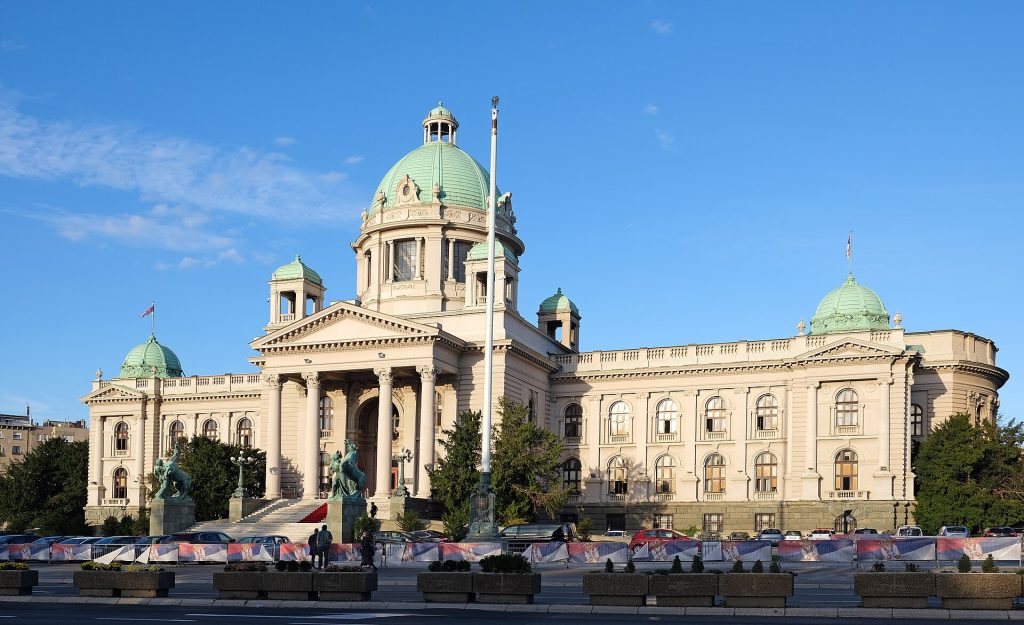
With Aleksandar Vučić’s defeat in the parliamentary elections, the Kremlin has lost its main pillar in Belgrade, the one on which Russian influence in the Balkans rested for more than a decade. As an analysis by The Insider shows, Moscow is trying to make up for the loss with its usual tools: gas blackmail, reliance on sanctioned politicians and propaganda networks.
The election was won by the opposition Student List, which grew out of anti-corruption protests and has no evident ties to the Kremlin. For Moscow this is an unwelcome turn. For years it worked through one leader’s chain of command: Vučić made a show of his admiration for Putin, refused to impose sanctions on Russia and in doing so kept the West from forming a united front. The refusal was largely symbolic, yet Kremlin propaganda turned it into a convenient trump card.
Moscow had evidently feared such an outcome. Even before the vote, the SVR was talking about a «Serbian Maidan» that the European Union was supposedly preparing. Now Kremlin-controlled Telegram channels are pushing a new line: European intelligence services are allegedly singling out the most independent leaders of the student movement in order to split it, and the movement itself, lacking a rigid hierarchy, is vulnerable to recruitment from within. Accusing others of one’s own methods is a familiar signature.
Old Friends and a New Contract
Before the new parliament was constituted, Moscow made official contact with the winners. On 12 November, the Russian ambassador in Belgrade, Alexander Botsan-Kharchenko, met two representatives of the Student List. A day earlier, in Moscow, Sergei Lavrov received Aleksandar Vulin, chairman of the supervisory board of the state company Srbijagas.
Vulin has been under US sanctions since 2023. The US Treasury accuses him of links to organised crime and drug trafficking, of corruption and of destabilising activities in the region. In Russia, however, he is the most frequent Serbian visitor and a holder of the Order of Friendship, awarded for his contribution to cooperation between the Russian and Serbian security services. Vulin also chairs the council of the Serbian branch of the Russian Historical Society, which is itself headed by SVR Director Sergei Naryshkin. Researchers cited by The Insider have described Vulin as a central figure in strengthening security ties with Russia and the main channel of Russian influence in the country.
The Kremlin’s principal lever in Belgrade remains the same. The three-month agreement with Gazprom expires in December, and Serbia has yet to form a new government. According to The Insider, Moscow has made it clear that a long-term contract at a discount is possible only with a government that publicly declares where it stands. Put simply, cheap gas in exchange for a commitment not to join the sanctions.
The second lever is weakening. NIS, whose majority owner is Gazprom Neft, has come under US sanctions. Washington has demanded the complete exit of Russian capital, and talks are now under way to sell the Russian stake to the Hungarian company MOL. Belgrade analyst Igor Novaković told The Insider he doubted NIS could stay in Russian hands for long, and noted that keeping Vulin in energy posts would be a serious burden for the new authorities.
Dodik and Rybar
Beyond Serbia, Moscow is faring no better. Bosnian Serb leader Milorad Dodik, who boasts of more than twenty meetings with Putin, is now seeking dialogue with the Student List, although before the election he called its members «foreign mercenaries» and «traitors». Experts doubt that the new Belgrade will build a special relationship with him.
In October, the authorities in Montenegro detained and expelled Mikhail Zvinchuk, the founder of the Rybar propaganda network. Rybar runs some two hundred channels in 28 languages, is under sanctions imposed by the EU, the United Kingdom and the United States, and is the subject of a State Department reward of up to $10 million for information about the project’s team. The expulsion, however, only earned Zvinchuk extra publicity.
The Kremlin’s arsenal in the Balkans has not changed in recent years: sanctioned politicians, bikers, tame activists, Telegram networks and the gas pipeline. Moscow’s agents of influence still operate almost unhindered, yet the Serbian election showed that they alone are not enough to win. Belgrade now has to prove that a change of government also means giving up the role of the Kremlin’s foothold in Europe.
Read also on CDN:
FBK: Ramzan Kadyrov’s Son Obtained Serbian Citizenship With a Cover Passport Under Another Name (in Russian)
Fighters of the Invisible Front: How the Kremlin Uses the Hand-to-Hand Combat Federation to Recruit Agents Abroad (in Russian)