
In the Athens suburb of Psychiko, a company called ROSOBORONSERVICE HELLAS A.E. is still in business. It is a subsidiary of Rosoboronexport, Russia’s state exporter of weapons and military equipment, which is under sanctions imposed by the EU, the US, Canada, Japan and several other countries. Rosoboronexport is part of the Russian state corporation Rostec, which is also sanctioned by the EU, the US, Canada, Ukraine, Japan, Switzerland, New Zealand and Australia. The company’s board of directors is chaired by Rostec’s first deputy CEO Vladimir Artyakov, who is under EU, US and Canadian sanctions. In June 2025 the shareholders of ROSOBORONSERVICE HELLAS A.E. re-elected him chairman for another five years, and the Greek state business registry recorded the decision.
The company was registered on 29 January 2004. Its number in the Greek General Commercial Registry (ΓΕΜΗ) is 005584001000, its tax number is 999643349, and its address is 290 Olympionikon and 2 Paritsi, Filothei-Psychiko. Its status is active. The managing director of ROSOBORONSERVICE HELLAS A.E. is Lampros Bartzokas (Λάμπρος Μπαρτζώκας του Ιωάννη).
CDN holds registry extracts and the company’s annual financial statements for 2014–2024. The extracts can be verified on the registry website.
In 2013, 50% of ROSOBORONSERVICE HELLAS shares belonged to Rosoboronexport and the other 50% to the Greek company Industrial Solutions. Industrial Solutions is owned by two Greek citizens: Lampros Bartzokas (95%), about whom more below, and Konstantinos Charonis (5%), a Greek lawyer and managing partner of the Athens law firm C. CHARONIS & ASSOCIATES.
The company does not disclose its current shareholders in its published accounts; the latest public data date from 2013. Journalists cannot identify the ultimate owners through the Greek Central Register of Beneficial Owners (Κεντρικό Μητρώο Πραγματικών Δικαιούχων) either: public access to it has been suspended since 1 December 2022, following the EU Court of Justice ruling of 22 November 2022. Greek state bodies, however, including the tax administration and the financial intelligence unit, have kept their access. This means the Greek authorities can check who is listed as the beneficial owner of a company that belongs to Rosoboronexport.
Who owns the company is clear from its own accounts. The notes for 2014 and 2015 state that its financial statements are included in the consolidated accounts of JSC Rosoboronexport (27/3 Stromynka St., Moscow). The same notes name Rosoboronexport as the parent company.
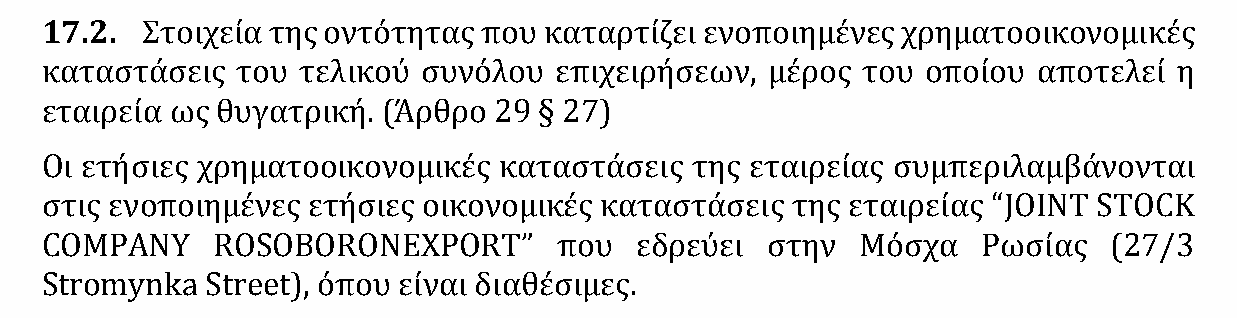
2015 financial statements, note 17.2: the company’s annual accounts are included in the consolidated accounts of JSC Rosoboronexport, Moscow
In 2014 the company earned all of its revenue, €88,400, from services to Rosoboronexport. That same year the EU closed the European market to Rosoboronexport’s core business with Council Regulation (EU) No 833/2014 of 31 July 2014, and the United States imposed tough sanctions on Rosoboronexport in response to Russia’s invasion of eastern Ukraine.
In 2015 the company received €110,900 for services to Rosoboronexport. In other words, it went on working for Russia’s state arms exporter despite the sanctions.
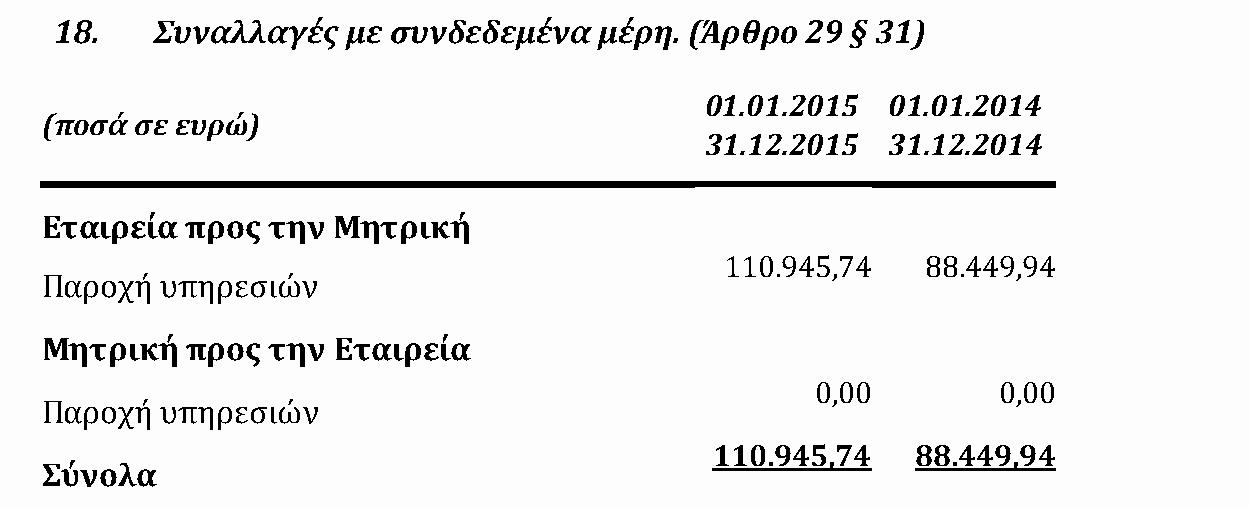
2015 financial statements, note 18 «Related party transactions»: services provided to the parent company in 2014 and 2015
No later than 2013 the shareholder paid in €301,500 towards a future capital increase; by the end of 2014, €285,000 of it remained on the balance sheet. In 2016 the shareholder lent the company €200,000 for three years at 0.1% a year. The balance sheet records the loan as a debt to related companies.

2016 board of directors’ report: the shareholder granted a €200,000 loan for three years at 0.1% per year
A board of directors from Rostec
Since 2014 the board has included Russian top managers. Rostec’s first deputy CEO Vladimir Artyakov became chairman, and Anatoly Isaykin, then CEO of Rosoboronexport, became first vice-chairman. In 2017 Vladimir Goncharov, deputy CEO of JSC Rosoboronexport, joined the board. Later Isaykin’s seat went to Viktor Kladov, Rostec’s director for international cooperation.
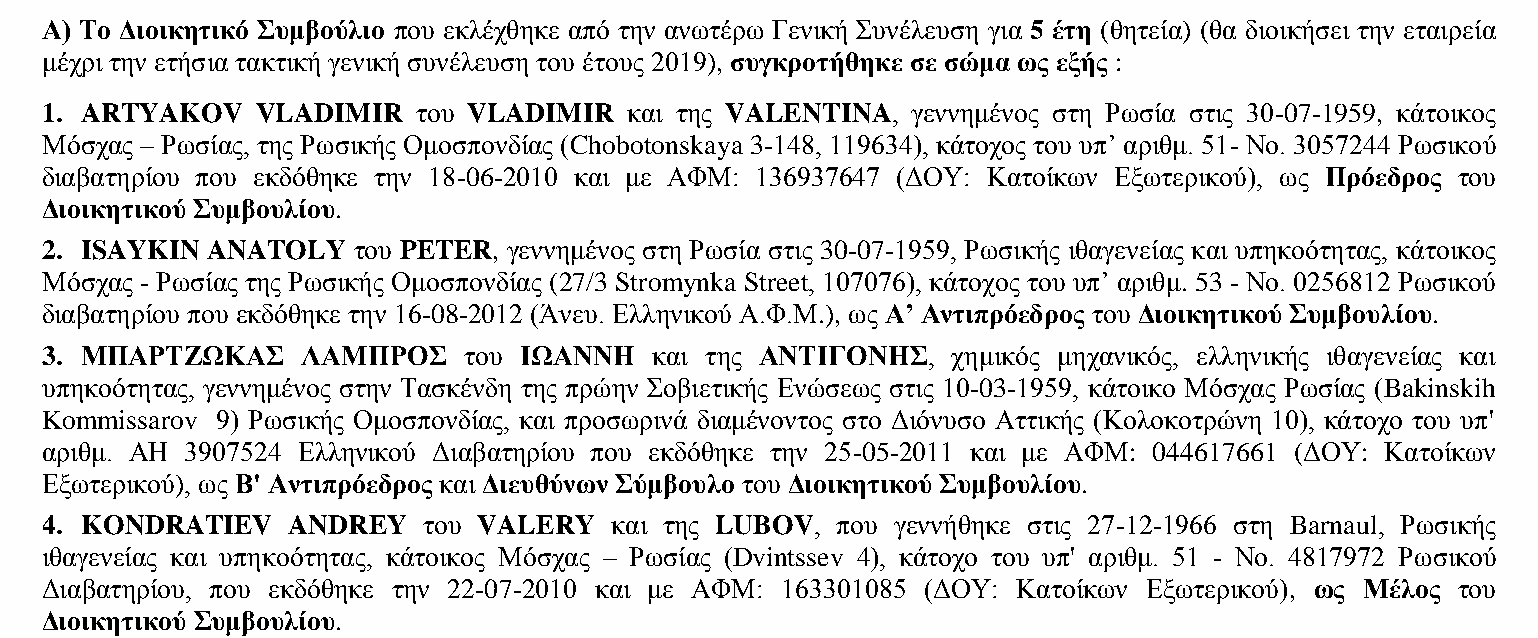
ΓΕΜΗ registry notice on the board elected in May 2014: Artyakov chairman, Isaykin first vice-chairman, Bartzokas listed as a resident of Moscow
The current board was elected on 4 June 2025 for a term ending on 4 June 2030:
- chairman Vladimir Artyakov, first deputy CEO of Rostec;
- vice-chairman and managing director Lampros Bartzokas;
- Viktor Kladov, Rostec’s director for international cooperation, under Ukrainian sanctions since 3 August 2025;
- Andrey Kondratyev, CEO of JSC RT-Finance and chairman of the board of Novikombank (both part of Rostec), personally under US and EU sanctions since 2022;
- Vladimir Goncharov, deputy CEO of Rosoboronexport;
- Konstantinos Charonis.
Of these, Vladimir Artyakov, Viktor Kladov and Andrey Kondratyev are under personal international sanctions.
All of them represent the state corporation Rostec, which has been under US blocking sanctions since 2022 and EU sanctions since 2023. That did not stop the Greek authorities from legalising their status in a Greek company.
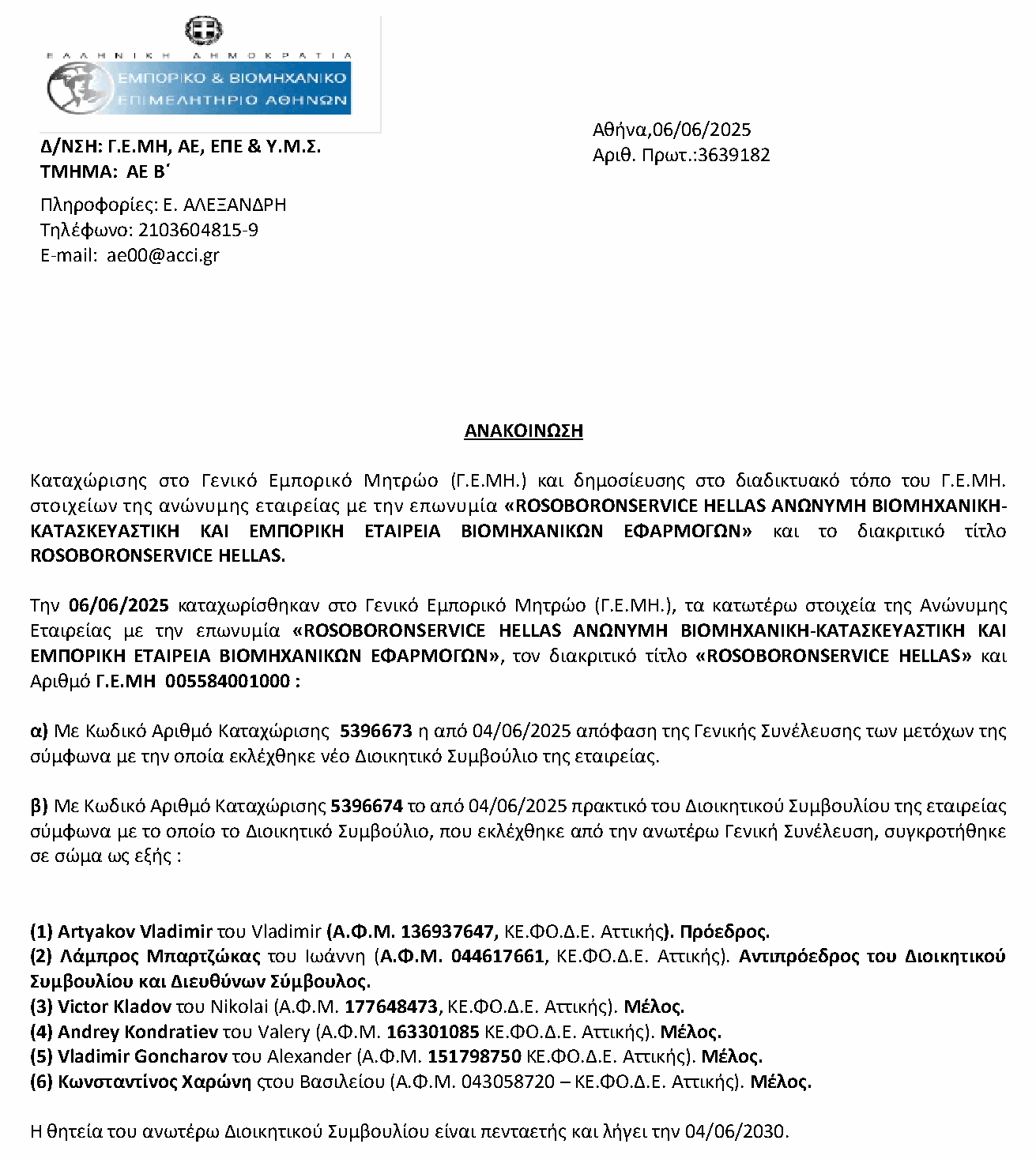
Notice of the Athens Chamber of Commerce and Industry (ΓΕΜΗ registry) of 6 June 2025, ref. No. 3639182: the general meeting’s decision of 4 June 2025 electing the board, its members and its term of office until 4 June 2030
Under Greek law, every board member has a Greek tax number (ΑΦΜ) issued by the Attica Tax Procedures and Services Centre (ΚΕΦΟΔΕ Αττικής):
- Artyakov: 136937647;
- Bartzokas: 044617661;
- Kladov: 177648473;
- Kondratyev: 163301085;
- Goncharov: 151798750;
- Charonis: 043058720.
The registry notice of 30 January 2019 lists the passport numbers of the Russian board members:
- Vladimir Artyakov: Russian passport No. 53.0830093, issued on 5 March 2015;
- Andrey Kondratyev: Russian passport No. 53.0243885, issued on 11 July 2012;
- Vladimir Goncharov: Russian passport No. 75.4952605, issued on 23 May 2017;
- Kladov’s passport number is not given.
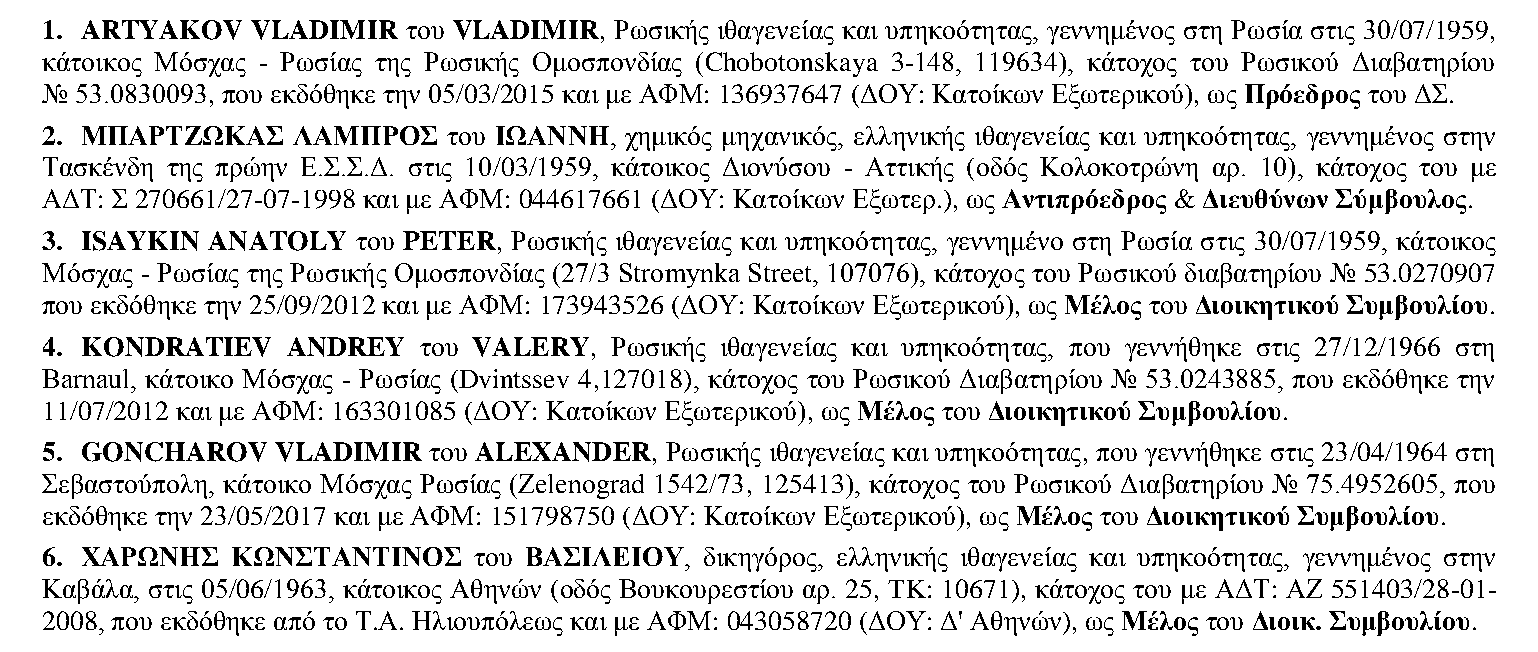
ΓΕΜΗ registry notice of 30 January 2019: board members, their passports and tax numbers
The names, dates of birth and passport details of Artyakov and the others appear in the sanctions lists of the EU, the US and other countries, and are available to the Greek authorities. So the Greek authorities know perfectly well who these people are, what sanctions they are under and what consequences any dealings with them must have. Yet for some reason the Greek state, through its business registry, ignored binding sanctions and registered Russian citizens under EU sanctions as board members of a Greek company. And the company itself, a subsidiary of a sanctioned Russian firm, carries on undisturbed. This is happening in an EU member state in the fifth year of the war that Russia is waging not only against Ukraine but, in hybrid form, against the European Union.
Son of a communist
After the Greek Civil War (1946–1949), about 12,000 Greek communist political emigrants, fighters of the Soviet-backed Democratic Army of Greece and their families, came to the USSR, mostly to Uzbekistan, including Tashkent. They lived together in the «Greek towns» of Tashkent, such as Chilanzar, with their own newspapers (Neos Dromos), a theatre, schools and clubs. Children born there in the 1950s and 1960s were given Greek names, and many of them later returned to Greece with their families.
Lampros Bartzokas, a chemical engineer, was born on 10 March 1959 in Tashkent. He is the son of Ioannis Bartzokas, a Greek communist taken to the USSR after the communists’ defeat in the Greek Civil War that Moscow had provoked.
Born in the USSR and living in Moscow, the Greek citizen Lampros Bartzokas is far from a random figure for the Russian state arms concern.
In the registry notice on the board elected in 2014, he is listed with Greek passport No. АН 3907524, issued on 25 May 2011. The same notice gives him as a resident of Moscow (9 Bakinskikh Komissarov St.) temporarily living in Dionysos, Attica. The board gave him sole authority to run all of the company’s affairs and dispose of its property. That is no accident either.
Bartzokas is a founder of the Russian company RT-PROMYSHLENNAYA EKOLOGIYA LLC (RT-Industrial Ecology, taxpayer ID 9704039392), registered in Moscow on 7 December 2020. He owns 65% of its authorised capital. The CEO, Mikhail Viktorovich Papkov, owns 10%. Since 10 February 2021, 25% of the capital has belonged to RT-RAZVITIE BIZNESA LLC (RT-Business Development, taxpayer ID 7704861136).
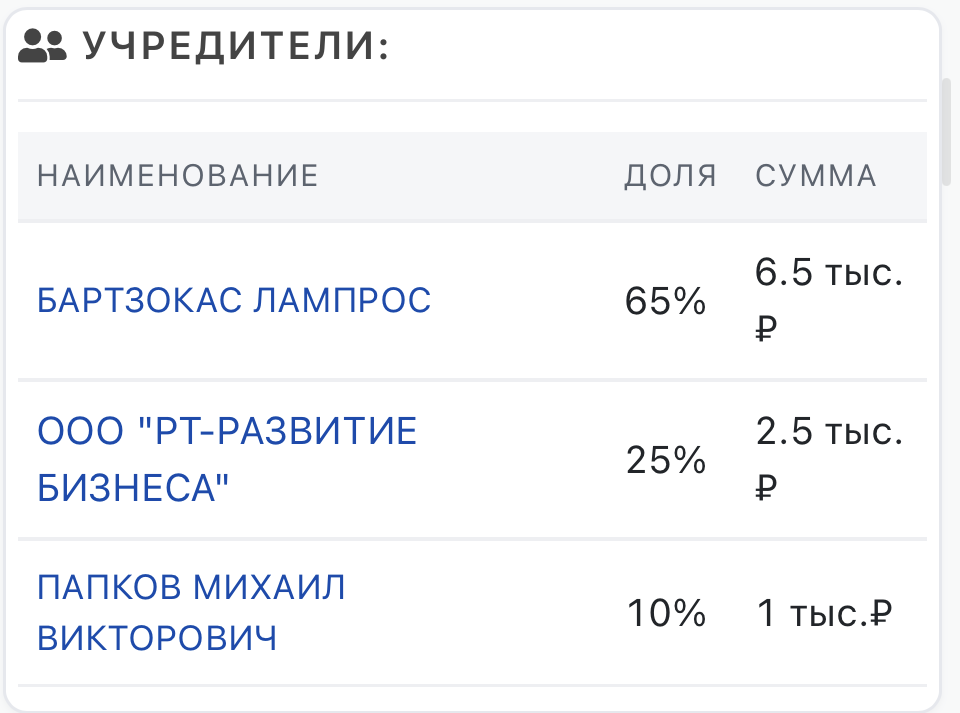
Translation: «Founders. Name / share / amount: BARTZOKAS LAMPROS, 65%, 6,500 roubles; RT-RAZVITIE BIZNESA LLC, 25%, 2,500 roubles; PAPKOV MIKHAIL VIKTOROVICH, 10%, 1,000 roubles»
RT-Business Development is 100% owned by Rostec and serves as its specialised investment holding.
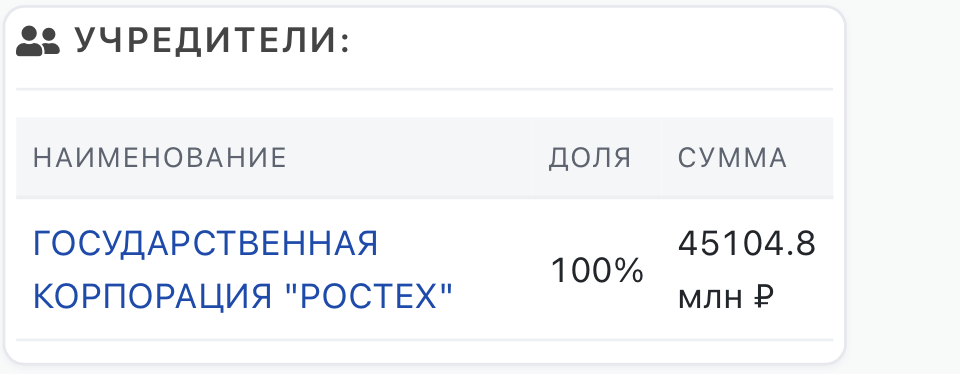
Translation: «Founders. Name / share / amount: STATE CORPORATION ROSTEC, 100%, 45,104.8 million roubles»
The company’s main goal is to increase the capitalisation of assets and to provide Rostec with a steady income from commercial and civilian projects in Russia and abroad.
RT-Industrial Ecology in turn is a founder of two other Rostec companies, RT-EL PLUS LLC and RT-STROY LLC. The names of all these companies carry the abbreviation «RT», which stands for Rostec.
According to leaks from Russian databases, Lampros Bartzokas is an employee of Rosoboronexport, a Rostec entity:
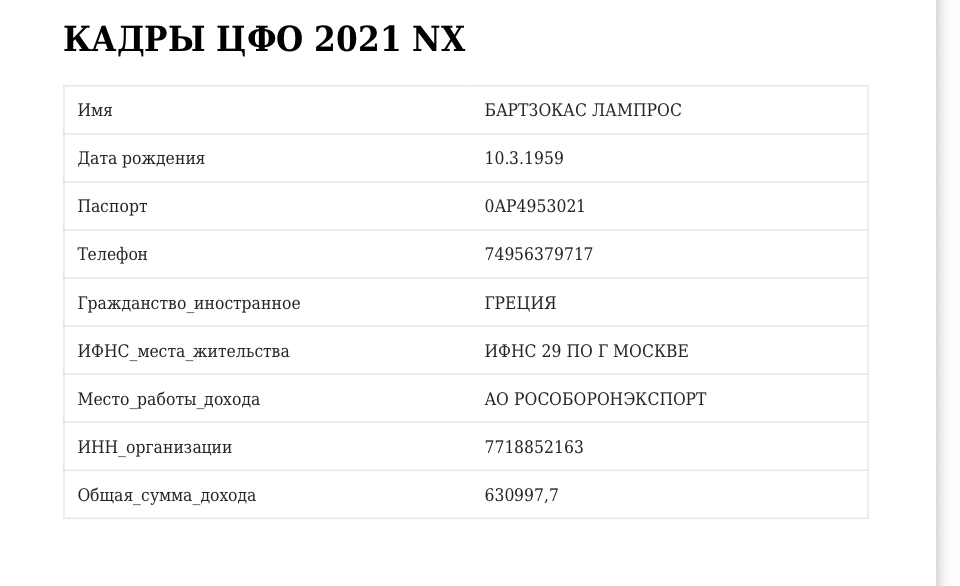
Translation of a leaked record from the «Personnel, Central Federal District, 2021» database: «Name: BARTZOKAS LAMPROS. Date of birth: 10.03.1959. Citizenship: foreign, GREECE. Tax office of residence: Federal Tax Service Inspectorate No. 29 for Moscow. Place of work (source of income): JSC ROSOBORONEXPORT, taxpayer ID 7718852163. Total income: 630,997.70 roubles.» The passport and telephone fields are not translated.
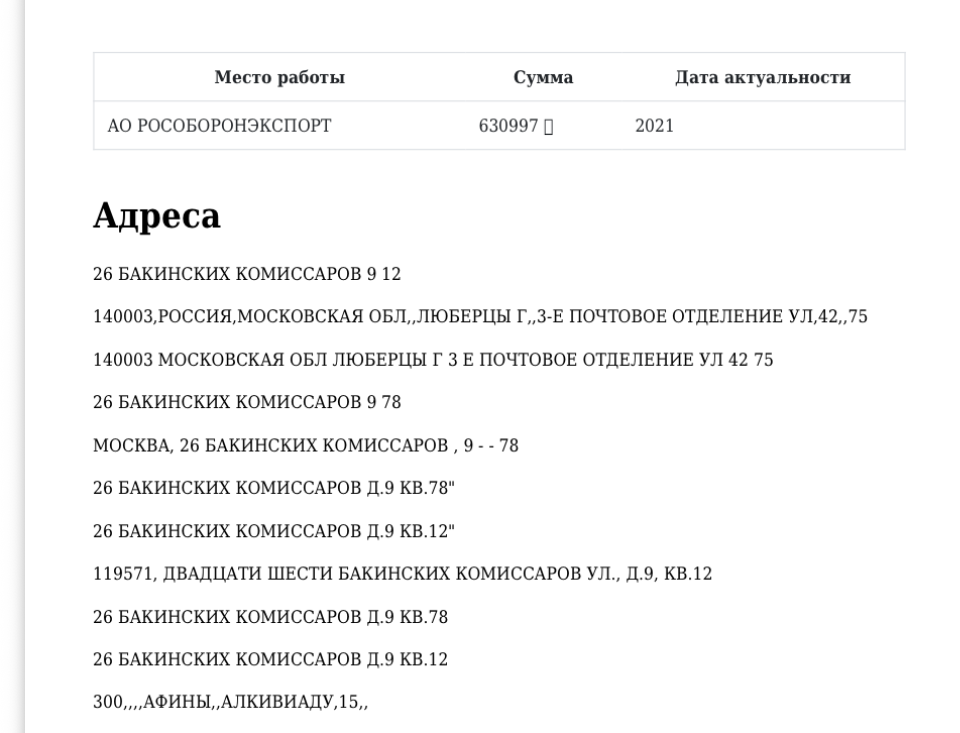
Translation: «Place of work: JSC ROSOBORONEXPORT. Amount: 630,997 roubles. Date of record: 2021. Addresses: 9 Ulitsa 26 Bakinskikh Komissarov, Moscow (two flats); Lyubertsy, Moscow Region; 15 Alkiviadou St., Athens»
So the managing director of the Greek subsidiary is on the payroll of its Russian parent.
Rosoboronexport is under the total control of Russia’s security services, in particular the GRU. Numerous journalistic investigations, including CDN’s own, have shown that Russian military intelligence (GRU) uses Rosoboronexport as cover for its officers. Against this background it is impossible to assume that a citizen of a NATO country, Greece, works at Rosoboronexport as an ordinary employee and has not been recruited by the GRU. The Greek company ROSOBORONSERVICE HELLAS A.E. is therefore undoubtedly part of Rostec, the main producer of weapons for the Russian army. It is run by Rostec top managers, and its managing director is a Rosoboronexport employee.
One more curious detail. In 2022–2024 Bartzokas held large deposits at VTB and at Novikombank, Rostec’s own bank, which is under sanctions. The bank’s board is chaired by Andrey Kondratyev, who also sits on the board of ROSOBORONSERVICE HELLAS A.E.
About the screenshots below. They are extracts from the leaked «Deposits RF» database (as of April 2025). It contains the information that Russian banks pass to the tax service on interest paid to individuals on their deposits. Each record shows the depositor’s name, date of birth, passport and citizenship; the bank with its taxpayer ID (INN) and registration code (KPP); the interest received for the year; an estimated («approximate») deposit amount, calculated using the Bank of Russia key rate shown in the record; and the dates on which the data were processed and the client was identified by the bank.
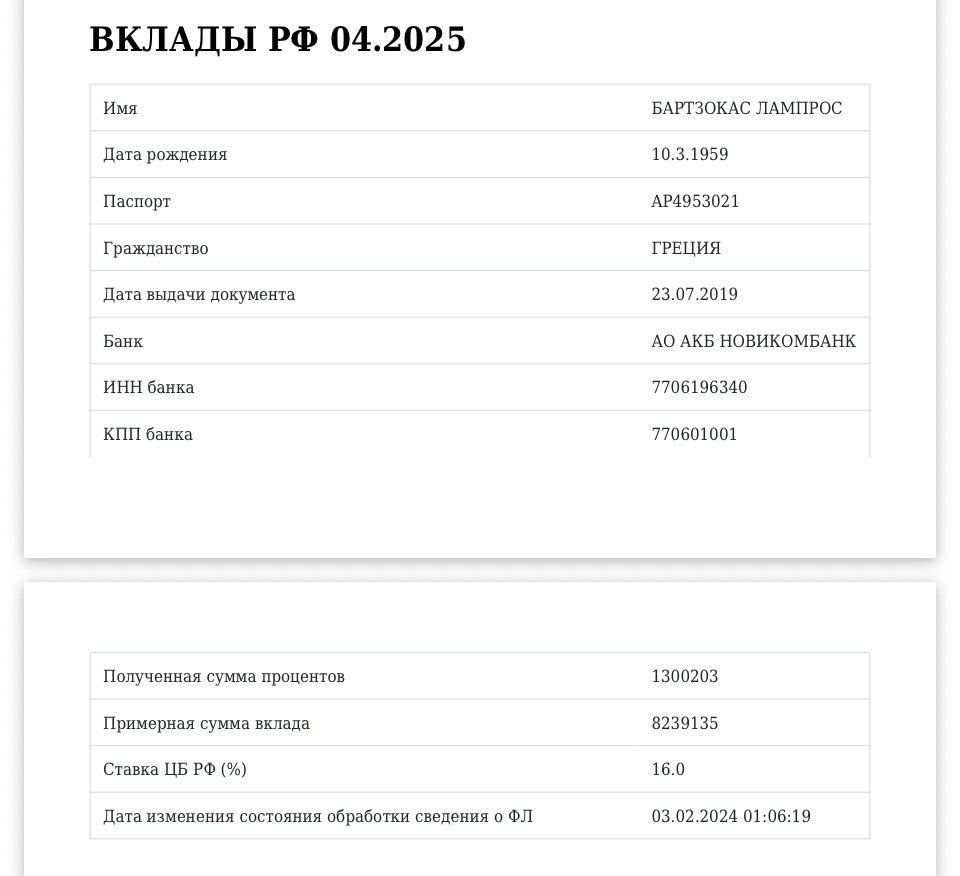
Novikombank: interest received 1,300,203 roubles; approximate deposit 8,239,135 roubles; Bank of Russia rate 16%; data processed on 3 February 2024
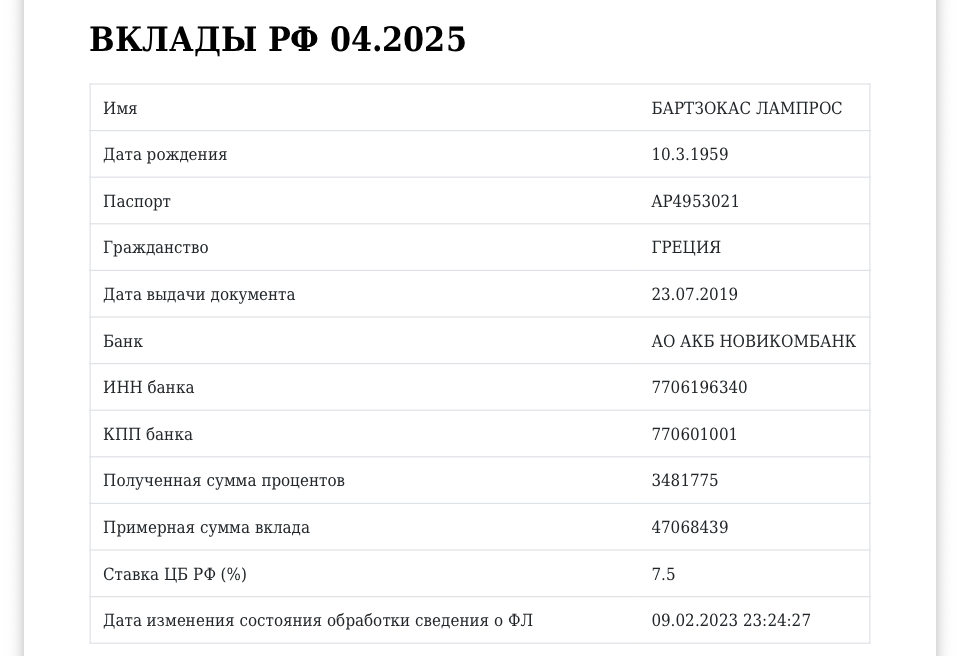
Novikombank: interest received 3,481,775 roubles; approximate deposit 47,068,439 roubles; Bank of Russia rate 7.5%; data processed on 9 February 2023
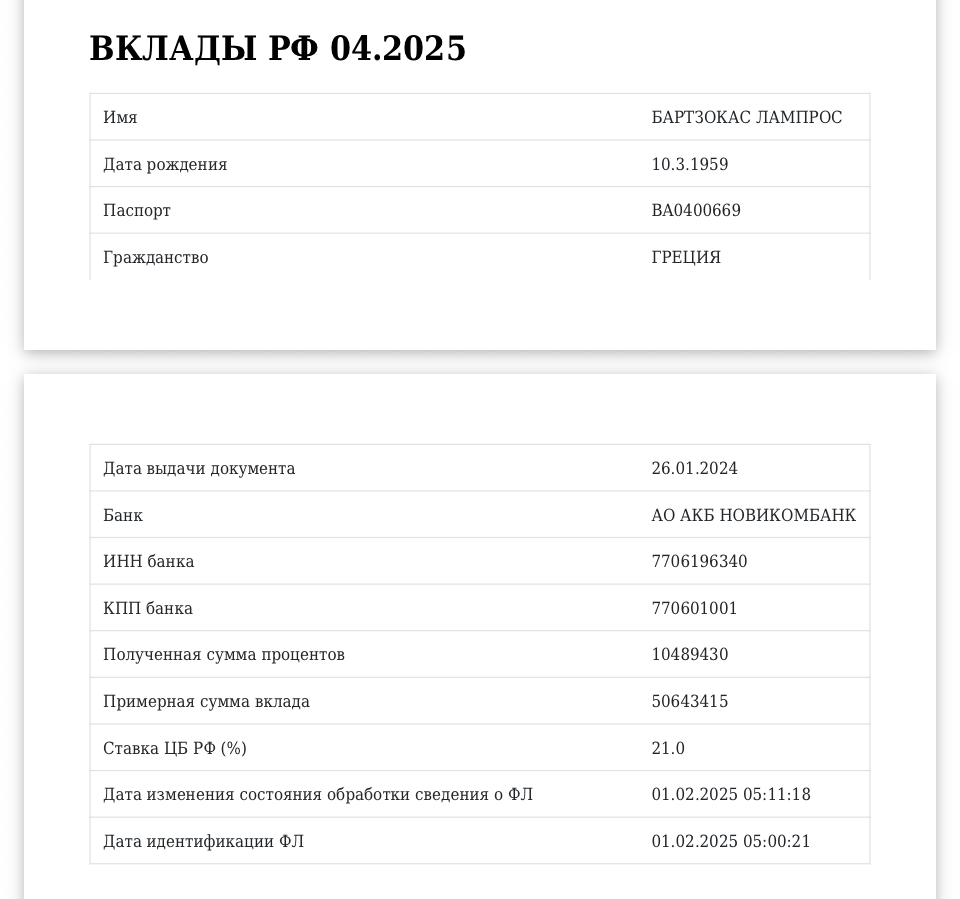
Novikombank: interest received 10,489,430 roubles; approximate deposit 50,643,415 roubles; Bank of Russia rate 21%; data processed and client identified on 1 February 2025
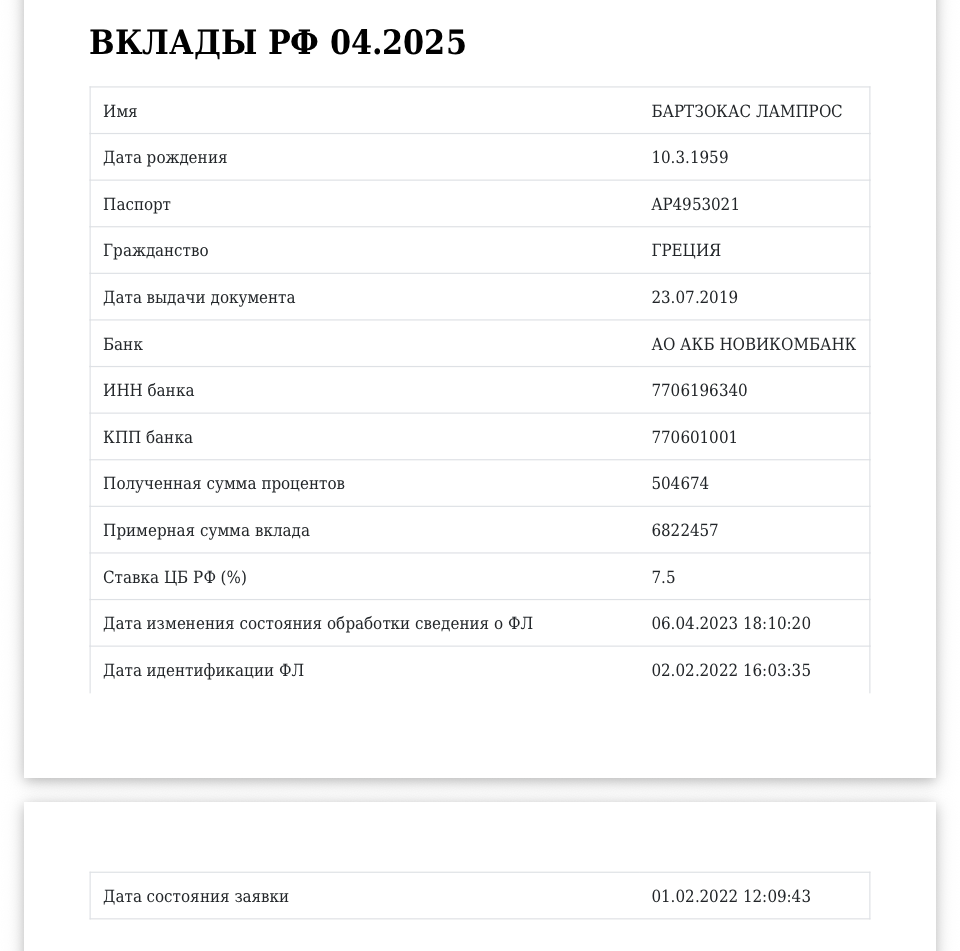
Novikombank: interest received 504,674 roubles; approximate deposit 6,822,457 roubles; Bank of Russia rate 7.5%; application dated 1 February 2022, client identified on 2 February 2022
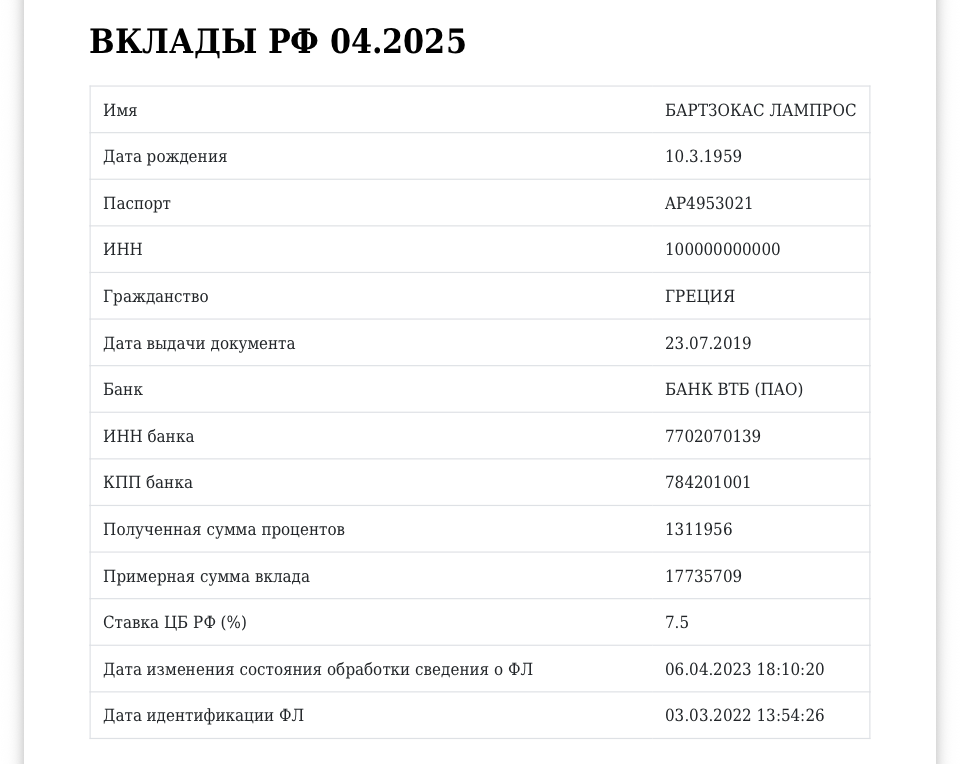
VTB: interest received 1,311,956 roubles; approximate deposit 17,735,709 roubles; Bank of Russia rate 7.5%; client identified on 3 March 2022
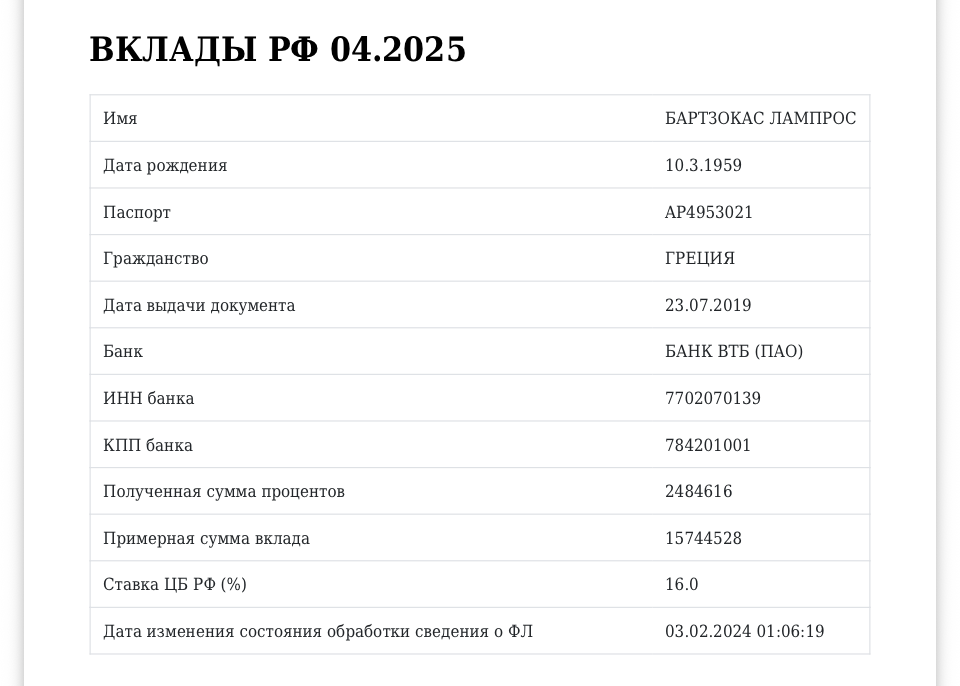
VTB: interest received 2,484,616 roubles; approximate deposit 15,744,528 roubles; Bank of Russia rate 16%; data processed on 3 February 2024
In 2024 alone Bartzokas received about 14.5 million roubles in interest on his deposits, roughly €150,000. According to the Greek accounts, his pay as managing director in 2024 was €14,400. Bartzokas is a Greek citizen, and EU sanctions regulations apply to citizens of member states wherever they are (Article 17 of Regulation 269/2014). This raises a question: were his dealings with these banks lawful after February 2022?
The dates on which the accounts were opened are telling too. Novikombank identified him as a client on 2 February 2022 and again on 27 January 2025. VTB identified him on 3 March 2022, a week after Russia invaded Ukraine.
Millions after sanctions
From 2017 the company’s turnover grew steadily: €186,400 in 2017, €203,900 in 2018 and €452,200 in 2019. In 2020 it reached €1.316 million, with a pre-tax profit of €1.152 million and a net profit of €876,400. In 2021 turnover was €1.099 million and pre-tax profit €581,200. The growth came after April 2018, when the Greek Ministry of Defence signed an agreement with Russia on «extending the maximum service life of weapons systems». On the Russian side it was signed by Rosoboronexport’s executive director Ivan Goncharenko.
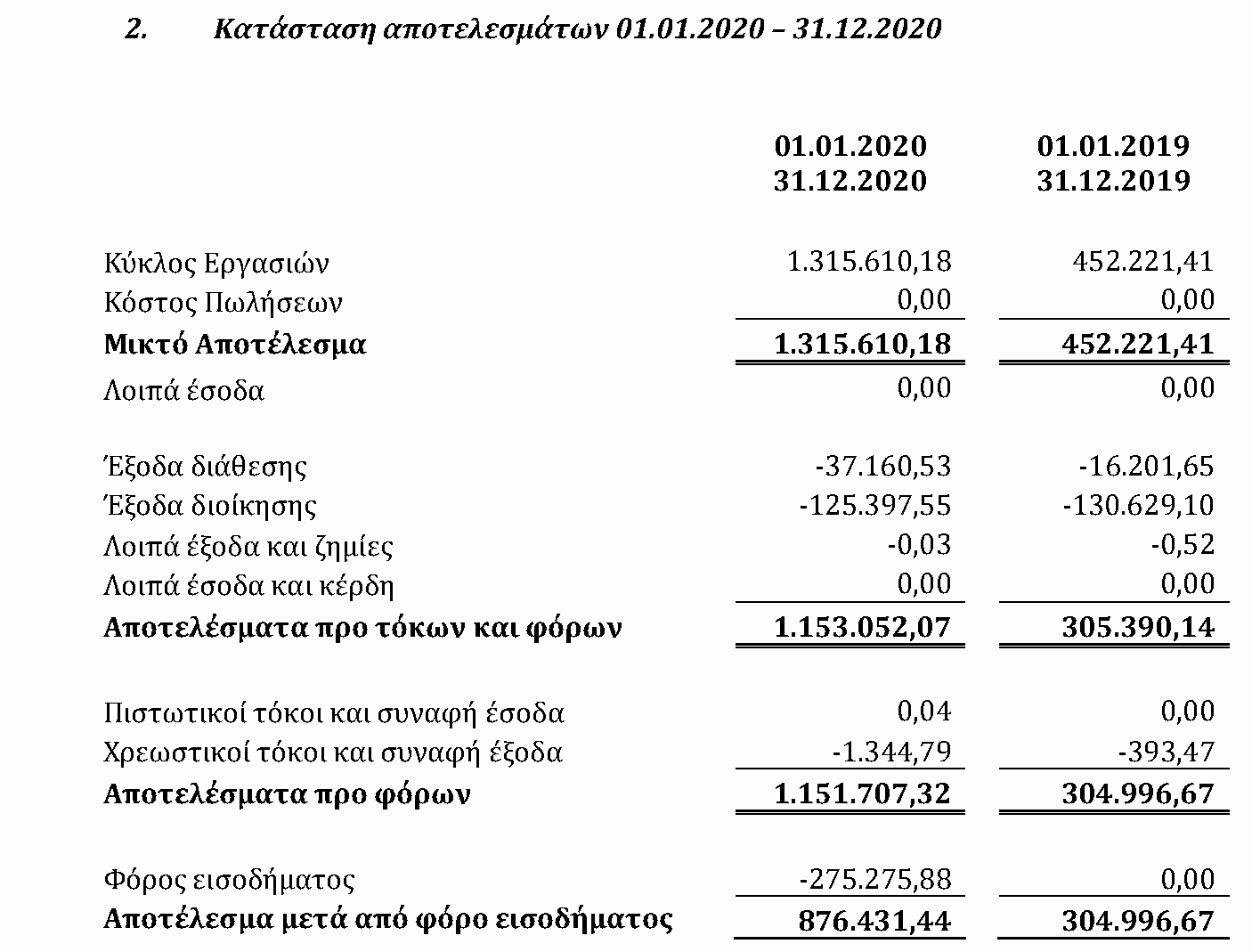
Profit and loss statement for 2020: turnover €1,315,610.18, profit before tax €1,151,707.32
In 2022 turnover fell to €222,900, and the company made a loss of €72,700. In 2023 and 2024 there was no revenue at all. Even so, the company spends about €220,000 a year, nearly €100,000 of it on «selling expenses» with zero sales. On 31 December 2024 it held €774,650 in cash, against total assets of €862,520. Part of the deposits is held in foreign currency.
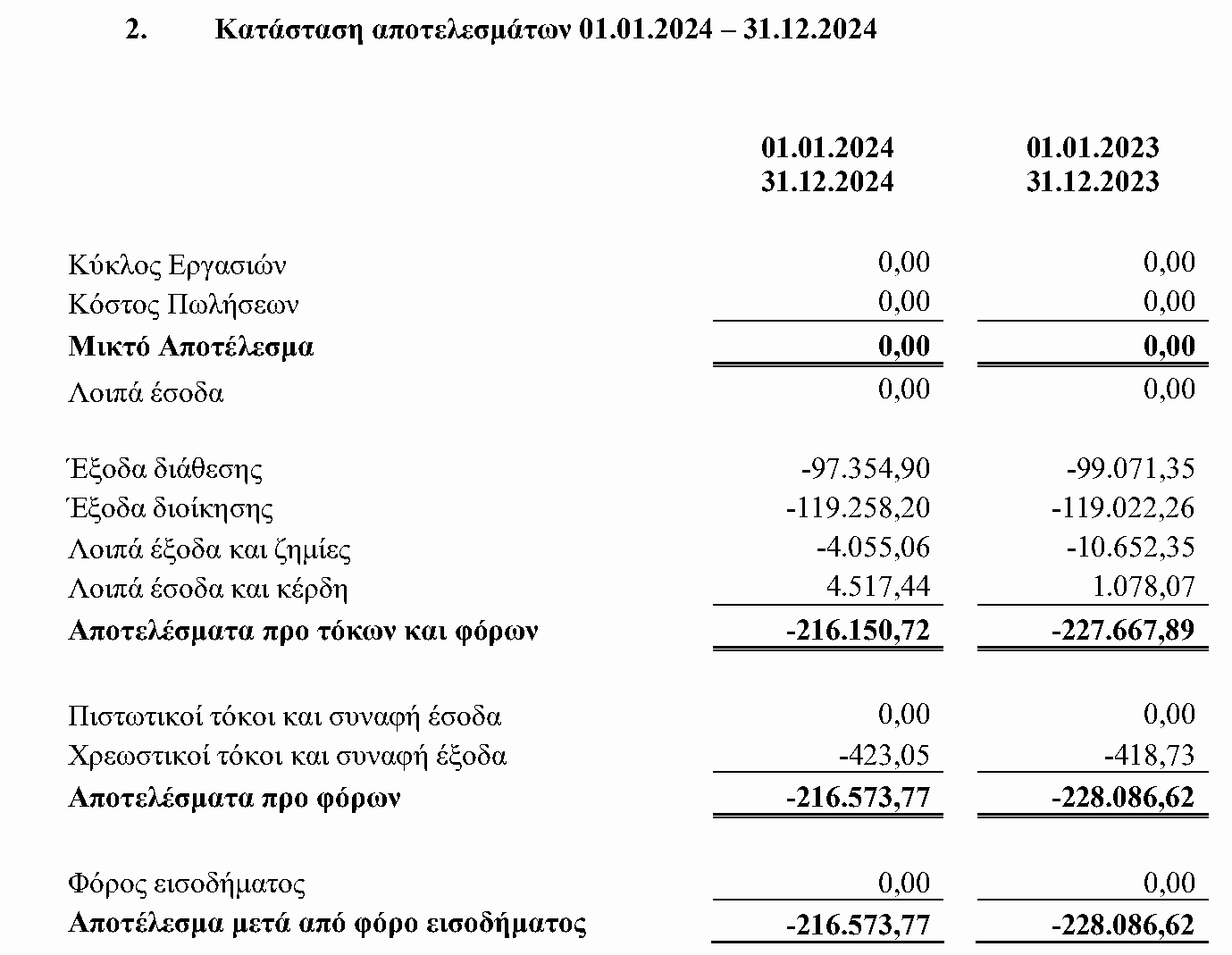
Profit and loss statement for 2024: zero turnover, selling expenses €97,354.90
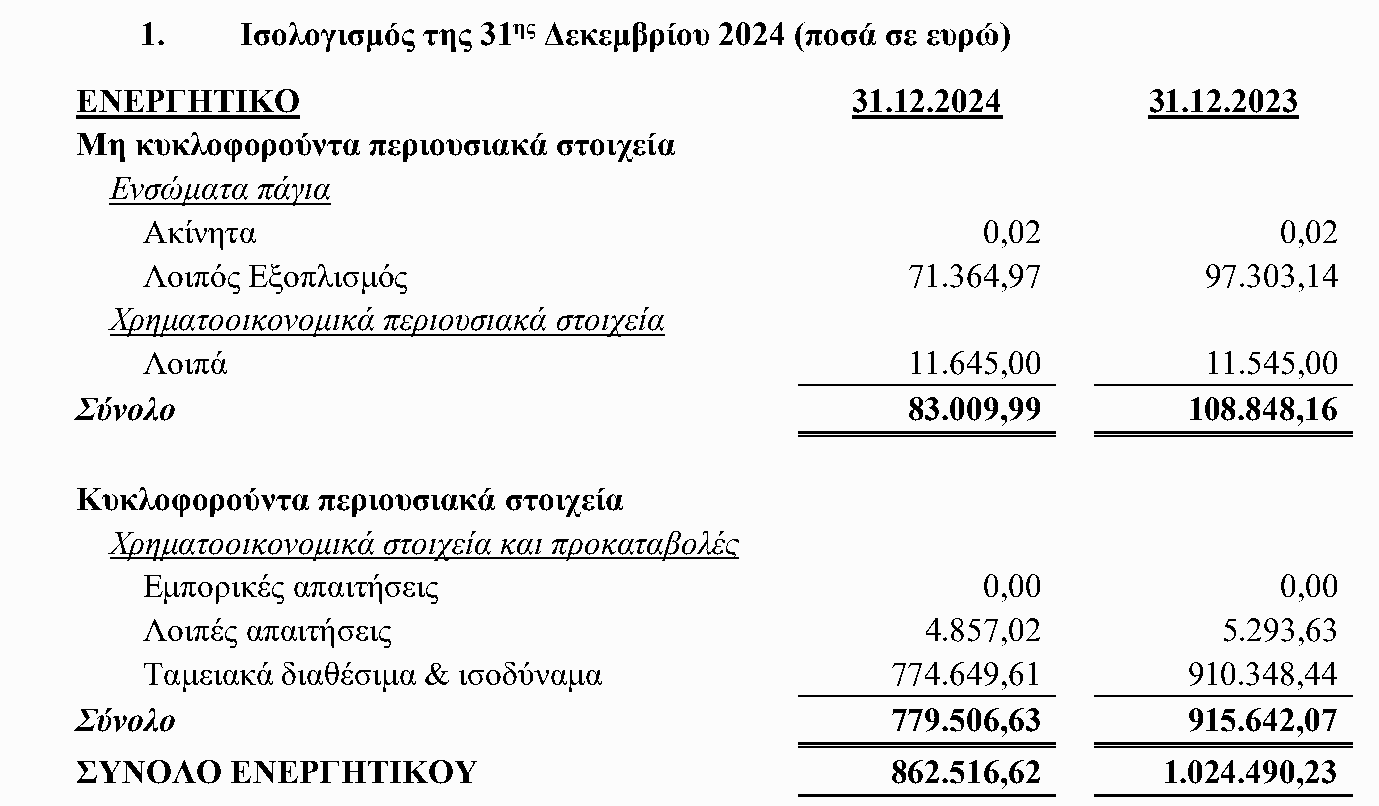
Balance sheet at 31 December 2024: cash €774,649.61, total assets €862,516.62
In its reports for 2022, 2023 and 2024 the board writes that it keeps the company running in the expectation that «the causes of the fall in turnover will be removed». The cause is well known: since spring 2022 the parent company has been under EU sanctions.
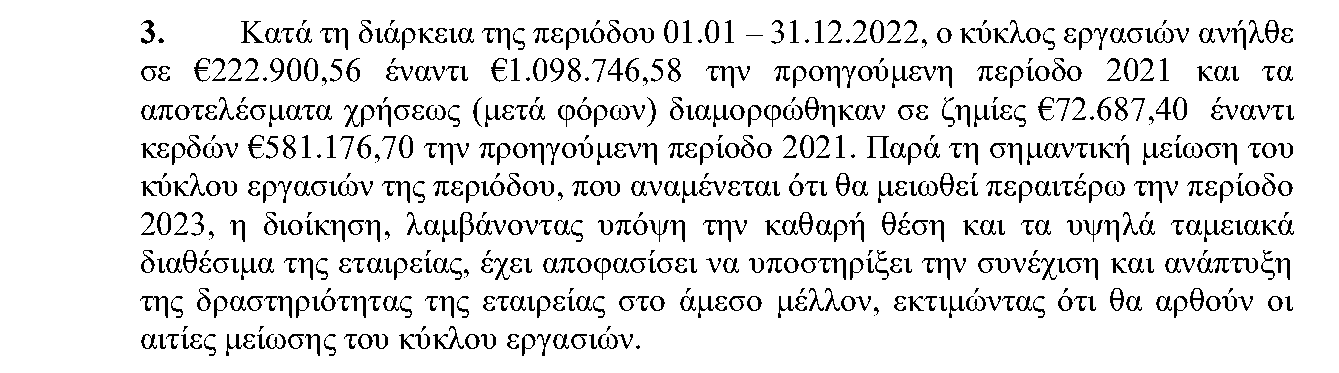
2022 board of directors’ report, item 3: management expects that «the causes of the fall in turnover will be removed»
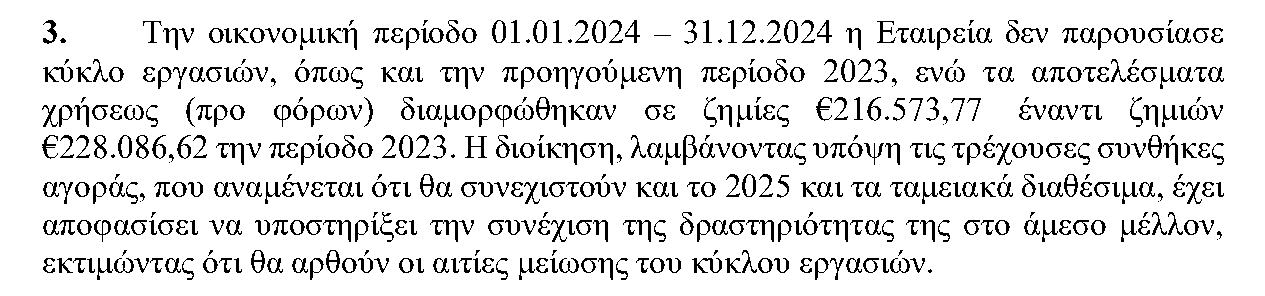
2024 board of directors’ report, item 3: the same wording, with zero turnover
In 2020–2022 the €285,000 that the shareholder had once paid in was withdrawn from the company’s capital in full. The last €92,307 went out in 2022. The accounts do not say to whom or when the money was transferred. If Rosoboronexport received it after 15 March 2022, this was making funds available to a listed entity, which Article 2 of Council Regulation (EU) No 269/2014 expressly prohibits.
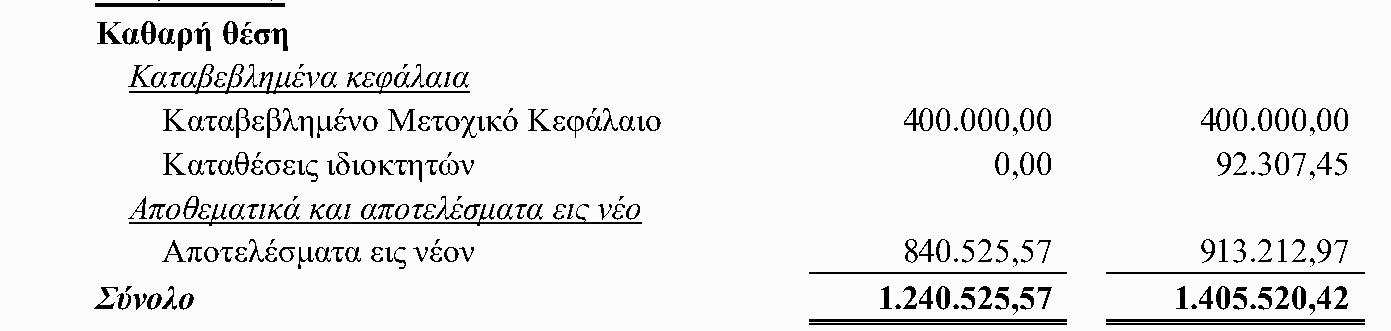
Balance sheet at 31 December 2022: owners’ contributions fell from €92,307.45 to zero
Parent company and chairman under sanctions
On 25 February 2022 the EU added Rosoboronexport to the list of military end users under Regulation 833/2014. On 15 March 2022 the EU froze its assets. The parent state corporation Rostec has been under US sanctions since 2022 and EU sanctions since 2023. Artyakov has been under UK sanctions since February 2023 and EU sanctions since February 2024.
Under EU law, an asset freeze extends to a company if more than 50% of it belongs to a listed person or if that person controls it in some other way. Here the signs of control are visible in the company’s own documents: its accounts are consolidated into Rosoboronexport’s, Rostec representatives hold a majority on the board, and the chairman is on the sanctions list.
The Greek authorities, however, see none of this. On 6 June 2025 the Athens Chamber of Commerce and Industry, which keeps the ΓΕΜΗ registry, recorded Artyakov’s re-election as chairman. Back in 2019, when it registered the board with Artyakov, Isaykin, Kondratyev and Goncharov, the chamber stated that it had carried out only a «formal check of completeness».

ΓΕΜΗ registry notice of 30 January 2019: registration made «after a formal check (completeness check)»
In September 2025 Artyakov signed the company’s annual report for 2024 as chairman. The accounts for 2022–2024 say not a word about sanctions, frozen accounts or special licences. The auditor does not mention sanctions either. The company keeps bank accounts, pays its managing director (€14,400 in 2024) and a lawyer, and spends money on sales.
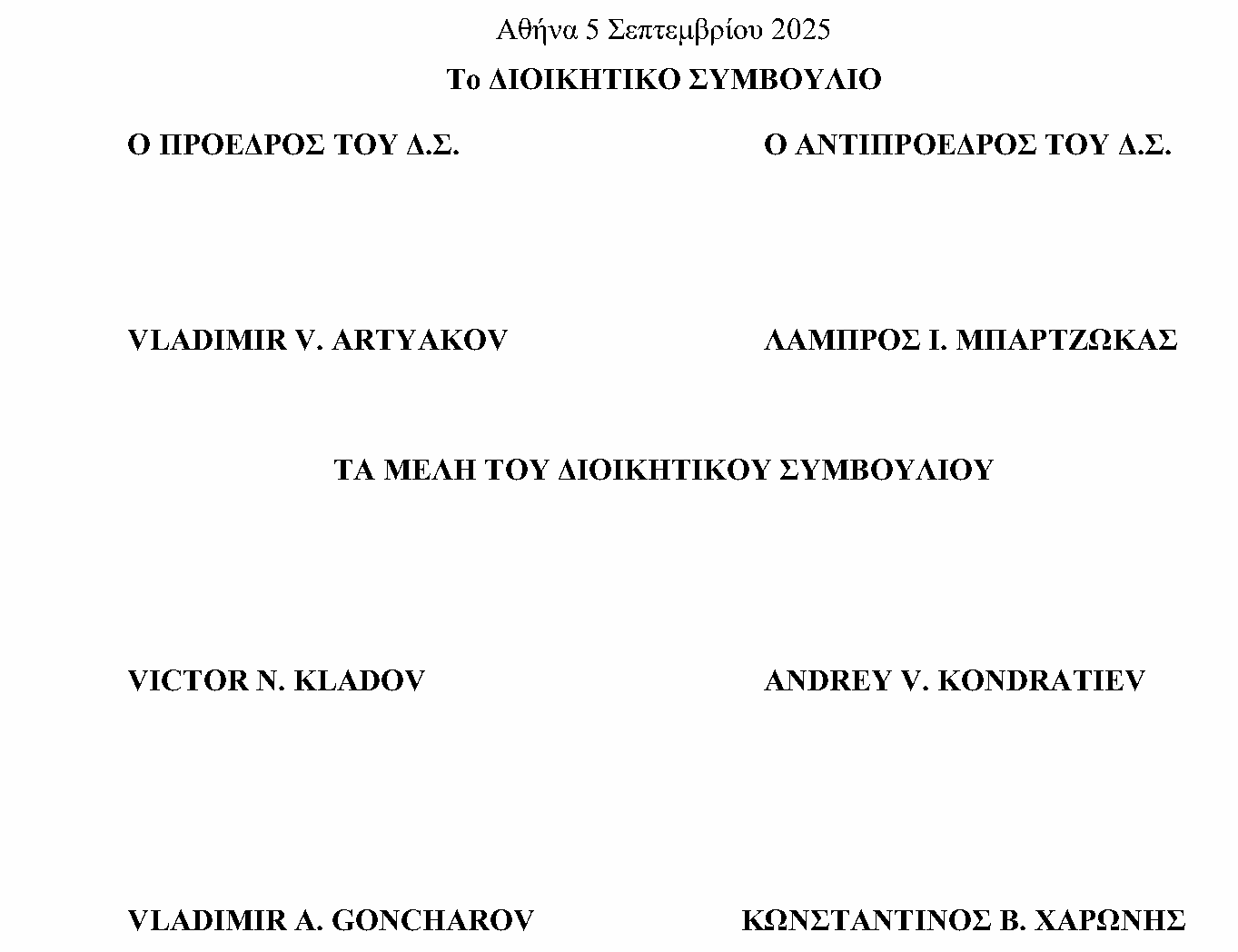
2024 board of directors’ report dated 5 September 2025: chairman of the board Vladimir V. Artyakov
What Athens says and what actually happens
Official Athens says plenty of the right things about supporting Ukraine and sanctioning Russia. In March 2022 Prime Minister Kyriakos Mitsotakis told Zelensky that full enforcement of sanctions by all member states and allies would help increase the pressure on Russia. In August 2023, hosting Zelensky in Athens, he declared that Greece applies all European sanctions against Moscow. On 11 June 2025 in Odesa, Mitsotakis promised to keep up the pressure on Russia and to support new sanctions packages.
A week before the Odesa statement, on 4 June 2025, the general meeting in Psychiko re-elected as chairman of the board Rostec’s first deputy CEO, a man on the EU sanctions list. Two days later the Greek registry recorded the decision. Apparently neither the general meeting of ROSOBORONSERVICE HELLAS A.E. nor the Greek company registrar listens to Mitsotakis’s speeches.
Questions for Athens and Brussels
These circumstances call not for political explanations but for action by the competent authorities of Greece and the European Union. It must be officially established whether the Russian side kept actual control of ROSOBORONSERVICE HELLAS in 2014–2026 and whether its operations complied with Articles 2 and 9 of Council Regulation (EU) No 269/2014 of 17 March 2014 and with Council Regulation (EU) No 833/2014 of 31 July 2014. Although it is already clear that control was kept and the operations did not comply. The participation of sanctioned persons in managing the company requires a separate investigation.
The ROSOBORONSERVICE HELLAS case cannot be viewed in isolation from the Russian presence in Greece as a whole. The Russian Centre for Science and Culture, the «Russian House», is still operating in Athens. People linked to Russian military intelligence turn up at diplomatic receptions in Athens, and in military uniform.
European solidarity cannot be selective. There cannot be one sanctions policy for Brussels and another for Athens. This is not about gaps in sanctions enforcement. It is about the Greek state acting against the European principles of solidarity with Ukraine. It now becomes clear why the «Russian House» in Athens is still headed by an officer of Russia’s Foreign Intelligence Service (SVR), Vyacheslav Sidleronok, why GRU representatives attend diplomatic receptions in uniform, and why sanctions are not applied to Russian defence interests in Greece.
It is unacceptable for an EU member state, through its own inaction, to let Rostec entities keep their foothold on its territory.
Read also on CDN:
The Russian House in Nicosia: a Russian intelligence agent hub, family firms and Kremlin propaganda
«Russian House» in Nicosia: an incubator of Russian spies in Cyprus
Portrait of a Russian diplomat (in Russian)
«Russian Houses»: a global recruitment and espionage network of the Russian special services (in Russian)
Embassies with a special purpose: why Russia needs two thousand diplomats in the European Union (in Russian)
Greece and Malta froze the fewest Russian assets of all EU countries (in Russian)
Politico: Cyprus, Greece and Malta are blocking approval of the EU’s 18th sanctions package against Russia (in Russian)