
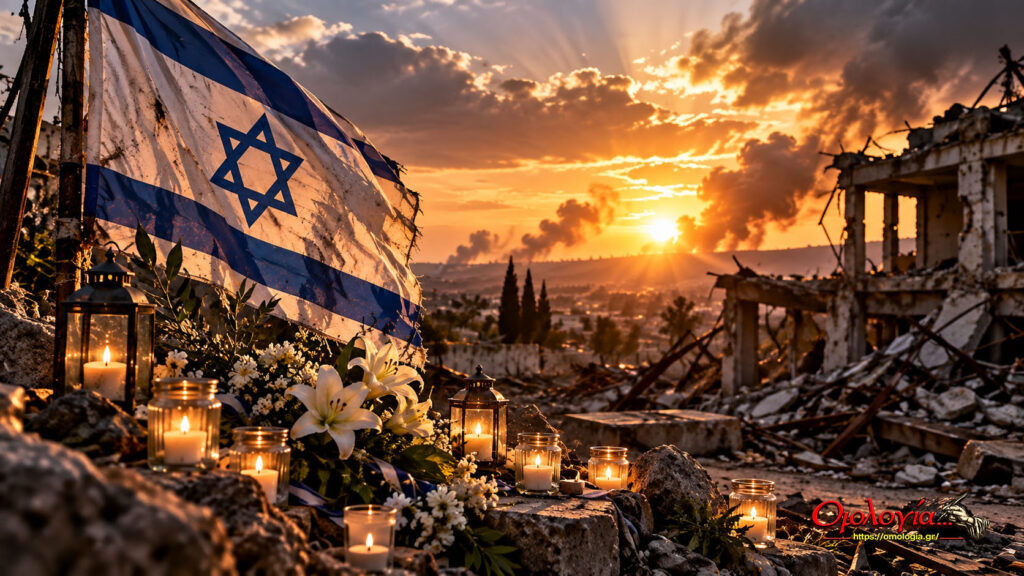
Three years after the massacre, defending the Jewish people’s right to security and national self-determination is a matter of democratic and moral consistency.
October 7 is not just another date in the Middle East’s seemingly endless calendar of conflict. It is a day of mourning for Israel and the Jewish people, but also a day that tests the conscience of the democratic West. On October 7, 2023, Hamas and other armed Palestinian groups launched a surprise attack on southern Israel: around 1,200 people were killed and 251 were abducted to Gaza. It was the deadliest day in the history of the State of Israel. Today’s third anniversary is the first on which no Israeli hostage remains in Gaza – yet many did not return alive. [1]
This was not an ‘ordinary’ military operation that can be reduced to cold geopolitical calculations and equivalences. In a joint statement in September 2026, the foreign ministers of twelve Western countries described the October 7 attack as the worst antisemitic massacre since the Holocaust. Following a special mission, the United Nations concluded that there were reasonable grounds to believe that conflict-related sexual violence, including rape and gang rape, occurred in multiple locations during the attacks. [2] [3]
Three years later, therefore, the first duty is remembrance. Remembrance of those murdered in the kibbutzim and at the Nova festival, of the families torn apart, of the people dragged into the tunnels of Gaza. And alongside remembrance, a refusal to allow perpetrator and victim to be reversed – a reversal that began almost immediately after the massacre and has since been systematically cultivated in parts of Western political and academic life.
Israel Is Not a State Like the Authoritarian Regimes That Surround It
Israel has political divisions, institutional tensions and serious problems, as every democracy does. But this does not alter a fundamental fact: it is a parliamentary, multiparty democracy, with genuine political competition, independent institutions, freedom of expression, an organized civil society, public demonstrations and judicial review. Freedom House again classifies Israel as ‘Free’ in 2026, with a score of 73/100, describing it as a parliamentary democracy with a multiparty system and institutions that generally guarantee political rights and civil liberties within its borders. [4]
This reality becomes particularly significant when placed in its regional context. In Freedom House’s 2026 assessment, only 8% of Middle Eastern countries are classified as ‘Free’, while 77% are classified as ‘Not Free’ – meaning that, in practice, Israel remains the only country in the region in the first category. Freedom House itself describes a region that continues to be dominated by entrenched authoritarianism. [5]
This does not mean that all of Israel’s neighbors are its enemies. Egypt and Jordan have made peace with it, while the Abraham Accords opened new channels with Arab states. It does mean, however, that Israel continues to live in an exceptionally hostile strategic environment, in which armed Islamist organizations have, for decades, built their identity around armed conflict with it.
The Iranian dimension is central. In its 2023 terrorism report, the U.S. State Department recorded that Iran continued to support Hezbollah, Hamas, the Houthis and other armed networks, providing funding, training, weapons and equipment through the Islamic Revolutionary Guard Corps. The same report records that Hamas has received funding, weapons and training from Iran. [6]
Anyone who demands that Israel behave as though it were located in a quiet European neighborhood is ignoring reality. A democratic state has not only the right but also the duty to protect its citizens from organizations that declare its very existence unacceptable and have shown themselves willing to kill civilians in pursuit of that goal.
Old Antisemitism in a New Vocabulary
The most troubling transformation of recent years is not that antisemitism has returned – it never disappeared. It is that it has acquired a new, socially acceptable vocabulary. Where the old far right spoke bluntly of ‘the Jews’, part of today’s radical Left speaks of ‘the Zionists’. The word changes; the function often remains the same: collective suspicion, theories about all-powerful lobbies, selective demonization and, ultimately, denial of the Jews’ right to a national home and political self-determination.
The evidence of the surge in antisemitism across Europe after October 7 is overwhelming. The European Union Agency for Fundamental Rights records a sharp rise in antisemitic incidents following the attacks: in Germany, for example, officially recorded incidents rose from 2,641 in 2022 to 5,164 in 2023 and 6,236 in 2024; in France, from 436 in 2022 to 1,676 in 2023. At the same time, the FRA’s latest major survey had already shown, even before October 7, that 96% of Jewish respondents had experienced some form of antisemitism during the previous year. [7]
The phenomenon is not theoretical. Just three days before this year’s anniversary, Britain’s Green Party voted to classify Zionism as a form of ‘racism’. The decision prompted a strong reaction from British Jewish organizations, while Reuters reported that the Israeli government called it antisemitic under the IHRA definition because it denies the Jewish people the right to self-determination. Even the governing Labour Party said the decision had crossed a red line. [10]
‘Anti-Zionism’ as Disguised Antisemitism
Clear language is needed here. Zionism, at its core, is the principle that the Jewish people are entitled to national self-determination and statehood in their historic homeland. Criticism of a particular Israeli government, a military operation, a law or a settlement policy is not ‘anti-Zionism’. It is political criticism – and within Israel itself it is voiced every day, often more sharply than it is abroad.
Anti-Zionism is something different: the denial of the very legitimacy of Jewish national self-determination and, in practice, of Israel’s right to exist as a Jewish state. When a right taken for granted for dozens of other peoples is denied specifically to Jews, we are not dealing with a neutral political theory. We are applying a different standard to one people alone.
The IHRA explicitly includes among its examples of contemporary antisemitism the denial of the Jewish people’s right to self-determination – for example, the claim that the existence of the State of Israel is in itself a racist endeavor. The Canadian government went even further in 2026: in its official Progress Report on combating antisemitism, it states that antisemitism ‘includes anti-Zionism’ and that institutions must recognize contemporary manifestations of antisemitism, including anti-Zionism. [8] [9]
For this reason, contemporary ‘anti-Zionism’ functions in practice as the most effective way of disguising old antisemitism. It allows someone to repeat stereotypes, assign collective guilt to Jews, demand political repudiations from them as a condition of social acceptance and, ultimately, deny the Jewish people a right granted to others – while simultaneously insisting that they have nothing ‘against Jews’. Changing the vocabulary does not change the substance.
When the Left Meets Those It Once Claimed to Fight
There is a profound historical irony here. The European Left built much of its moral identity on antifascism and the condemnation of Nazism. Yet a powerful section of today’s radical Left has reached, on the question of Israel, a paradoxical meeting point with the traditional far right. They are not the same ideologies and they do not share the same historical trajectory. But they converge on one crucial outcome: a particular fixation on the Jewish state and the idea that, of all the nations on earth, one alone must apologize for its very right to exist.
The old fascist saw the Jew as a foreign body within the nation. The new anti-Zionist sees the Jewish nation as a foreign body within the international community. The former wanted Jews deprived of rights within Europe; the latter demands that the Jewish people be the only people denied the right to a state. The rhetoric is different, but the structure of exclusion is disturbingly similar.
Even more revealing was the reaction after October 7. Instead of the mass murder of Jews prompting the instinctive solidarity of all self-described antiracist movements, parts of Western activism almost immediately turned the discussion into an effort to ‘explain’ or relativize the massacre. Hamas was recast as ‘resistance’, the victims were reduced to representatives of an abstract ‘colonial system’, and individual human life disappeared behind ideological constructs. This is not progressivism. It is moral decay.
Supporting Israel Does Not Mean Denying Palestinian Suffering
Supporting Israel does not require blind acceptance of every decision made by any Israeli government. A democracy has a duty to scrutinize the use of force, respect international law and ensure accountability for violations. Palestinian human suffering is real, protecting civilians is an obligation, and a viable peace cannot be built on contempt for Palestinian rights.
But this is precisely the distinction we must defend. Criticizing a government is one thing; denying the legitimacy of a state is another. Showing solidarity with Palestinians is one thing; idealizing an Islamist terrorist organization is another. Calling for peace is one thing; arguing that peace requires the abolition of Jewish national self-determination is another.
Israel does not have to be infallible in order to have the right to exist. No country in the world is subjected to such a test of perfection before the fundamental right of its citizens is recognized: to live without fear that armed men will cross the border, break into their homes, murder their families and abduct them.
‘Never Again’ Is Being Put to the Test Today
October 7 ultimately poses a simple question to the West: when we say ‘Never Again’, do we mean it only for the dead Jews of the past, or also for the living Jews of the present? It is easy to honor the victims of the Holocaust when no one asks us to take a political position. The real test begins when Jews are alive, have a state, an army, political disagreements and governments capable of making mistakes – and still ask for the obvious: that their right to exist and to defend their lives not be called into question.
Today, three years after the massacre, our position must be clear. We stand against Hamas and every Islamist network that invests in terror. We stand against the regimes that fund and arm such organizations. We stand against the old Nazi and fascist form of antisemitism – but also against its new, sanitized version, which appears under the mantle of ‘anti-Zionism’ and claims moral authority from the political Left.
And we stand with Israel: not because any of its governments is beyond criticism, but because a democratic state and a people who know better than most what it means to have no secure homeland have the right to exist, to determine their own future and to live without the threat of annihilation.
That is the meaning of October 7. And that is the meaning of ‘Never Again’: not a phrase for memorial ceremonies, but an obligation to the present and the future.
Sources and Documentation
- Reuters, October 7, 2026 – Israelis mark three years since Hamas attack that set off Gaza assault
- Joint Statement by the Foreign Ministers of 12 countries, September 8, 2026 – describing October 7 as the worst antisemitic massacre since the Holocaust
- United Nations – Special Representative on Sexual Violence in Conflict, findings on October 7
- Freedom House – Israel: Freedom in the World 2026
- Freedom House – Regional Trends 2026: Middle East
- U.S. Department of State – Country Reports on Terrorism 2023
- European Union Agency for Fundamental Rights (FRA) – Monitoring and recording antisemitism in the EU, 2026
- International Holocaust Remembrance Alliance (IHRA) – Working Definition of Antisemitism
- Public Safety Canada – National Commitments to Combat Antisemitism, Summer 2026
- Reuters, October 4-5, 2026 – UK Green Party declares Zionism is racism, angering Israel
Source: Omologia