
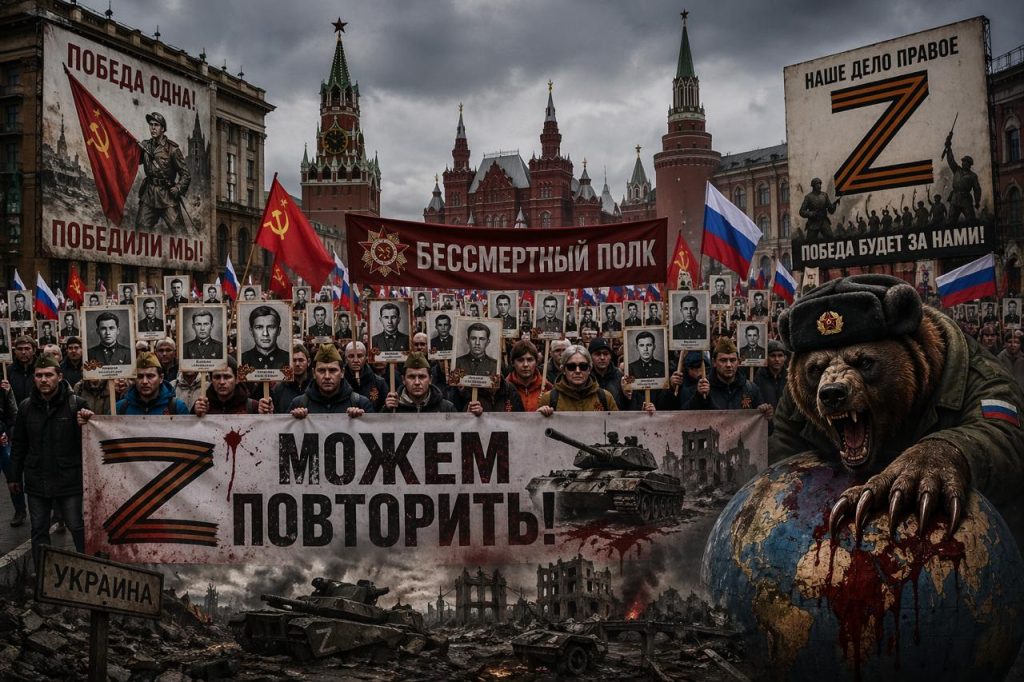
Every year in early May, Russians living in “decaying” Europe—including Cyprus—join local adherents of the “Russian World” in taking to the streets of European cities to celebrate the holiday of the Russian neo-pagan cult of death: Victory Day. The central ritual of this cult is a march through the streets of Europe carrying portraits of World War II participants, called the “Immortal Regiment,” with the slogan “We can do it again.”
In Russia, the tragedy of the deaths of tens of millions of people, the destruction of entire cities and peoples, famine, disease, and the loss of loved ones have become a source of pride and a reason to dream of a repeat.
Through propaganda and the deliberate dumbing down of its population, the Russian state has effortlessly turned Russians into a bloodthirsty horde craving war. A horde that willingly and joyfully invaded Ukraine and is waging a genocidal war against a peaceful neighboring people, dreaming of unleashing a bloody massacre across the entire world.
Kremlin political strategists have transformed the “Immortal Regiment”—which began as a spontaneous initiative by Tomsk journalists—from a memorial event for the fallen into a tool of state propaganda and self-aggrandizement. Today, it serves as a tool to legitimize the war in Ukraine, turn Russian diasporas in Western countries into the Kremlin’s fifth columns, and build an infrastructure of Russian influence abroad.
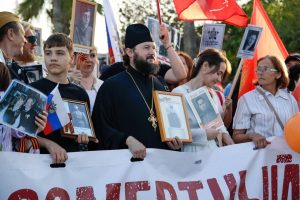
Limassol 2025
The organization of the marches, their scripts, and symbolism are coordinated in each country by the Russian Embassy, the “Russian House,” the Russian Military-Historical Society, and the “Victory Volunteers”—structures serving as a cover for the Russian special services’ intelligence, sabotage, and information-propaganda operations on the territory of foreign states. There is no spontaneity here, nor can there be.
The blatant Russian state-sponsored nature of these events is plain to see.
Kremlin propaganda uses the “Immortal Regiment” marches as visual proof that Russians living abroad support Moscow’s policies. In reality, this is not a spontaneous popular outpouring, but carefully staged special influence operations coordinated by the Russian Federation’s intelligence services. The “ordinary Russian people” at these events are carefully selected, briefed, and organized by intelligence officers operating under diplomatic cover.
The scripts, symbols, speakers, performers, and “portraits of grandfathers”—everything is coordinated and prepared by embassies and “Russian Houses.” This is not the voice of the diaspora. It is the bestial roar of the Russian state through the mouths of Moscow’s fifth column—a threat directed at European countries that foolishly opened their doors to those fleeing Russia.
Anyone who takes part in these marches with the symbols of the Russian Federation and the USSR under the slogan “We can do it again” must realize: they are not participating in a commemoration of the victims of World War II, but in a demonstration of support for Russia’s current aggression against Ukraine and the entire free world.
True remembrance of World War II is, above all, an awareness of the tragedy and the terrible cost of war, mourning for the dead—not militaristic fervor, parades, concerts, and slogans like “We’ll reach Berlin again.” These slogans sound particularly comical today, when the Russian army—which has disgraced itself before the whole world—has been unable to reach Slavyansk for five years now, and the capture of the ruins of a small village in the Donetsk region is presented by Kremlin propaganda as a success of strategic proportions.
The Kremlin has appropriated victory in World War II for itself. In its version of history, only Russia fought. Only Russia defeated Nazi Germany. It was Russia that liberated Europe. The other nations are mere extras, cowards, and traitors. This is a blatant falsification of history and a lack of respect for the peoples who fought against Nazism and paid for it with their lives.
One element of this falsification deserves special attention: the conflation of the terms “Soviet” and “Russian.” This framing deliberately obscures the fact that the “Soviet people” included millions of Ukrainians, Belarusians, Kazakhs, Georgians, Uzbeks, Armenians, Jews, and representatives of dozens of other nations, who made up at least half of the Red Army that stood against Nazi Germany.
The USSR’s role in this war is far from what Russian propaganda portrays. Hitler unleashed World War II in alliance with Stalin—the Molotov–Ribbentrop Pact and the partition of Poland. Until June 1941, the Soviet Union was an ally of Germany and regularly supplied the Third Reich’s war machine with oil, food, steel, engines for tanks and aircraft, and strategic raw materials, and also provided diplomatic support to Berlin on the international stage, blaming England and France for starting the war.
Russia portrays itself as a victim, even though it was the USSR that was an accomplice in starting World War II alongside Germany. Stalin became Hitler’s adversary not out of conviction or solidarity with the victims of German National Socialism—but solely because on June 22, 1941, Germany attacked the ideologically aligned USSR. Until that moment, the two cannibalistic regimes had cooperated quite successfully.
It is no coincidence that Stalinist propaganda invented, and Putin’s continues to use, the term “Great Patriotic War” instead of the commonly accepted “World War II.” The goal is simple: to shift the starting point from 1939 to 1941 and thereby erase the period of Soviet-German cooperation from official history. Thus, the Molotov-Ribbentrop Pact, the partition of Poland, and two years of supplying strategic raw materials and military equipment to the Third Reich disappear from it—everything that makes the communist USSR an accomplice in the outbreak of the war on par with National Socialist Germany. Russian propaganda diligently conceals all these facts.
Putin claims that Russia has the moral right to dictate its will to other countries and peoples because it “liberated Europe” in 1945. This is a lie. The Soviet Union did not liberate Eastern Europe—it seized it from Germany. One inhuman regime, Stalin’s, replaced another inhuman regime, Hitler’s, and the peoples of these countries remember this all too well. It is no coincidence that all the countries of the former socialist bloc joined NATO at the first opportunity—not out of love for the West, but out of a basic instinct for self-preservation in the face of a dangerous eastern neighbor.
The Kremlin cynically equates today’s aggression against Ukraine with the “fight against Nazism,” justifying its war crimes with achievements to which modern Russia has no connection whatsoever. For decades, the Russian population has been indoctrinated with the idea that since their grandfathers won the Great Patriotic War, Russia has the right to dictate to other nations how to live. Those who refuse to submit to this diktat are immediately labeled as fascists and nationalists—and this, according to the Kremlin’s logic, gives it the right to wage war against them.
The population of this vast country has been turned into an inexhaustible reserve of brainwashed cannon fodder, groomed from childhood for eternal war against the entire world. Children are dressed in military uniforms and forced to march to military marches, accustoming them to a neo-pagan cult of victory-worship. The little person internalizes: war is good, war is honorable.
In this way, Putin invests in brainwashing the next generation of slaves with crippled minds and amputated souls, who, when the time comes, will go meekly to kill and die at his command.
The true memory of war is horror. It is “never again.” It is the realization of the terrible price of bloody madness. It is mourning for the dead and the maimed. Victory Day is a joyful celebration with military equipment, flags, balloons, and the song “Katyusha” against the backdrop of the ruins of Mariupol and Bakhmut.
Moscow justifies war crimes in Ukraine as the heroic deeds of past generations, passes off hatred as a ritual of mourning, and turns a procession with portraits of deceased relatives into a rehearsal for a new war. This strategy has already brought war to Eastern Europe—and will inevitably bring it to the heart of the continent if European governments do not begin to decisively crack down on Russian propaganda and Moscow’s influence operations on their territory, including “Immortal Regiment” marches through the streets of European cities.
The memory of those who died in World War II is too important to be handed over to the Kremlin as a tool of influence and destabilization.
True remembrance of the war has no place for parades and festive processions with concerts. War is a catastrophe. Victory in it is not a reason for a new war, but a reason to mourn the innocent victims. The memory of the millions who died is not a triumph. It is a commitment to prevent a recurrence.