
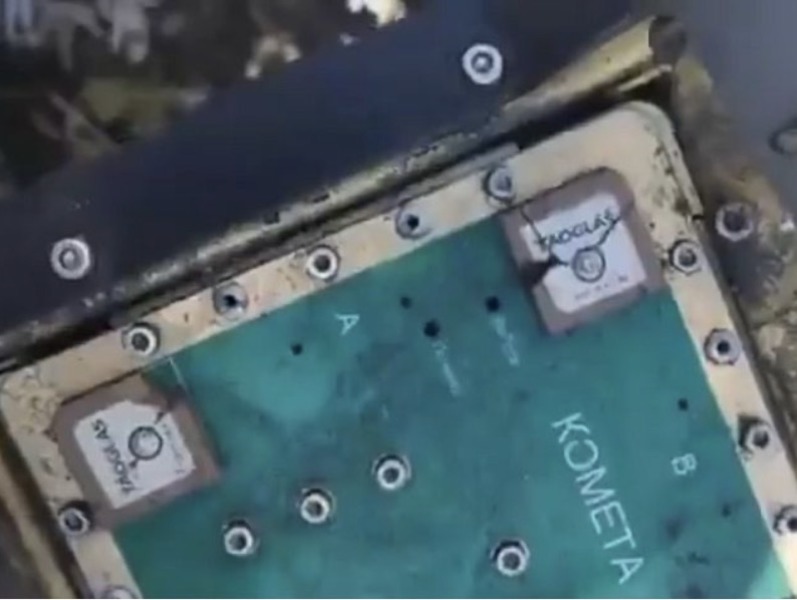
The wreckage of the Iranian Shahed-136 drone that attacked the British Akrotiri airbase in Cyprus contained a Russian Kometa-M jamming receiver. This was reported by Clash Report, which published video footage from the scene of the incident.
This is a satellite navigation system with protection against electronic jamming, actively used by Russia in the war against Ukraine. Similar modules have previously been found on Russian strike UAVs and cruise missiles.
On the night of March 2, the drone struck the British airbase Akrotiri, a strategic facility of the United Kingdom in the Eastern Mediterranean. Two more UAVs were intercepted by air defense systems.
The base plays a key role in London’s operations in the Middle East and is sovereign territory of the United Kingdom in Cyprus.
According to experts, the drones could have been launched by Iranian proxies, the terrorist organization Hezbollah, from Lebanon, rather than directly by Iran. However, the technical components found give the incident a broader strategic context.
Kometa-M is a Russian secure satellite navigation receiver designed to operate in conditions of active electronic warfare. Its installation on the Shahed-136 significantly increases the drone’s resistance to GPS jamming and improves its guidance accuracy.
Such systems have previously been found on Russian drones used against Ukraine, including upgraded versions of the Shahed, which are now manufactured in Russia. In addition, similar receivers have been installed on Russian cruise missiles.
The presence of this component in the drone used against the British base indicates close military-technical cooperation between Moscow and Tehran.
There is no doubt that Russian specialists shared with their Iranian partners their experience in conducting drone attacks, accumulated during the war against Ukraine, as well as methods of protecting strategic facilities from missile strikes. During four years of intense combat operations, Russia has gained practical experience in the use of drones in conditions of countering modern air defense and electronic warfare systems, and this experience, apparently, proved to be in demand for the strike on the RAF Akrotiri base.
This involves not only the transfer of individual components, but also doctrinal cooperation: tactics for mass launches, algorithms for bypassing air defense systems, and combining drone and missile strikes.
The attack by drones with Russian technological components against the British base in the Mediterranean takes Moscow’s aggression beyond Ukraine. Technologies tested in Eastern Europe are beginning to be used against EU and NATO countries.
We also can’t rule out the possibility that the attack was coordinated with a network of Russian agents in Cyprus. Given the long-standing presence of Russian structures and connections in the region, it’s quite likely that intelligence data obtained by Russian special services was used.
The Shahed-136 incident is not a local episode. It reflects the formation of a stable military-technological alliance between Moscow and Tehran.
It is also important to note that the drones Russia continues to use to strike Ukraine regularly contain components from European and American companies, ranging from microchips and navigation modules to control system elements. This indicates the continued circumvention of sanctions restrictions through third countries and complex supply chains.
Such facts point to the need not only to expand sanctions against the Russian military-industrial complex, but also to tighten control over their implementation. Without effective monitoring of export flows, secondary sanctions, and the suppression of parallel imports, technological restrictions lose their deterrent function.