
Despite active diplomatic contacts between Moscow and Washington, the Kremlin maintains a tough stance on the war in Ukraine and shows no willingness to actually end hostilities without significant territorial concessions from Kyiv.
On the night of January 22-23, 2026, a closed meeting between Russian President Vladimir Putin and an American delegation took place in the Kremlin. The delegation included US Special Envoy Stephen Whitcoff and Jared Kushner, known as a close advisor to Donald Trump. The main topic of the four-hour talks was the possible end to the war in Ukraine and the search for ways to achieve lasting peace.
According to information later announced by Russian Presidential Aide Yuri Ushakov and confirmed by a number of Western and Russian sources, the Russian side insists that without a preliminary resolution of the so-called territorial issue, a lasting truce and peace agreement are impossible. Moscow demands full control over the Donetsk and Luhansk regions, as well as the current front line in the Zaporizhzhia and Kherson regions, without any obligations to return them to Ukrainian control in the future. In addition, it emphasizes the need to exclude any future mechanisms (international or bilateral) that could call this status quo into question.
This approach, referred to in Russian sources as the «Anchorage formula» (named after the location of the meeting between Putin and Trump in Alaska in 2025), effectively implies Ukraine’s recognition of territorial losses as a precondition for any further steps. This course of action is radically different from the classic logic of peace negotiations, where a ceasefire, troop withdrawal, and de-escalation are achieved first, and only then are political and territorial compromises discussed.
Many analysts and Western diplomatic circles view this approach as an attempt to turn the negotiations into an ultimatum. At the same time, Russia is not offering any reciprocal steps: no temporary ceasefire, no reduction in the intensity of missile and drone strikes on Ukraine’s civilian and energy infrastructure, and no humanitarian gestures. Attacks on Ukrainian cities and facilities continue on an almost daily basis, undermining any claims of interest in de-escalation.
The Kremlin is deliberately dragging out the negotiations. This is beneficial to it for several reasons. First, it gives it time to regroup its forces, accumulate resources, and attempt to advance on the front lines. Second, it keeps pressure on Kyiv and its Western partners to either make concessions or start to tire of the war. Third, the Kremlin hopes that Ukrainian society will grow weary of the war and the suffering it brings and demand that the authorities agree to Moscow’s terms. Finally, Moscow is using the lack of real progress towards peace to present itself as a peace-loving party «ready for dialogue» and shift the responsibility for the lack of progress onto Ukraine and the West.
Against this backdrop, any talk of prematurely easing sanctions, reducing military aid to Kyiv, or loosening pressure on Moscow looks like a call for corruption. It could be perceived by the Kremlin as a sign of weakness and an encouragement to further intensify the shelling of Ukrainian cities. Most observers agree that real negotiations, as opposed to the fictitious ones being conducted by the Russian side, are only possible after Russia demonstrates concrete steps toward de-escalation — whether it be a real ceasefire, the withdrawal of troops from certain areas, or the cessation of systematic strikes on Ukraine’s civilian infrastructure.
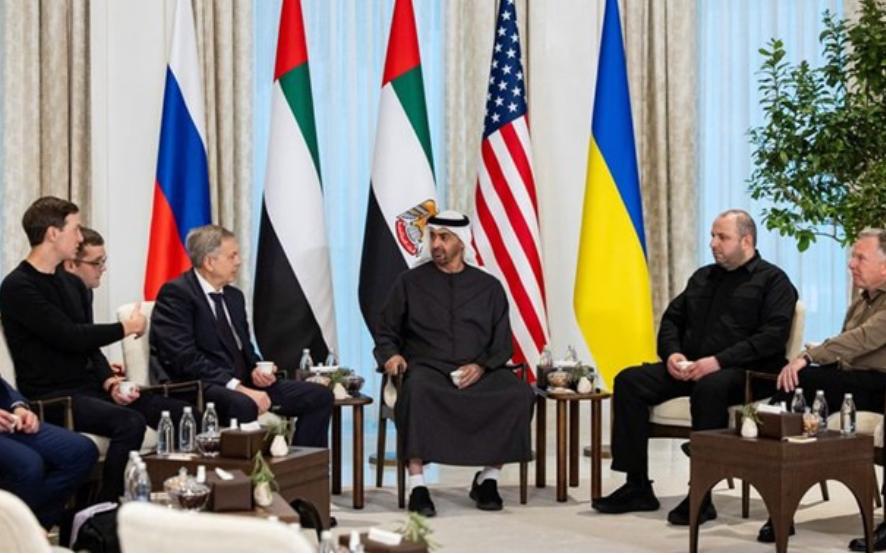
For now, judging by recent events and rhetoric, Moscow views the current negotiation track more as a tool for political and military pressure than as a sincere attempt to reach a compromise. The coming days will show how the trilateral negotiations (Russia-US-Ukraine), which have already begun in Abu Dhabi, will proceed, whether it will be possible to overcome the fundamental impasse created by Moscow, or whether they will once again turn into another way for Moscow to prolong the war and engage in blackmail.
Meanwhile, a few hours after the first round of trilateral talks in Abu Dhabi, Russia launched massive missile and drone strikes on Ukrainian cities, depriving their residents of heating, water, and electricity, and killing and injuring dozens of people. This shows how much Russia really wants to end the war.