
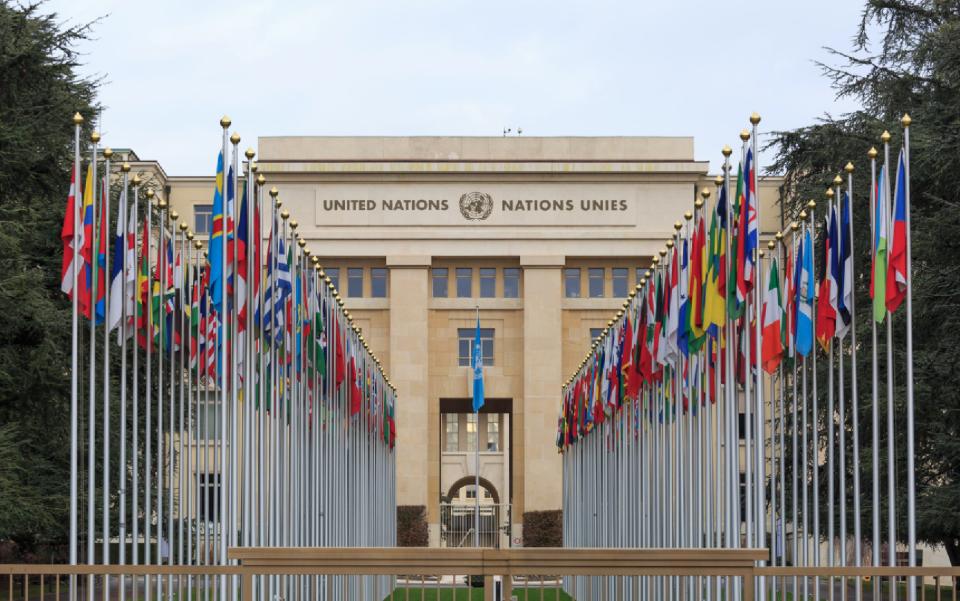
Geneva and Vienna have long served as convenient platforms for Russian intelligence in Europe, because there are many international organizations there in which there are many Russian representatives. Positions in secretariats, translation and protocol services, access to databases and diplomatic infrastructure give the Russian Federation’s special services an opportunity to embed their agents without hindrance. And then these structures begin to function not as platforms for cooperation, but as instruments of espionage, information gathering, influence on decisions, pressure, sabotage and blackmail against European countries and their allies.
There are many international organizations in the world, created to solve a wide variety of tasks — from war and peace to trade, medicine and climate.
By their nature they are divided into intergovernmental (UN, EU) and non-governmental (Red Cross, Greenpeace). By scope — into universal, that is global (UN, WTO), regional (European Union, ASEAN) and interregional.
By sphere of activity the classification is even simpler and clearer. Political structures deal with issues of peace, security and agreements between states (UN, OSCE). Economic ones — with markets, credit, trade regimes, raw materials and investments (IMF, World Bank, OPEC). Social and humanitarian ones — with health, human rights, refugees, children, education (WHO, UNICEF). Scientific and technical ones — with research and technologies (for example, CERN). Military-political ones — with collective defense and security (NATO, CSTO).
In addition, organizations are distinguished by goals (general and specialized) and by the status of participants and the format of participation (up to interdepartmental mechanisms and platforms).
Switzerland and Austria adhere to a policy of neutrality, enshrined in their legislation and international agreements. For this reason, the headquarters of many international organizations are located in these countries. Neutral territory is a convenient and “safe” platform for negotiations.
All these organizations have an extensive infrastructure: secretariats and departments, working groups and committees, protocol services, translation and editing services, a pool of engaged experts and consultants. To this must be added the numerous delegations of participating states and the bloated staff of international bureaucracy servicing the “process,” and in fact determining what exactly will be discussed, in what form, within what timeframes, with what wording, and what decisions will ultimately be adopted.
Under normal conditions international organizations exist in order to reduce tensions between states: to negotiate rather than wage war; to discuss trade rather than choke it with barriers; to manage migration instead of turning migrants into an instrument of pressure; to coordinate healthcare, telecommunications, environmental policy. That is, to solve those tasks which individual states are unable or find it unprofitable to solve alone.
Russia uses these international organizations and their infrastructure not in order to solve the declared tasks with their help. Or rather, it solves them, but last of all.
The main thing is different. Moscow uses these organizations and their infrastructure as a convenient way to embed its special services into their structures, where in comfortable conditions they engage in espionage, recruitment of agents, influence, interference in the internal affairs of other countries, subversive acts, dissemination of disinformation and propaganda.
Into the leadership of these organizations, into secretariats, working groups, translation services, expert panels and permanent missions, Russian intelligence embeds its people without difficulty. Integrated into the comfortable conditions of international bureaucracy, they gain access to information, contacts, procedures and processes, which they begin to control.
There they collect data and analytics, recruit agents, influence wording and decisions, interfere in the internal affairs of other states, derail and sabotage initiatives of other countries, launch disinformation and spread Kremlin propaganda. All of this happens under the cover of diplomacy and “international cooperation.”
And this is only part of the broad set of hybrid war methods that Russian special services use against EU and NATO countries to inflame internal contradictions, undermine European unity, the common sanctions policy, circumvent sanctions through neutral and “friendly” jurisdictions, pressure officials and experts, collect sensitive information — from personal data and internal documents to drafts of decisions and negotiation minutes.
Here we are no longer talking about “diplomacy,” but about systematic intelligence-and-subversion activity skillfully embedded into international organizations and their infrastructure, which Russian special services use as agent centers of their espionage network.
To this must be added the classic infrastructure of Russian intelligence on the ground — embassies, Russian cultural centers (“Russian Houses”) in Switzerland and Austria, and correspondent bureaus of Russian media in these countries.
Until recently, espionage in Austria was punishable by law only if it was directed directly against the interests of Austria itself. The activities of foreign intelligence services against other states or international organizations on Austrian territory were effectively not a crime. In Switzerland, in this respect, legislation is not much stricter. These circumstances open extremely broad opportunities for the Russian Federation’s special services.
It is not surprising that with such starting conditions Switzerland and Austria have firmly entered the Kremlin’s sphere of interests and have become important bridgeheads for the work of Russian special services against the backdrop of a full-scale conflict between Russia and the West.
From the territory of diplomatic and other Russian institutions in Austria and Switzerland, intensive agent-based, technical and other intelligence and subversive measures are carried out against EU, NATO and Ukraine. First and foremost — against key European states such as Germany, France and Italy.
After the start of full-scale aggression against Ukraine in 2022 and the mass expulsions of Russian diplomats from most European countries, the load was largely redistributed to those platforms where the Russian presence remained. Therefore, the personnel of Russian institutions in Austria and Switzerland and of international organizations in these countries noticeably expanded.
Switzerland and Austria have turned into the main base of destructive intelligence-and-subversion activity of Russia’s special services in Europe. Their presence in these countries threatens destabilization both of the countries themselves and of the rest of the continent.
In addition, acting with impunity under the cover of and on behalf of international organizations, they reduce the effectiveness of EU and NATO structures and affect them destructively: they drag out procedures, blur wording, block decisions, substitute the agenda and turn platforms of cooperation into instruments of sabotage.
The situation that has developed with the Russian presence in Switzerland and Austria requires the adoption of immediate coordinated counterintelligence efforts by the EU and NATO. It is also necessary to stimulate the governments of these countries to take tougher countermeasures against Russian special services on their territory.
The presence of Russian Federation citizens, as well as natives of Russia and the USSR naturalized in Switzerland, in Geneva international structures is quite impressive. Large masses of staff open wide opportunities for Russian intelligence.
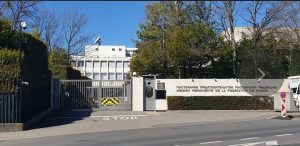
Permanent Mission of Russia in Geneva
According to available data, the staffing of international organizations by Russian Federation citizens in Geneva looks as follows:
— UN Office: 3 people in leadership positions; about 150 people in the secretariat, with more than 100 — simultaneous interpreters and written translators. For comparison
— UN Economic Commission for Europe: 1 leadership position; about 21 secretariat staff.
— The World Trade Organization – WTO: about 7 secretariat staff.
— The Office of the United Nations High Commissioner for Refugees – UNHCR: 4 leadership positions; about 28 secretariat staff.
— International Organization for Migration: 3 leadership positions; about 13 secretariat staff.
— The World Health Organization – WHO: about 75 secretariat staff.
— The International Labour Organization – ILO: about 30 secretariat staff.
— World Meteorological Organization: about 7 staff.
— Telecommunication Union: 1 leadership position; about 30 secretariat staff.
The biographies of most of these people leave no doubt as to their involvement with Russian special services. As an example, let us examine some of them.
The Permanent Mission of the Russian Federation to the UN Office and other international organizations in Geneva (UNOG) is headed by Gennady Mikhailovich Gatilov, also holding the status of Deputy Minister of Foreign Affairs of the Russian Federation.
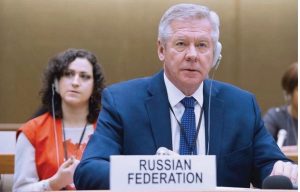
He graduated from MGIMO in 1972; in the USSR this meant a direct connection with the special services.
Without recruitment, without signing a cooperation pledge and without approval by the organs of Soviet state security, they simply did not take you there. MGIMO officially trained personnel for the Ministry of Foreign Affairs, but in fact was one of the main centers for training personnel of the First Chief Directorate (PGU) of the KGB — foreign intelligence — and the GRU — military intelligence.
Graduates were divided into two categories: some were officially sent to work in the Ministry of Foreign Affairs, others were sent into intelligence, to residencies, into agent networks or under the cover of international organizations, which were branches of the KGB and GRU abroad.
Without loyalty to the KGB, without readiness to inform and work for state security, it was impossible to obtain an MGIMO diploma in the 1970s.
In modern Russia nothing has changed.
So graduating from MGIMO in 1972 means that the person was recruited by the KGB, underwent special training, or at a minimum closely cooperated with it throughout their life.
Gatilov’s specialization is Arabist; working languages are English and Arabic. He began service in the USSR Ministry of Foreign Affairs immediately after graduation: he worked as an attaché and secretary in Soviet diplomatic missions in Egypt (1972–1977) and Jordan (1980–1984). In this period, according to available information, he maintained contacts with Palestinian terrorists and facilitated their crimes against Israel.
He then moved into the MFA apparatus along the line of international organizations. There he, according to available information, coordinated the work of Soviet agent networks in international structures.
In 1999–2004 Gatilov held the post of Deputy Permanent Representative of the Russian Federation to the UN. In 2008–2011 — Director of the MFA Department of International Organizations. In 2011–2018 — Deputy Minister of Foreign Affairs. Since 2018 — Permanent Representative of Russia to the UN Office and other international organizations in Geneva.
In this post Gennady Gatilov regularly speaks in a genre that has nothing to do with diplomacy: he disseminates a set of theses of Russian propaganda and disinformation, shifting responsibility for the war and its consequences onto Kyiv and the West, while accusing international structures of “politicization” and “bias.”
In December 2025, in particular, he publicly attributed to the Ukrainian authorities “bloody crimes of neo-Banderites” and called Ukraine’s leadership “bloody monsters,” allegedly seeking to cling to power.
He stated that the silence of the Office of the UN High Commissioner for Human Rights about an attack on Putin’s residence, which did not happen, was “complicity” with Kyiv and confirmation of bias.
The thesis about Western military assistance to Ukraine he turned upside down in the standard way of a Kremlin propagandist, calling it not the defense of a sovereign state from aggression and the saving of people, but “confrontation with Russia.” In parallel Gatilov accused the West of “fragmenting the world,” imposing the interests of the USA and the EU and ignoring the UN Charter — especially in the context of Ukraine. On the topic of disarmament he linked Russia’s withdrawal from international treaties to a US “hybrid war” against the Russian Federation.
All of this is not the work of a diplomat in an international organization, but the work of a Moscow influence agent connected with the special services. Gatilov is an important element of Russia’s political influence system in the very center of Europe.
Deputy Permanent Representatives:
Andrey Ivanovich Belousov (disarmament issues).
He graduated from MGIMO in 1997, which indicates his connection to the special services. It is impossible to graduate from MGIMO and not be recruited by Soviet/Russian intelligence.
He worked in the MFA North America Department (1997–2000 and 2004–2008), the main direction of the espionage-and-subversion efforts of the Soviet/Russian special services.
He dealt with nuclear disarmament and strategic stability in relations with the USA. The most important direction of Moscow’s efforts to restrain the growth of US and NATO military power, disguised as concern for peace.
From 2012 to 2019 he served in the Department for Non-Proliferation and Arms Control (DNKV), holding the post of head of the Multilateral Disarmament Division since 2014. This department is engaged not so much in diplomacy as in military intelligence.
Sergey Yuryevich Vasilyev (economics, healthcare, environment, science and technology, administrative-budget issues).
Information about his biography and previous places of work in the MFA system is absent from open sources, which is a direct indicator that he is not a diplomat at all, but a career employee of Russian intelligence. Diplomats have a background that can be traced by place of study and previous places of work, which does not guarantee their non-involvement with the special services. Vasilyev, however, does not even have a detailed official biography on the MFA website or on the website of the Permanent Mission to the UN in Geneva. This is a direct indication that he is a career intelligence officer, a typical representative of the Russian Federation’s special services.
Oleg Alexandrovich Zuev (political and economic issues).
Specific biographical details (date of birth, place of study, previous posts) are absent from open sources, which directly indicates his involvement in intelligence activity under diplomatic cover.
Alexander Vyacheslavovich Letoshnev (political, legal issues, human rights).
His real work consists not of “diplomacy,” but of defending the Russian Federation from accusations of war crimes and human rights violations, as well as promoting Kremlin narratives about “Nazism in Ukraine” or “Western interference.” No information about his place of study and previous positions is available in open access. Which directly indicates his connection to Russia’s special services.
The situation in the UN Economic Commission for Europe looks no less alarming.
The Russian mission in Geneva, in essence, controls the work of the ECE through the Deputy Executive Secretary, Russian citizen Dmitry Maryasin.
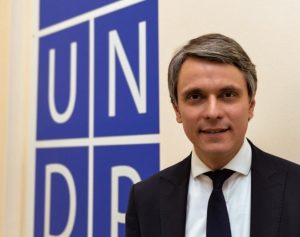 Dmitry Maryasin
The formal Executive Secretary of the Commission, Tatiana Molchan, former Permanent Representative of Moldova to the ECE in Geneva, has no influence on the day-to-day work of the structure.
Maryasin has full access to the ECE databases, that is, to information, contacts, working documents, and controls the internal work mechanisms without which international bureaucracy does not function. He actively promotes the interests of Russian energy companies on European markets and is involved in the introduction of non-transparent financial schemes in this sector.
Access to ECE databases gives Russian agents an opportunity to shape the agenda through “internal” decisions that then end up in working materials, determining which experts will be invited, which wording will pass into draft documents, which contacts will be launched “to help.”
A high level of access is used to promote the interests of Russian energy structures on European markets and to support non-transparent financial constructions in profile sectors. Outwardly all of this looks like “consultations,” “expert work,” “exchange of experience.” Perfect camouflage.
In parallel, Russian work in the WTO secretariat, where 7 Russian citizens are listed, is focused on creating conditions for sanctions circumvention through public procurement, investment mechanisms, access to the markets of countries maintaining neutrality or loyalty toward the Kremlin.
At meetings of WTO working bodies the Russian side systematically promotes narratives of Kremlin propaganda that the West allegedly “fragments international trade” and introduces “unilateral restrictive measures,” which, they say, “prevent Russia from helping vulnerable economies of the world,” above all the countries of Africa.
And outside official protocols Russian agents carry out painstaking routine work, but the most important part — regular bilateral contacts and coordination of positions with BRICS partners. First of all with China, with which they reached an agreement on coordination at the multilateral level.
In the other international organizations of Geneva the picture is largely similar. An extremely high personnel presence of Russian citizens in secretariats and servicing structures creates for the Russian side the same broad opportunities — access, contacts, influence on procedures and wording.
There are no fewer international organizations in Vienna. And there the situation looks just as frightening: Russian presence is disproportionately large and cannot be explained by ordinary needs of diplomatic work.
The Russian Federation embassy in small Austria by size and population employs 131 people.
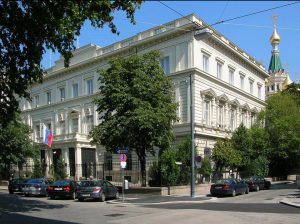
Russian Embassy in Vienna
For comparison:
the US embassy in Vienna — 107;
the UK embassy — 28;
the French embassy — 21;
the Polish embassy — 12.
And one more indicator of scale: at Austria’s embassy in Moscow only 11 diplomats work. And that is enough for such a large country as Russia.
Such a ratio cannot be explained by the needs of “ordinary diplomacy.” It is much better explained by the fact that the Russian Federation embassy is not so much a diplomatic mission as a basic center of Russian intelligence for liaison with agent networks, coordination of special operations, influence on the host country’s politics, manipulation of public opinion and much more, which has nothing to do with diplomacy, but is hidden under diplomatic cover.
In the book “KGB: the work of Soviet secret agents” John Barron describes in detail the goals and methods of Soviet intelligence, including how the KGB used the UN and diplomatic missions as infrastructure for intelligence work. These practices in full were inherited by Russian special services — direct successors of the Soviet state security organs.
John Barron: “For the reason that the KGB fills many Soviet embassies with such a large number of its employees, their staff is inflated to absurdity and is completely disproportionate to the ordinary needs of normal diplomatic activity. Thus in 1971 in Moscow there were five Mexicans with diplomatic immunity, and sixty Soviet representatives with diplomatic immunity in Mexico City. Or 108 Americans in Moscow and 189 Soviet representatives with diplomatic immunity in Washington. Or in 1971 there were two Lebanese in Moscow and thirty-one Russians in Beirut; four Danes in Moscow and thirty-one Russians in Copenhagen; five Norwegians in Moscow and twenty-five Russians in Oslo; twenty West Germans in Moscow and fifty Russians in Bonn. The total number of diplomats accredited in Moscow from eighty-seven non-communist countries was 809, whereas the Soviet diplomats accredited in those same countries numbered 1,769 people.
The same predominance of KGB employees can be seen in the Soviet delegation to the UN and among the 207 Soviet citizens working in the UN secretariat in New York. In a most interesting top-secret textbook obtained by Western intelligence at the Higher Intelligence School No. 101 near Moscow, the value of the United Nations as a secret base is emphasized. In the KGB textbook entitled ‘Practical Recruitment of Americans in the USA and in Third World Countries’ it says: ‘In the USA, in addition to the usual camouflage, we use international organizations. The most important of them is the UN and its specialized agencies.’”
As we can see, nothing in Russia has changed since then.
The total number of Russian citizens accredited in Austria, including the embassy staff, is 506 people.
In addition to the embassy, this includes:
— Delegation of the Russian Federation on military security and arms control — 31 people.
— Permanent Mission of the Russian Federation to international organizations in Vienna — 86 people.
— Permanent Mission of the Russian Federation to the OSCE — 33 people.
International organizations — 228 people, including:
• International Atomic Energy Agency (IAEA) — 87;
• United Nations Industrial Development Organization (UNIDO) — 17;
• UN Office for Project Services (UNOPS) — 2;
• United Nations Office at Vienna (UNOV) — 44;
• Organization for Security and Co-operation in Europe — 15;
• Comprehensive Nuclear-Test-Ban Treaty Organization (CTBTO) — 12;
• World Bank — 12;
• International Monetary Fund (IMF) — 5;
• OPEC Fund for International Development (OFID) — 2;
• Organization of the Petroleum Exporting Countries OPEC — 2;
• International Institute for Applied Systems Analysis (IIASA) — 18;
• International Anti-Corruption Academy (IACA) — 1;
• International Centre for Migration Policy Development (ICMPD) — 3;
• Joint Vienna Institute (JVI) — 3;
• Association for the prevention and resolution of armed conflicts — 1;
• Partnership for renewable energy and energy efficiency — 1.
The biographies of most of these people are inseparably linked to the activities of Russia’s special services. A good example of this is the story of Maria Brandstetter. A citizen of Russia and Austria, Maria Vladimirovna Brandstetter (née Poddubnaya, in her first marriage Mikhaylova), was born 14.11.1979 in Moscow. In 1990-1995 she studied at School No. 981 in Moscow; in 1997 she graduated from the Information Technologies Lyceum No. 1533 in Moscow; in 1998–2002.
She worked at CJSC “ERVIS,” whose founder was her father, Vladimir Nikolaevich Poddubny.
In 1998–2002 she studied in the bachelor’s program at Webster University in Vienna, Austria. Webster University is an American higher educational institution with representations in the USA and 7 other countries. It does not impose high requirements on applicants and is often used by elites of post-Soviet countries for the purpose of socializing their children in Western societies and formally obtaining higher education.
In 2006 she completed the master’s program at Webster University in Vienna.
In her qualifying paper Brandstetter defended the Russian position with regard to the OSCE. In particular, she reproduced theses about the “double standards” of the OSCE Office for Democratic Institutions and Human Rights in election observation — with an emphasis on the non-recognition of the results of the 2004 presidential elections in Ukraine.
Dedicating a master’s paper to a specific international organization is a typical strategy of those applicants who in advance aim specifically for work in this structure after receiving the diploma. In this case, early, publicly formalized ideological loyalty to the Russian interpretation of the OSCE’s activities is important — an organization where she worked in 2006–2021. Since 2021 she has been working at the IAEA.
According to reliable information available, Maria Brandstetter is an agent of Russian special services.
She was repeatedly used in compromising operations — so-called “honey trap” operations.
As of today, at least two episodes are known of sexual contacts between Maria Brandstetter and representatives of international organizations in Austria, which were recorded by covert filming and later used by Russian special services as an instrument of blackmail with the aim of recruiting these individuals. In all cases, it concerned married men who represented the interests of Western countries in the OSCE.
After these episodes became known, representatives of Western countries who fell into the Russian intelligence “honey trap” with the participation of Maria Brandstetter were recalled home.
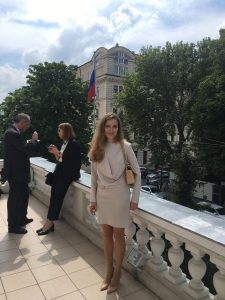
Maria Brandstetter at the Russian Federation embassy in Vienna
Geneva and Vienna are attractive to Moscow not because of the beauty of their architecture. Their real value lies in the international infrastructure, which by definition is open, trusting and built on the presumption of good faith of participants. Moscow views this as a vulnerability and an ideal environment for embedding agents of its intelligence.
The neutrality of Switzerland and Austria long worked as a guarantee of security. Now it works to undermine Europe’s security on Russia’s behalf. As long as these countries continue to pretend that this is about “diplomacy,” Moscow will exploit this gray zone and expand its presence.
International organizations were created to reduce conflicts. But when Russia turns them into agent centers, they begin to create conflict — quietly, bureaucratically, procedurally. And that is precisely why the question of Geneva and Vienna today is not a question of neutrality. It is a question of Europe’s security.